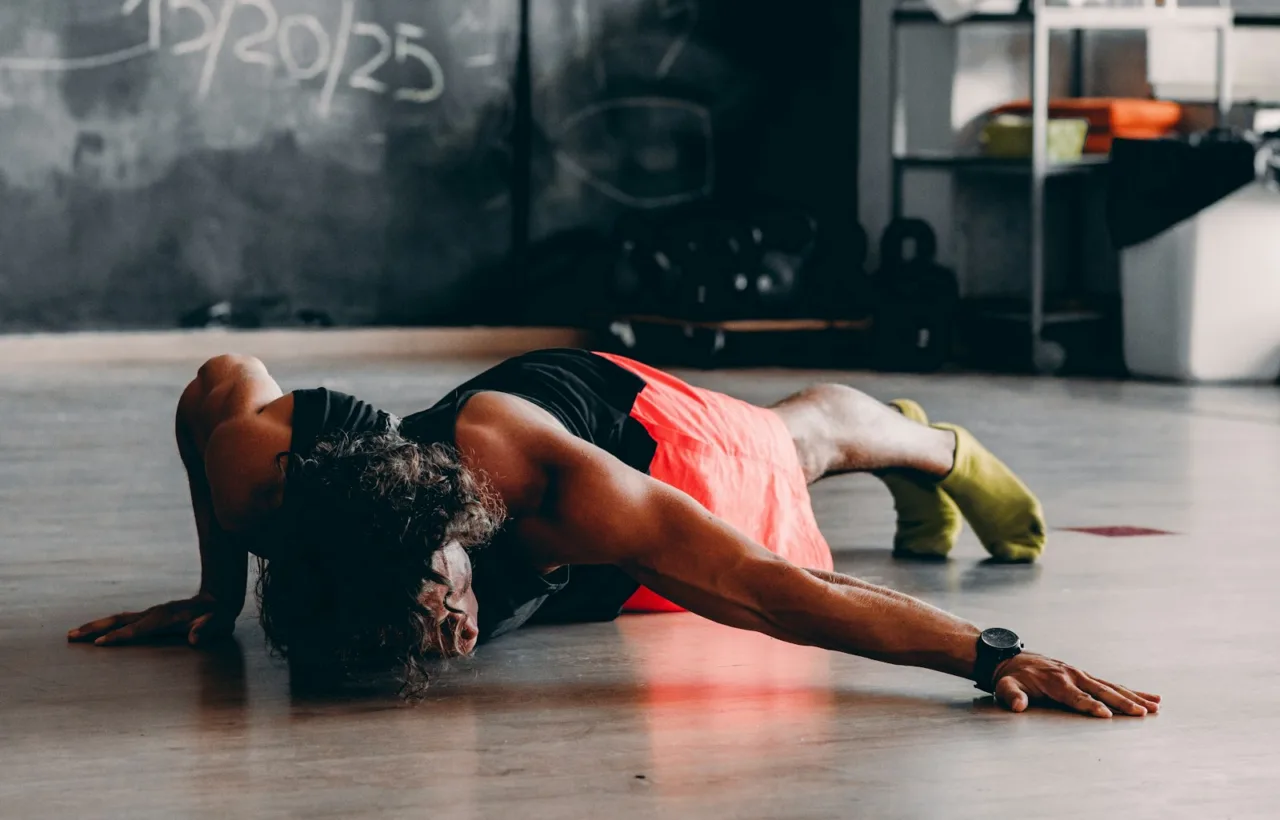

An at-home arm workout can build stronger arms using bodyweight exercises, household items, and strategic movement patterns that challenge your biceps, triceps, and shoulders effectively. The key is creating resistance through leverage, tempo control, and progressive variations that deliver results without requiring a single dumbbell.
Most people assume arm training demands weights, but your arms don't distinguish between a dumbbell and your own body mass—they only respond to tension, time under load, and progressive challenge. Understanding how to manipulate angles, grip positions, and movement speed gives you everything needed for a complete arm workout in any living space.
Why Arm Training at Home Works (With the Right Approach)
Your arms respond to mechanical tension regardless of the resistance source. When you perform a push-up with proper form, your triceps experience the same type of muscle fiber recruitment as they would during a cable pushdown—the difference lies in how you create and control that tension.
The challenge at home isn't lack of equipment; it's the limited ways to isolate pulling movements for biceps. Push exercises for triceps are straightforward through variations of push-ups, dips, and pike presses. Pull exercises require more creativity, using door frames, towels, or isometric holds to generate the contraction your biceps need.
Three principles make home arm training effective:
- Leverage manipulation: Changing body angles increases or decreases resistance (elevated push-ups are harder than standard, inverted rows with feet elevated are harder than bent-knee rows)
- Tempo control: Slowing the eccentric (lowering) phase to 3-4 seconds increases time under tension without adding weight
- Unilateral work: Single-arm variations force each arm to handle full resistance, preventing the stronger side from compensating
The Complete At-Home Arm Routine
This workout targets all three major arm muscle groups—triceps, biceps, and shoulders—through six exercises you can perform in 25-30 minutes. Complete 3-4 sets of each exercise, resting 60-90 seconds between sets.
Triceps Exercises
Close-Grip Push-Ups
Position your hands directly under your shoulders, forming a diamond shape with your thumbs and index fingers. Keep your elbows tight to your body as you lower yourself until your chest nearly touches your hands, then press back up. This hand position shifts work from your chest to your triceps.
Perform 8-12 repetitions. If standard close-grip push-ups are too difficult, elevate your hands on a couch or countertop. To increase difficulty, elevate your feet on a chair.
Triceps Dips (Chair or Couch)
Sit on the edge of a sturdy chair or couch, place your hands beside your hips with fingers facing forward, and walk your feet out. Lower your body by bending your elbows to roughly 90 degrees, keeping your back close to the chair edge, then press back up. Your triceps handle most of your body weight in this movement.
Perform 10-15 repetitions. Bend your knees to make it easier, or elevate your feet on another chair to increase resistance. Keep your shoulders down and away from your ears throughout.
Overhead Triceps Extension (Towel Variation)
Hold a towel with both hands overhead, arms fully extended. Lower the towel behind your head by bending your elbows while keeping your upper arms stationary, then extend back to the starting position. Create resistance by pulling the towel taut with opposing hands or by hooking it under one foot and pulling upward.
Perform 12-15 repetitions, focusing on the stretch at the bottom and the squeeze at the top.
Biceps Exercises
Doorframe Rows
Stand facing an open doorway, gripping both sides of the frame at chest height. Lean back with straight arms, feet planted close to the door base, then pull your chest toward the door by bending your elbows and squeezing your biceps. The farther you walk your feet forward (closer to the door), the more horizontal your body becomes and the harder the exercise.
Perform 10-15 repetitions. For maximum bicep engagement, use an underhand grip (palms facing you) and focus on pulling with your arms rather than your back.
Towel Curls (Self-Resisted)
Stand on the middle of a towel, holding one end in each hand. Curl your hands toward your shoulders while simultaneously pulling down with your feet to create resistance against the towel. Control the lowering phase for 3-4 seconds to maximize time under tension.
Perform 12-15 repetitions. This method, called self-resistance, allows you to adjust difficulty in real-time by increasing or decreasing the downward pressure.
Isometric Door Pull
Stand in a doorway with one foot braced against the door frame, gripping the opposite side of the frame with both hands in an underhand grip. Pull as hard as possible without moving, as if trying to tear the doorframe toward you, holding maximum tension for 30-45 seconds. Your biceps will contract intensely despite the lack of movement.
Repeat 3 times. Isometric holds build strength at specific angles and teach you to generate maximum muscle tension.
Shoulder Exercises
Pike Push-Ups
Start in a downward dog position with your hips high in the air, hands shoulder-width apart, and feet hip-width apart. Lower the top of your head toward the floor by bending your elbows, then press back up. This angle shifts the load onto your shoulders, similar to an overhead press.
Perform 8-12 repetitions. Elevate your feet on a couch to increase difficulty and move closer to a handstand push-up position.
Progressive Overload Without Weights
Your muscles adapt to consistent stress by growing stronger, so you must gradually increase training difficulty to continue seeing results. At home, progression happens through five methods:
Add repetitions: Increase reps from 10 to 12, then 15, before moving to a harder variation.
Slow the tempo: Extend the lowering phase to 4-5 seconds, which increases time under tension significantly.
Reduce rest periods: Decrease rest from 90 seconds to 60 seconds between sets, forcing your muscles to recover faster.
Change the leverage: Elevate your feet during push exercises or your hands during pull exercises to increase the percentage of body weight you're lifting.
Add pause repetitions: Hold the bottom or top position for 2-3 seconds during each rep, creating an isometric challenge within the dynamic movement.
Track your workouts by recording exercises, sets, reps, and variations used. When you can complete the top end of the rep range (15 reps) with good form, move to the next progression level the following week.
Common Mistakes That Limit Results
Rushing Through Repetitions
Moving too quickly reduces time under tension and relies on momentum rather than muscle force. A controlled push-up with a 2-second lowering phase and a 1-second press builds more strength than twice as many fast, bouncy reps. A 2015 meta-analysis in Sports Medicine found that muscle growth was similar across repetition durations from about 0.5 to 8 seconds, so a controlled tempo matters more than an exact slow count.
Ignoring the Eccentric Phase
The lowering portion of each exercise causes the most muscle damage and growth stimulus, yet most people focus only on the lifting phase. Emphasize the lowering phase by actively controlling it rather than dropping down quickly.
Training Arms Every Day
Your muscles grow during recovery, not during training. Working your arms daily prevents adequate recovery and leads to diminished performance and plateau. Train arms 2-3 times per week with at least one rest day between sessions, in line with the American College of Sports Medicine recommendation of 2-3 days per week of resistance training for beginners.
Using Only One Grip or Angle
Your biceps and triceps have multiple heads that respond to different arm positions. The long head of your triceps responds better to overhead movements (like the towel extension), while the lateral head responds to pressing movements (like close-grip push-ups). Similarly, your biceps respond to both standard and hammer grips. Include variety across your weekly training.
Skipping Warm-Up
Jumping straight into intense arm work with cold muscles increases injury risk, particularly to the elbows and shoulders. Spend 5 minutes on arm circles, wrist rotations, and light movement before starting your workout.
Sample Weekly Schedule
This schedule balances volume, intensity, and recovery for steady arm development:
| Day | Focus | Exercises |
|---|---|---|
| Monday | Triceps + Shoulders | Close-grip push-ups, dips, pike push-ups (3-4 sets each) |
| Tuesday | Rest or light activity | Walking, stretching, mobility work |
| Wednesday | Biceps + Pulling | Doorframe rows, towel curls, isometric door pull (3-4 sets each) |
| Thursday | Rest or light activity | Walking, stretching, mobility work |
| Friday | Full Arms | 2-3 sets of each exercise from Monday and Wednesday |
| Weekend | Rest | Active recovery or complete rest |
Adjust this template based on your schedule and recovery capacity. If you train other body parts (legs, chest, back), integrate arm work into those sessions rather than performing arms in isolation every time.
Can Bodyweight Build Arms? What Studies Found
Backed by research
What the research says about training arms without weights
- A 2017 training study found that push-ups and low-load bench pressing increased triceps and chest muscle thickness by similar amounts.Source: Kikuchi N, Nakazato K (2017). Low-load bench press and push-up induce similar muscle hypertrophy and strength gain. J Exerc Sci Fit
- When muscle activation was matched, elastic-band push-ups and the bench press produced similar strength gains.Source: Calatayud J et al. (2015). Bench press and push-up at comparable levels of muscle activity results in similar strength gains. J Strength Cond Res
- A 2017 meta-analysis found that muscle growth was similar with light and heavy loads, while maximal strength benefited most from heavy loads.Source: Schoenfeld BJ et al. (2017). Strength and hypertrophy adaptations between low- vs. high-load resistance training. J Strength Cond Res
- The American College of Sports Medicine recommends making an exercise harder once you can do one or two reps more than your target; without weights, that means moving to a harder variation.Source: American College of Sports Medicine (2009). Progression models in resistance training for healthy adults. Med Sci Sports Exerc
When You'll See Changes
Most people notice increased muscle tone and strength within 3-4 weeks of consistent training, though visible size increases take longer. Initial improvements come from neuromuscular adaptation—your nervous system becomes more efficient at recruiting muscle fibers—rather than actual muscle growth.
Visible muscle growth usually takes several weeks of consistent progressive training, along with adequate protein intake (about 1.4-2.0 grams per kilogram, or roughly 0.6-0.9 grams per pound, of body weight daily, according to the International Society of Sports Nutrition) and sufficient recovery. Your rate of progress depends on training age, genetics, nutrition, sleep, and overall stress.
Take progress photos every two weeks from the same angle and lighting. Visual changes appear gradually and are often more noticeable in photos than in the mirror.
Equipment Worth Adding When Ready
While bodyweight exercises form a complete arm routine, a few inexpensive items expand your options significantly:
Resistance bands (£10-25): Add variable resistance to curls, extensions, and overhead presses. Choose bands rated for 15-30 pounds of resistance to start.
Adjustable dumbbells or water jugs: Fill gallon jugs with water (roughly 8 pounds each) or sand (12+ pounds) for weighted curls, extensions, and presses. This allows you to add exact resistance rather than relying solely on leverage changes.
Pull-up bar (£15-40): Mounts in a doorway and enables chin-ups, the most effective bodyweight bicep exercise. Choose a model that fits your door frame width and supports your body weight plus 50 pounds as a safety margin.
Start with bodyweight training for at least 4-6 weeks before adding equipment. This builds foundational strength and movement patterns that make equipped training more effective.
Training Around Arm Injuries and Joint Issues
Elbow tendinitis (tennis elbow or golfer's elbow) is common in arm training and causes pain on the inner or outer elbow. If you experience sharp elbow pain during or after training, cut back your training volume, avoid exercises that cause pain, and see a doctor or physiotherapist if the pain persists.
For shoulder discomfort during pike push-ups or dips, reduce range of motion initially—lower only halfway down—and focus on perfect form rather than depth. Shoulder pain often indicates insufficient scapular control or poor positioning rather than a strength issue.
Wrist pain during push-ups typically comes from excessive extension. Perform push-ups on your fists or use push-up handles that keep your wrists neutral. Alternatively, perform push-ups on your knuckles on a folded towel or mat.
If pain persists beyond a week, worsens during daily activities, or occurs with sharp, shooting sensations, consult a physiotherapist before continuing training. Chronic overuse injuries respond better to early intervention than continued training through pain.
Building Arms Without Weights: Common Questions
How often should I train arms at home for best results?
Train arms 2-3 times per week with at least one rest day between sessions. Two sessions work well if you're training full body on other days; three dedicated arm sessions suit arm-specific goals or split routines. Training more frequently prevents adequate recovery and limits growth.
Can I build big arms without weights?
You can build significantly stronger and more defined arms without weights, though genetic ceiling for pure size is somewhat lower compared to progressive barbell or dumbbell training. Most people can add 1-2 inches to their arms through consistent bodyweight training, proper nutrition, and progressive overload over 6-12 months.
Should I do high reps since I'm not using weights?
Not necessarily. The 8-15 rep range builds muscle effectively regardless of equipment. If you can perform more than 20 reps easily, progress to a harder variation rather than continuing to add reps. Excessive reps (30+) shift training toward muscular endurance rather than strength or size.
How do I target the bicep peak specifically?
The bicep peak is largely genetic and determined by muscle belly length and insertion point. You cannot change its shape, but you can maximize its development by including exercises that fully flex the elbow (like towel curls and doorframe rows) and emphasizing the top squeeze position where the bicep is fully shortened.
Why do my triceps grow faster than my biceps at home?
Triceps respond well to pushing exercises, which are easier to load heavily at home through push-up variations, dips, and pike presses. Biceps require pulling resistance, which is harder to create without equipment. This imbalance is common—address it by adding extra bicep volume (one additional set per exercise) and focusing on slow eccentrics during all pulling movements.
Do I need protein supplements to build arm muscle?
Protein supplements are convenient but not required. Whole food protein sources (chicken, fish, eggs, legumes, dairy) provide everything needed for muscle growth. Aim for roughly 0.7-1 gram of protein per pound of body weight daily, spread across 3-4 meals. Supplements make sense if your schedule or food preferences make meeting protein targets through whole foods difficult.
How This Guide Was Put Together
This guide is based on resistance training principles from the American College of Sports Medicine, exercise biomechanics for bodyweight training, and practical progressions for home-based arm development. All training recommendations follow established guidelines for muscle hypertrophy and strength development, with exercises selected for feasibility without equipment and effectiveness for arm-specific growth.


