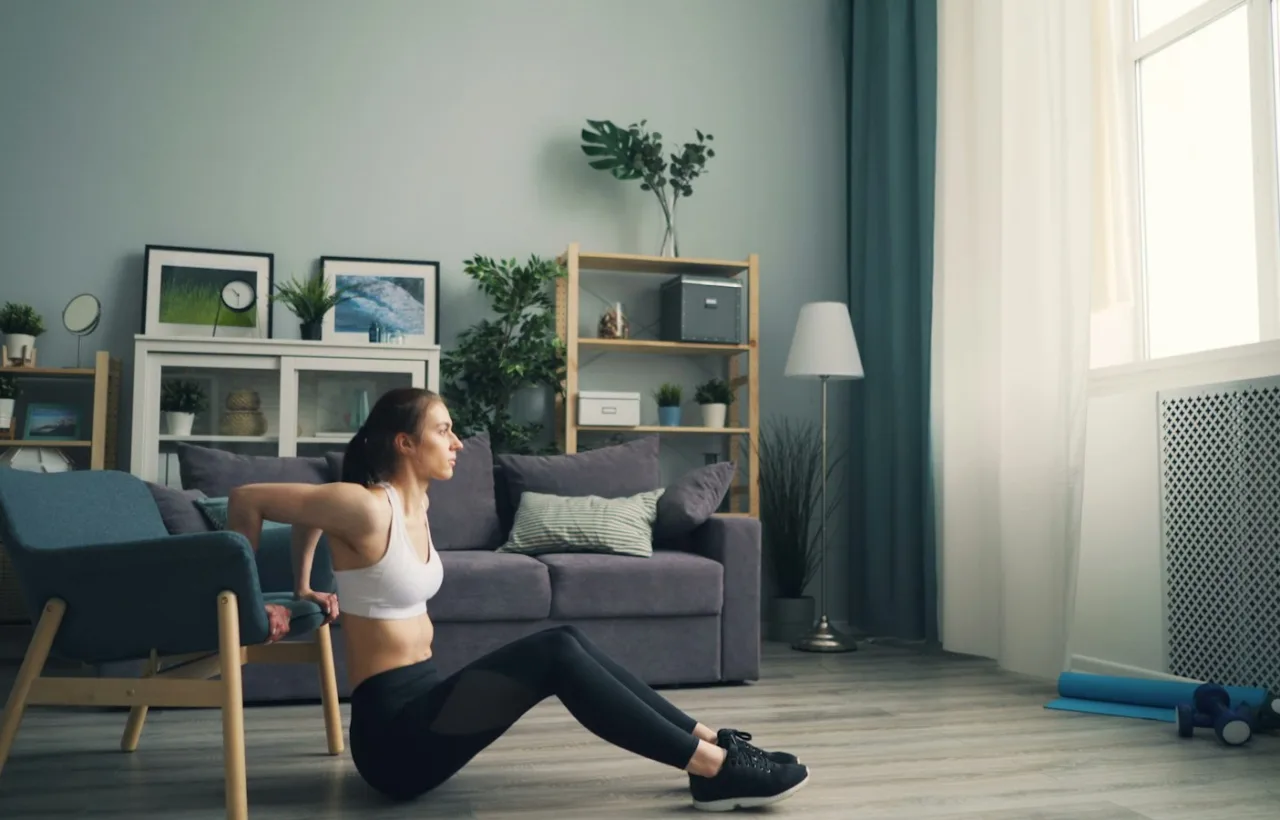

A toned legs home workout builds stronger, more defined legs using bodyweight exercises that target all major muscle groups. This guide shows you a complete workout plan, explains why hamstrings are the hardest part to train without equipment, and gives you troubleshooting for the most common form mistakes beginners make.
Most home leg workouts focus only on pushing movements like squats and lunges. That covers your quads and glutes well, but leaves hamstrings and inner thighs undertrained. A complete routine balances push, pull, and stabilization work across all planes of movement. You will get better results, avoid muscle imbalances, and reduce injury risk.
This plan is built from the WHO's 2020 physical activity guidelines, which recommend adults do muscle-strengthening activities involving all major muscle groups at moderate or greater intensity on two or more days per week.
Why Hamstrings Are the Hard Part at Home
Your legs have four main muscle groups: quadriceps (front thigh), hamstrings (back thigh), glutes (hips and buttocks), and calves. Squats, lunges, and step-ups work the quads and glutes through knee and hip extension—all pushing movements. Those are easy to load with just your bodyweight or household items.
Hamstrings pull your heel toward your glutes and help extend your hip. Without a cable machine or resistance band, you need floor-based exercises like single-leg Romanian deadlifts, glute bridges with a hamstring focus, or sliding leg curls. These require more balance and body control, so they feel awkward at first.
The result: most beginners end up with quad-dominant workouts. Over time, this creates a strength imbalance between the front and back of your thigh. Research in professional soccer players has linked hamstring-to-quadriceps strength imbalances to a higher rate of hamstring injuries, and correcting those imbalances lowered the risk. (source: Croisier JL et al., 2008, Am J Sports Med) You are not training for competition, but the principle applies—balanced development matters for joint health and function.
The fix is simple: include at least one hamstring-focused exercise in every leg session, and count the tempo. A slow eccentric (lowering phase) of 3–4 seconds makes bodyweight hamstring curls much more effective.
The Core Workout Structure
This routine hits all four muscle groups twice per week. You can do it Monday and Thursday, Tuesday and Friday, or any two non-consecutive days. Each session takes 25–35 minutes.
Warm-up (5 minutes)
- 2 minutes of walking in place, marching with high knees, or light jogging
- 10 leg swings forward and back on each leg
- 10 lateral leg swings on each leg
- 10 bodyweight squats with a 2-second pause at the bottom
A proper warm-up increases muscle temperature and synovial fluid in your joints, reducing stiffness and preparing connective tissue for load. A good warm-up usually takes 5–10 minutes of light cardio and dynamic movements before resistance training.
Main workout (15–25 minutes)
Do 3 sets of each exercise, resting 60–90 seconds between sets. Choose a rep range based on your goal:
| Goal | Reps per set | Tempo | Rest |
|---|---|---|---|
| Muscle endurance and tone | 12–20 | Controlled, 2-1-2 | 60 sec |
| Strength and size | 6–12 | Slow eccentric, 3-1-1 | 90 sec |
| Mix (recommended for beginners) | 10–15 | 2-1-2 | 75 sec |
Tempo is written as seconds: eccentric (lowering) – pause – concentric (lifting). For example, 2-1-2 means lower for 2 seconds, pause for 1 second, lift for 2 seconds.
Exercise selection
Choose one from each category per session. Rotate through different options across the week to avoid overuse and keep your joints healthy.
Category 1: Quad-dominant push
- Bodyweight squats: feet hip-width, weight in midfoot, chest up. Lower until thighs are parallel or just below. If your knees cave inward, place a resistance band or towel around your thighs and push outward as you squat.
- Bulgarian split squats: rear foot elevated on a low chair or couch, front foot far enough forward that your knee stays behind your toes at the bottom. This is harder than regular squats because each leg works independently.
- Walking lunges: step forward, lower until both knees are at 90 degrees, push through your front heel to step the back leg forward into the next lunge. Keep your torso upright.
Category 2: Hamstring and glute pull
- Single-leg Romanian deadlifts: stand on one leg, hinge at the hip to lower your torso while extending the other leg behind you for balance. Your back stays flat. Lower until you feel a stretch in your hamstring, then drive your hips forward to stand. Touch a wall or chair for balance at first.
- Glute bridge with hamstring focus: lie on your back, feet hip-width and close to your glutes. Press through your heels to lift your hips. At the top, dig your heels into the floor as if trying to pull them toward you without actually moving them. This engages your hamstrings more than a standard bridge. Lower for 3–4 seconds.
- Sliding leg curls: lie on your back, heels on a towel or paper plates on a smooth floor. Lift your hips, then pull your heels toward your glutes by bending your knees. Extend slowly. This is advanced; start with glute bridges if it feels too hard.
Category 3: Inner and outer thigh stabilizers
- Lateral lunges: step to the side, bend the stepping leg, keep the other leg straight, then push back to center. This works your inner thigh (adductors) and the outside of your hip (abductors).
- Clamshells: lie on your side, knees bent, feet together. Lift your top knee without rotating your hips. This isolates the gluteus medius, which stabilizes your pelvis when you walk or stand on one leg.
- Curtsy lunges: cross one leg behind the other as you lunge, like a curtsy. This angle loads your glutes and outer hip differently than a forward lunge.
Category 4: Calves
- Standing calf raises: rise onto the balls of your feet, pause at the top, lower slowly. Do these on a step with your heels hanging off the edge for a greater range of motion.
- Single-leg calf raises: same movement, but one leg at a time. Much harder and reveals strength imbalances between sides.
A complete session might look like this:
- Bulgarian split squats: 3 sets of 12 per leg
- Glute bridge (hamstring focus): 3 sets of 15
- Lateral lunges: 3 sets of 10 per side
- Single-leg calf raises: 3 sets of 15 per leg
Cool-down (3–5 minutes)
- Standing quad stretch: pull one heel to your glutes, hold 30 seconds each side
- Seated hamstring stretch: sit with one leg extended, reach toward your toes, hold 30 seconds each side
- Figure-four glute stretch: lie on your back, cross one ankle over the opposite knee, pull the uncrossed leg toward your chest, hold 30 seconds each side
Stretching after training, when muscles are warm, is a convenient time to work on flexibility.
Watch the Form for Key Exercises
Progression: How to Keep Getting Results
Your muscles adapt to a given load within 4–6 weeks. When an exercise starts to feel easy at the top of your rep range, make it harder using one of these methods:
Add reps or sets. Move from 3 sets of 10 to 3 sets of 12, then 3 sets of 15. Once you hit 3 sets of 15–20, switch to a harder variation rather than doing 25+ reps, because very high rep ranges train endurance more than strength or muscle tone.
Slow the tempo. A 4-second eccentric phase doubles the time your muscles are under tension. This is one of the simplest ways to increase difficulty without equipment.
Switch to a single-leg variation. Single-leg Romanian deadlifts are much harder than the two-leg version. Single-leg calf raises, pistol squats (advanced), and single-leg glute bridges all force each leg to handle your full bodyweight.
Add a pause. Hold the bottom of a squat or lunge for 2–3 seconds. This removes the stretch reflex (the bounce) and makes your muscles work harder.
Use household items for load. A backpack filled with books, a gallon jug of water (8.3 pounds), or a laundry detergent bottle add weight to squats, lunges, and Romanian deadlifts. Start light and add weight only after you can do 15 reps with perfect form.
The WHO guidelines call for “moderate or greater intensity,” which in practice means the last 2–3 reps of each set should feel challenging. If you finish a set and could easily do 5 more reps, the load is too light.
Form Mistakes That Waste Your Effort
Knees caving inward during squats or lunges. This puts stress on your knee ligaments and limits glute activation. Your knees should track in line with your toes throughout the movement. If they collapse inward, widen your stance slightly, point your toes out 10–15 degrees, and actively push your knees outward as you squat. Weak glutes are usually the cause; clamshells and lateral walks with a band will fix it over time.
Letting your front knee shoot past your toes in lunges. This shifts load to your knee joint instead of your muscles. Step far enough forward that your shin stays vertical when you are at the bottom of the lunge.
Rounding your lower back in Romanian deadlifts. If your hamstrings are tight, you will compensate by rounding your spine. This defeats the purpose of the exercise and risks lower back strain. Bend your knees slightly, keep your chest up, and only hinge as far as you can while maintaining a flat back. Flexibility will improve with practice.
Lifting your hips too high in glute bridges. Hyperextending your lower back at the top of a bridge shifts work away from your glutes. Stop when your body forms a straight line from knees to shoulders. Squeeze your glutes hard at the top; if your hamstrings cramp, your feet are too close to your body.
Bouncing out of the bottom of squats. Using momentum reduces time under tension and makes the exercise less effective. Pause for 1 second at the bottom, then drive up with control.
Doing calf raises too fast. Your calf muscles respond better to slow, controlled reps with a full stretch at the bottom and a hard contraction at the top. Rise in 2 seconds, pause for 1 second, lower for 3 seconds.
What the Research Says About Bodyweight Training
A 2017 study in the Journal of Exercise Science & Fitness compared push-up training to bench press training at a matched load over 8 weeks. Both groups gained similar strength and chest and triceps muscle thickness, which suggests bodyweight exercises can build muscle when sets are hard enough. The key is progressive overload—making the exercises harder over time, not repeating the same easy routine for months.
A 2021 meta-analysis in Ageing Research Reviews found that unsupervised home-based resistance training improved some measures of lower-limb strength, balance, and muscle power in older adults.
These results apply to healthy adults training for general fitness and muscle tone. If you have joint problems, previous injuries, or chronic conditions, check with a healthcare provider before starting a new exercise program. Bodyweight training is generally low-impact, but exercises like jump lunges or single-leg work can stress unstable joints.
Adjusting for Your Starting Point
Complete beginners: start with 2 sets of each exercise instead of 3. Focus on learning the movement patterns before adding reps or intensity. It is normal to feel sore for 2–3 days after your first few sessions as your muscles adapt.
Returning after a break: your muscles lose strength faster than they lose motor patterns, so you will regain lost fitness more quickly than you built it the first time. Start at 60–70% of where you left off and increase weekly.
Limited mobility: if you cannot squat to parallel or hinge at the hip without rounding your back, scale the range of motion. Squat to a chair or bench at first, and practice hip hinge drills with a dowel along your spine to learn the correct position. Mobility improves with consistent practice.
Already active: if you run, cycle, or do other cardio regularly, your legs may already have good endurance but lack strength in certain planes of movement. Lateral lunges and single-leg work will feel disproportionately hard. That is normal—you are filling gaps.
Toned Legs: What People Ask
How often should I train legs at home?
Two to three times per week, with at least one rest day between sessions. Your muscles grow during recovery, not during the workout itself. The WHO recommends muscle-strengthening activities on two or more days per week for health benefits. More is not always better; three well-executed sessions beat five rushed ones.
Can I build muscle without weights?
Yes, as long as you progressively overload your muscles by increasing reps, sets, tempo, or exercise difficulty. Muscle growth is triggered by mechanical tension, and bodyweight exercises create plenty of tension if you work close to failure. A 2017 meta-analysis in the Journal of Strength and Conditioning Research found that light and heavy loads produce similar muscle growth when sets are taken to muscular failure.
Why do my legs shake during single-leg exercises?
Shaking is a sign that your stabilizer muscles—the smaller muscles around your hips, knees, and ankles—are working hard to keep you balanced. This is normal and improves with practice. Start by holding onto a wall or chair, and reduce your reliance on support as you get stronger.
Do I need to feel sore to know the workout worked?
No. Soreness (delayed onset muscle soreness, or DOMS) is most common when you try a new exercise or increase intensity suddenly. It is not required for muscle growth or strength gains. Consistent progressive overload matters more than soreness. If you are never sore, you are likely adapting well. If you are always sore, you may be progressing too aggressively or not recovering enough.
How long before I see results?
Strength gains appear first, usually within 2–3 weeks, as your nervous system adapts and learns to recruit muscle fibers more efficiently. Visible muscle tone changes typically show up after 6–8 weeks of consistent training and adequate protein intake. Fat loss, which makes muscle definition more visible, depends on your overall calorie balance and happens alongside training, not because of it.
Can I combine this with running or cycling?
Yes. Cardio and resistance training complement each other. Schedule your leg workouts on days when you do easy cardio, or do hard cardio on your rest days. Avoid doing a hard run and a hard leg workout on the same day; your muscles need recovery time. When possible, leave several hours between a hard cardio session and a hard leg workout on the same day.
How This Guide Was Put Together
This workout plan is based on the WHO's 2020 physical activity guidelines for adults and the principles of progressive overload and balanced muscle development documented in the sports medicine studies linked throughout. The exercise selection and form cues follow standard biomechanical principles taught in certified personal training programs.
If you have existing injuries, joint instability, cardiovascular conditions, or other health concerns, consult a healthcare provider before starting a new exercise program. This guide is general information, not personalized medical or fitness advice.


