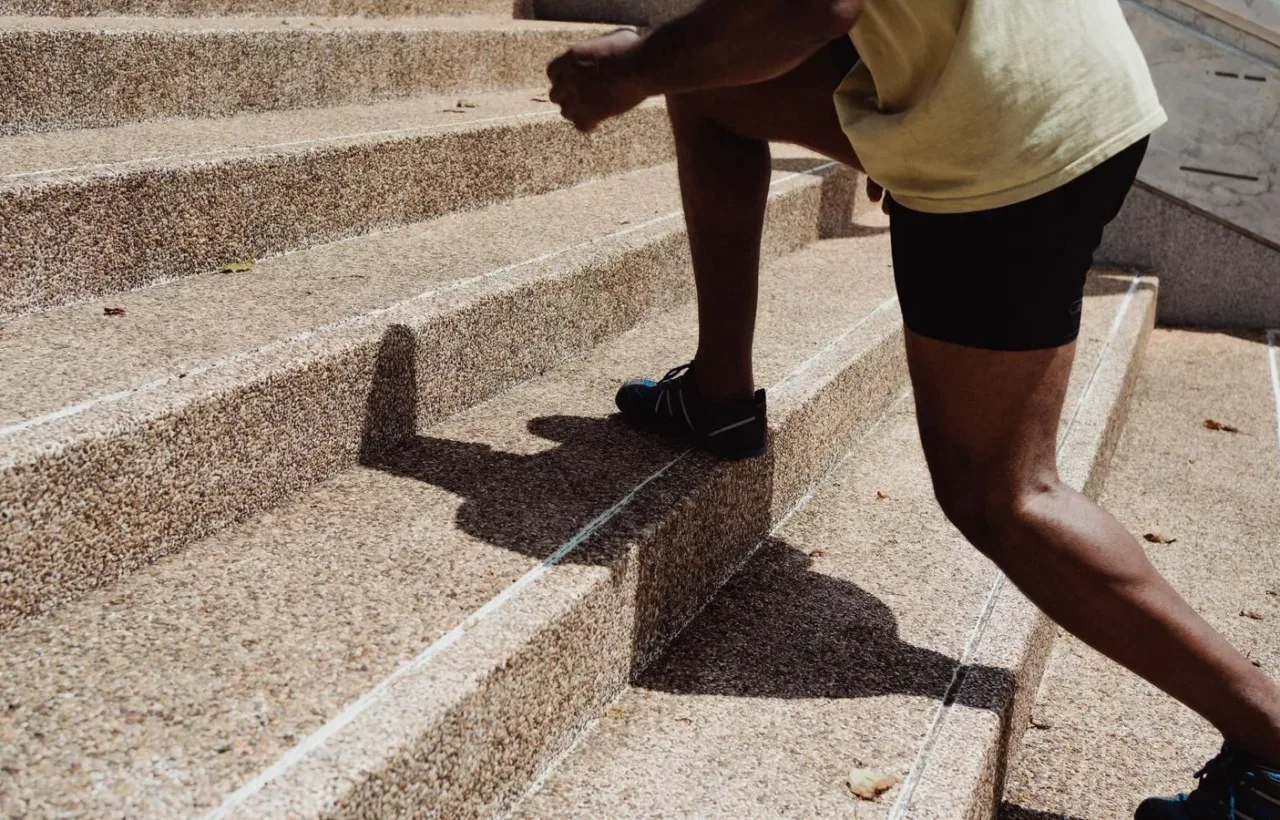

A step workout routine at home uses a low, stable platform and repeated stepping patterns to raise your heart rate while strengthening your thighs, glutes, and calves. The routine below takes 25 minutes, needs no jumping, and can be done on an aerobic step, the bottom stair, or — to start — on the floor. You will learn how to set the right step height, do the main moves with safe form, and progress over four weeks without adding time.
What a Step Workout Actually Trains
A step workout is two kinds of training in one session. The continuous stepping patterns are aerobic exercise, which means exercise that raises your heart rate and breathing for several minutes at a time. The slower step-ups are muscle-strengthening exercise, which means working a muscle against resistance — here, your own body weight — until it is tired.
That mix matters because one type does not replace the other. Stepping can cover both your cardio and your leg strength in the same session, but it does not train pushing, pulling, or your upper body. Add push-ups and a row on other days if you want full-body coverage.
Step training is low-impact when done as described here, with one foot always in contact with the step or floor. Low-impact does not mean low effort. A low height at a steady pace can still be moderate intensity, and a slower, controlled step-up can be hard strength work for one leg at a time.
What You Need and How High Your Step Should Be
You need a surface that does not move, slide, or tip, supportive shoes, and enough clear floor to step on and off without turning sharply. That is all.
Choose your surface by stability first, not by height:
| Option | Best for | Use it when | Avoid it when |
|---|---|---|---|
| Floor markings or no platform | Complete beginners, balance concerns | You are learning the patterns or checking your knee comfort | You want harder leg strength work — the floor gives cardio practice, not a step-up load |
| Bottom stair with a rail or wall nearby | Beginners with no equipment | The stair is solid, dry, and you can hold support for balance | The stair is tall, narrow, carpeted loosely, or without support nearby |
| Adjustable aerobic step, 4 inches (10 cm) | Most beginners | You can place your whole foot flat on the platform | The platform wobbles, slides, or your heel hangs off the back |
| Aerobic step, 6 to 8 inches (15 to 20 cm) | Regular exercisers new to step, then experienced steppers | Your form stays controlled for a full session at the lower height | Your knee bends deeper than a right angle under your full weight, or you have to pull yourself up |
Guidance summarising the American Council on Exercise step recommendations lists 4 inches (10 cm) for people who have not exercised regularly, up to 6 inches (15 cm) for regular exercisers who are new to step, and 8 inches (20 cm) as the most common height for experienced steppers, with the rule that your knee should not bend deeper than 90 degrees when it bears your full weight on the step — see the summary of ACE step height guidance. Higher is not better if it changes your form. Start at the lowest height that makes you breathe harder, and stay there for at least the first week.
Do not use stacks of books, soft boxes, a wheeled stool, or a chair that can slide. For balance support, use a wall, a rail, or a solid surface. The NHS advises using something stable for home strength work, not an object that may move, and choosing a solid, stable chair without wheels when a chair is used for support, according to its home strength exercises.
If you have knee pain, a joint replacement, balance problems that raise your fall risk, chest pain, or a heart or lung condition, get medical advice before starting step training. The NHS advises adults to speak to a GP first if they have not exercised for some time, or if they have medical conditions or concerns. Stop the session if you feel chest pain, dizziness, or severe breathlessness, and seek medical help for those symptoms. This routine is for generally healthy adults and is not a substitute for advice about your own condition.
Form First: Five Rules That Make Stepping Work
Good form is what turns stepping into training instead of knee strain. Learn these rules on the floor or the lowest step before you add pace or height.
- Place your whole foot on the step. Your heel should not hang off the back edge, because a partial foot placement shifts the load to your calf and Achilles and makes the platform easier to miss.
- Push through the whole foot of the top leg. Do not pull up with the bottom leg or push off its toes to launch yourself, because that takes work away from the leg you are trying to strengthen.
- Keep your knee in line with your foot. Let it track over your second toe, not cave inward, because inward collapse is harder to control when you are tired.
- Step up tall and step down close. Stand fully upright on top before stepping down, then land near the step with a soft knee, because stepping far back makes the landing harder to control.
- Keep the pace you can repeat quietly. Quiet landings and a steady rhythm are useful form checks. If you start slapping the platform, missing the centre, or holding your breath, slow down or lower the step.
Work at moderate intensity for most of this routine. The NHS describes moderate activity as raising your heart rate and making you breathe faster and feel warmer, and gives a simple check: you can still talk, but not sing. Short answers are fine. If you cannot say a few words, you are working harder than this plan intends.
The 25-Minute Step Workout Routine at Home
This routine has a warm-up, two cardio blocks built from the same four patterns, one slow strength block, and a cool-down. Repeat the full session two or three times a week on non-consecutive days.
| Part | Time | What to do |
|---|---|---|
| Warm-up | 3 minutes | March on the floor, step-touch side to side, then practise 6 slow basic steps |
| Cardio Block 1 | 8 minutes | 40 seconds per pattern, 20 seconds marching on the floor, repeat the set twice |
| Strength Block | 8 minutes | Slow step-ups and calf raises, described below |
| Cardio Block 2 | 4 minutes | Repeat your two best patterns from Block 1, 40 seconds on, 20 seconds marching, twice |
| Cool-down | 2 minutes | Slow march, then calf, thigh, and hip stretches while breathing normally |
Warm-up
March in place for 1 minute, then step-touch for 1 minute. Use the last minute for slow basic steps at an easy pace, because cold muscles and joints need a gradual start. Mayo Clinic Health System advises warming up with brisk walking for five to 10 minutes before strength training in a full session; here the warm-up plus the easy first cardio set serves that purpose for a short home routine. If you feel stiff, extend the warm-up and shorten Cardio Block 2.
The four cardio patterns
Basic step is the foundation pattern: step up with your right foot, up with your left, down with your right, down with your left. Change the leading foot after each set so both sides work evenly.
V-step is a wider basic step. Step up to the right corner of the platform with your right foot, up to the left corner with your left, then step down to the centre with each foot. The wider stance is often easier for balance than the basic step.
Step and knee lift adds hip work. Step up with one foot, lift the opposite knee to about hip height without pulling it with your hands, then step down. Keep the lift controlled; the height of the knee matters less than staying upright and balanced.
Step and hamstring curl is the gentler knee-lift alternative. Step up with one foot, bend the opposite knee to bring your heel toward your buttock, then step down. Choose this pattern if a knee lift makes you lean back or lose balance.
Rotate through the four patterns in Cardio Block 1. In Cardio Block 2, repeat the two patterns you did most cleanly, because clean repetitions at a steady pace train you better than a new pattern done badly.
The strength block
Do the strength moves slowly, with a pause at the top. Slow work is the point here, not speed.
- Slow step-up: 8 to 12 repetitions per leg, 2 sets. Step up, stand tall for a second, step down with control, and complete all repetitions on one leg before switching, or alternate legs if that helps your balance. Rest 30 to 60 seconds between sets.
- Lateral step-up: 6 to 10 repetitions per leg, 1 to 2 sets, only if you can do the forward step-up well. Stand side-on to the step, place the nearer foot fully on it, and push up without pushing off the floor leg.
- Calf raise: 10 to 15 repetitions, 2 sets. Stand on the floor and rise onto the balls of your feet, pause, and lower slowly. Hold a wall for balance if needed. Use the step edge only if you can hold solid support and place your feet securely.
The repetition range follows the CDC guidance for muscle-strengthening: try 8 to 12 repetitions per activity for one set, work to the point where another repetition would be hard, and do two or three sets for more benefit. For calf raises, which many people find easier, the higher range above keeps the same principle — the last few repetitions should feel hard while your form stays clean.
How to Fit This Into a Week and Progress It
Two or three step sessions a week is enough for this routine, because the strength block needs recovery days. Mayo Clinic advises resting a muscle group for at least 48 hours before working it hard again, so keep at least one easier day between step sessions.
| Day | Session |
|---|---|
| Monday | Step routine, 25 minutes |
| Tuesday | Walk or other light activity |
| Wednesday | Step routine, 25 minutes, plus push-up and row practice if you do upper-body work |
| Thursday | Rest or walk |
| Friday | Optional third step routine |
| Weekend | Walk, cycle, swim, or rest |
Progress by changing one thing at a time, in this order:
| Week | Change to make | Keep the same |
|---|---|---|
| Week 1 | Learn the patterns at 4 inches (10 cm) or on the floor, easy pace | Height and session length |
| Week 2 | Complete both cardio blocks without extra breaks | Height |
| Week 3 | Add the second set of lateral step-ups, or extend Cardio Block 2 by 2 minutes | Height |
| Week 4 | Raise the step by one riser, about 2 inches (5 cm), only if week 3 felt controlled | Pace for the first session at the new height |
This order matters because pace, height, and volume all raise the load, and changing them together makes it impossible to tell what caused sore knees or poor form. For the strength moves, the American College of Sports Medicine position stand on progression recommends novice loads of 8 to 12 repetition maximum and a 2 to 10% load increase when you can do one to two repetitions over your target, with training on two to three days a week for novices, according to the ACSM position stand abstract on PubMed. At home, that small increase usually means slower repetitions, a slightly higher step, or holding a light household weight close to your chest — not a big jump in all three.
Mistakes That Make Step Workouts Feel Hard on the Knees
Most step problems come from setup and pace, not from stepping itself. Check these before you decide step training does not suit you.
- The step is too high for your current strength. Your knee bends deeper than a right angle, you rock forward, or you push hard off the bottom foot. Lower the step and rebuild the pattern.
- Only your toes reach the platform. This usually happens when you stand too far back. Move closer, look down briefly to place the foot until the position feels automatic, and reset if you miss the centre.
- You race the music instead of your form. Fast patterns hide partial foot placements and hard landings. Slow down until every landing is quiet, even if that means marching on the floor for part of a set.
- You do the strength block as cardio. Rushing step-ups turns them into bouncing. Keep the pause at the top and the slow step down, because the lowering phase is part of the strength work.
- You repeat the same hard leg session daily. Sore, tired legs produce sloppy landings. Keep the non-consecutive schedule and use walking on the other days.
Joint soreness that is sharp, swelling, or pain that changes how you walk is not normal training soreness. Stop that move, use a lower step or floor work at your next session if symptoms settle, and get advice from a clinician or physiotherapist if pain persists.
What the Guidelines and Research Say About Stepping
Step training fits the standard adult activity targets when you use it regularly through the week. According to the WHO, adults should do at least 150 to 300 minutes of moderate-intensity aerobic activity, or 75 to 150 minutes of vigorous activity, per week, plus muscle-strengthening activities involving all major muscle groups on two or more days. Two or three 25-minute step sessions will not cover the full aerobic total on their own, so walking and other activity on the other days are part of the plan, not an extra.
The CDC lists legs, hips, back, chest, abdomen, shoulders, and arms as the major muscle groups to work for muscle-strengthening benefits, in its guidance on what counts as muscle-strengthening activity. This routine covers legs, hips, and abdomen well. It does not cover chest, back, shoulders, and arms, which is why a complete weekly plan needs a push, a pull, and a core move from another session.
For the strength value of the step-up itself, a systematic review by Krause Neto and colleagues, covering 16 studies that measured gluteus maximus activation, classified the step-up and its lateral, diagonal, and crossover variations as very high activation exercises and concluded that they presented the highest levels among the exercises reviewed, in the systematic review in the Journal of Sports Science & Medicine. Activation is a measure of how hard a muscle works during a move, not a promise of a particular change in size or shape. It supports choosing the step-up as a main leg exercise, paired with enough repetitions, recovery, and overall activity.
Step Workout Questions, Answered Straight
Do I need an aerobic step platform to start?
No. You can learn every pattern in this routine on the floor and do your first step-ups on a solid bottom stair. A platform helps because its height is lower and more adjustable than most stairs, but it is not required for the first two weeks.
How many times a week should I do a step workout routine at home?
Do this full routine two or three times a week on non-consecutive days. That spacing lets you work hard in the strength block and still recover. Use walking or lighter cardio on the days between sessions to build your weekly aerobic total.
Will a step workout make my legs bulky or just stronger?
For most beginners, the first change is strength and control, such as finding stairs and step-ups easier, not a large change in size. Muscle size changes depend on total training volume, food intake, and how long you keep progressing the load. This routine is set up for general strength and cardio fitness, not for maximum muscle growth.
What should I do if stepping hurts my knee?
Lower the step first, slow down, and check that your whole foot is on the platform and your knee tracks in line with your foot. If pain is sharp, causes swelling, or persists across sessions, stop step-ups and get advice from a clinician or physiotherapist before continuing. Do not raise the height or add weight to work through knee pain.
Can I do a step workout without music?
Yes. Music only helps some people keep a pace. You can use a timer for the 40-second work periods, count repetitions for the strength block, and use the talk test — you can talk, but not sing — to judge intensity.
Related Home Workouts
How This Guide Was Put Together
This guide is based on the WHO physical activity recommendations, CDC guidance on what counts as muscle-strengthening activity, NHS physical activity and home strength guidance, Mayo Clinic Health System strength training advice, the ACSM position stand on progression for resistance training, and the Krause Neto et al. systematic review of gluteus maximus activation linked above. No personal testing, expert interviews, or individual results are claimed.
Sources
- World Health Organization. Physical activity fact sheet.
- Centers for Disease Control and Prevention. What Counts as Physical Activity for Adults.
- NHS. Physical activity guidelines for adults aged 19 to 64.
- NHS. Strength exercises.
- Mayo Clinic Health System. Weight training tips for beginners.
- American College of Sports Medicine. Progression models in resistance training for healthy adults, position stand, 2002. PubMed abstract.
- Krause Neto, W., et al. Gluteus Maximus Activation during Common Strength and Hypertrophy Exercises: A Systematic Review, Journal of Sports Science & Medicine, 2020. Full text PDF.


