
A chest shoulder tricep workout at home trains all your main pushing muscles in one session, using a push-up, a press, an overhead move, and a triceps extension. You do not need a bench press or a cable machine to do it well. Pick a push-up level you can control for full reps, press from the floor if you have a weight, and finish with work that puts your arms overhead.
After this guide, you will know how to run the session twice a week, how to make each move easier or harder, and how to progress without adding weight every time.
What This Push Workout Trains, and Why the Three Muscles Belong Together
These three muscles belong in one session because they work together every time you push something away from you. The chest starts the push, the front and side of the shoulder help lift and stabilise the arm, and the triceps straighten the elbow to finish it.
The pectoralis major is the large, fan-shaped muscle that makes up the bulk of the chest. According to StatPearls anatomy of the pectoral muscles, it has a clavicular head and a sternocostal head, and it helps flex, adduct, and rotate the arm at the shoulder.
The deltoid is the cap over the shoulder. Its front part helps with pressing and lifting the arm forward, its side part helps lift the arm out to the side, and its back part helps pull the arm back. A home push session trains the front and side parts most, which is why you also need pulling and rear-shoulder work on other days for balance.
The triceps brachii is the muscle on the back of the upper arm. StatPearls anatomy of the triceps muscle describes its three heads — long, lateral, and medial — and its main job of extending the forearm at the elbow. The long head starts on the scapula, the shoulder blade, so its length changes when your arm is overhead. That is why one overhead triceps move belongs in the plan, not just more push-ups.
The Chest Shoulder Tricep Workout at Home: The Twice-Weekly Plan
Run this workout twice a week on non-consecutive days, for 30 to 40 minutes. Do Workout A one day and Workout B three or four days later, so the same muscles get at least one full rest day between sessions.
Warm up for 5 to 10 minutes first with brisk marching, arm circles, wall push-ups, and easy shoulder movement. Mayo Clinic Health System guidance on weight training advises warming up in this way, starting light, and resting a muscle group for at least 48 hours before working it hard again.
If you have not exercised for some time, have a medical condition, or have had a shoulder, elbow, wrist, or chest injury, speak to your doctor or GP first and start with the easiest versions. Stop a move if you feel sharp, pinching, or shooting pain, numbness, or a joint giving way. Muscle effort and a mild burn are normal. Joint pain is a reason to change the move, reduce the range, or stop.
| Workout | Exercises, in order | Sets and reps |
|---|---|---|
| A — Push-up focus | 1. Push-up at your level 2. Pike push-up or overhead press 3. Close-grip push-up 4. Overhead triceps extension | 3 sets of 6–12 / 3 sets of 6–10 / 2 sets of 6–12 / 2 sets of 8–12 |
| B — Press focus | 1. Floor press with dumbbells, a backpack, or push-up from a harder level 2. Push-up at your level 3. Pike push-up or overhead press, lighter 4. Triceps kickback or chair dip, short range | 3 sets of 8–12 / 2 sets of 8–15 / 2 sets of 6–10 / 2 sets of 8–12 |
Rest 60 to 120 seconds between sets. Rest longer after the first exercise, because it is the heaviest push of the day and you want good form on every set.
If you have no weight at all, skip the floor press in Workout B and use a harder push-up level instead. The plan still works, because progression comes from the version you choose, not from the equipment alone.
1. Push-up at your level
Choose the highest level where you can keep a straight line from head to heels, or head to knees, for every rep.
- Wall push-up: Hands on a wall at chest height, feet back, lower your chest toward the wall and push away. North Tees and Hartlepool NHS standing exercises use wall press-ups for 2 sets of 10 reps as a starting point.
- Hands-elevated push-up: Hands on a solid counter, table, or chair seat with no wheels. The higher the surface, the easier the rep.
- Knee push-up: Knees on a mat, hands under your shoulders, lower with control.
- Floor push-up: Hands flat, body straight, lower until your chest is a fist-height from the floor.
- Feet-elevated push-up: Feet on a low, stable step. This shifts more work to the upper chest and shoulders, so use it only after floor push-ups feel solid.
Keep your elbows about 45 degrees from your sides, not straight out in a T shape. That position lets your chest and triceps share the work and usually feels better on the front of the shoulder.
2. Floor press
Lie on your back with knees bent and feet flat. Hold a dumbbell in each hand, or one weight with both hands, or a loaded backpack held at the handles over your chest.
Lower the weights until your upper arms lightly touch the floor. Press up until your arms are straight but your elbows are not locked hard. The floor limits how far your elbows drop, which makes this a useful chest press for people who find a bench uncomfortable or who do not own one.
Use a weight you can lower slowly for 8 to 12 reps. If the last two reps do not slow down at all, the weight is too light for strength work at this range.
3. Pike push-up or overhead press
Pick one based on your shoulders and equipment. Choose the pike push-up if you have no weight and you can do floor push-ups with good form. Choose a light overhead press if pike push-ups bother your neck or wrists, or if you prefer a set weight.
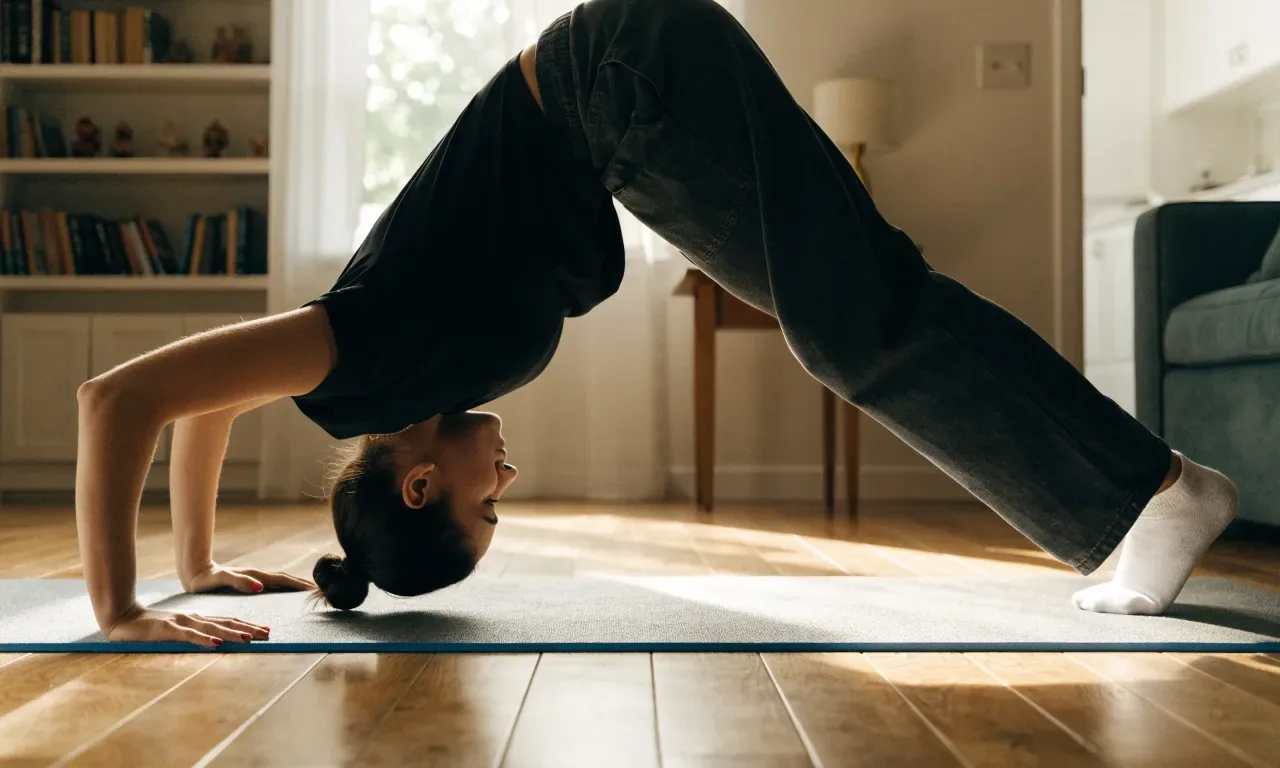
For the pike version, start in a push-up position and walk your feet in, lifting your hips so your body forms an inverted V. Bend your elbows and lower the top of your head toward the floor between your hands, then press back up. Keep the movement short and controlled at first.
For the overhead press, stand or sit tall, hold light dumbbells or filled bottles at shoulder height, and press overhead without arching your lower back. Lower slowly to shoulder height. Start lighter than you think you need, because the shoulders fatigue fast after push-ups.
4. Close-grip push-up
Place your hands under your chest, narrower than shoulder width, and do a push-up with elbows tracking close to your ribs. This shifts more work to the triceps while still training the chest.
If a full close-grip push-up is too hard, do it with hands elevated or from your knees. Reps should be clean, not fast. When your elbows start to flare wide or your hips sag, the set is done.
A related version, the triangle or diamond push-up with thumbs and index fingers touching, is the move used in the triceps research covered below. It is hard, so treat it as a progression, not a starting point.
5. Overhead triceps extension
Hold one dumbbell, bottle, or backpack with both hands overhead, elbows pointing forward and close to your head. Lower the weight behind your head by bending only at the elbows, then straighten your arms.
Keep your ribs down and your upper arms still. Moving the weight overhead puts the long head of the triceps in a different position from push-ups, which is the reason to include this move. If overhead work pinches your shoulder, swap it for the kickback below and keep the range pain-free.
6. Triceps kickback or short-range chair dip
For a kickback, hinge forward with a flat back, hold a light weight, keep your upper arm level with your torso, and straighten your elbow behind you. Lower slowly. This needs very little weight to work.
Chair dips are an option only if they feel clean on your shoulders. Use a solid, stable chair with no wheels, as the NHS strength exercises advise for chair-based work, and build up slowly. Keep the range short, with your torso close to the chair, and stop well before your shoulders roll forward or pinch. If dips bother your shoulders at all, use close-grip push-ups and kickbacks instead. You lose nothing important by skipping dips.
Choose Your Version by Equipment and Strength
Use this table to set the session up in under a minute. Stay at one level until you can finish all sets at the top of the rep range with good form on two separate workouts.
| If you have | Chest move | Shoulder move | Triceps move | Best starting choice if |
|---|---|---|---|---|
| No equipment | Wall, hands-elevated, knee, or floor push-up | Pike push-up, short range | Close-grip push-up at an easier push-up level | You are new, returning, or floor push-ups are still hard |
| One dumbbell, band, or loaded backpack | Floor press with one weight, plus push-ups | One-arm or two-hand overhead press, light | Overhead extension, plus kickback if you have a dumbbell | You can do 10 clean floor push-ups |
| Two dumbbells | Floor press | Standing or seated overhead press | Overhead extension and kickback | You want clearer load progression week to week |
Choose no-equipment training if you are still building basic push-up form. Choose one weight if you want to progress the press and the overhead extension without buying a set. Choose two dumbbells if load control matters most to you, because you can make smaller jumps.
Form Rules That Keep the Work in the Right Muscles
Good form is not about looking rigid. It is about putting the effort where you meant to put it and keeping joints in positions they can repeat.
- Brace before you move. Tighten your stomach and glutes before each push-up or press, so your lower back does not arch or sag.
- Lower slowly. Take about two seconds down and one to two seconds up. Rushing the lowering phase removes half the work and makes elbow and shoulder control worse.
- Use a full, comfortable range. Chest close to the surface on push-ups, upper arms to the floor on floor press, elbows bending fully on extensions without pain.
- Keep wrists as neutral as you can. If flat palms on the floor hurt your wrists, use fists, handles, dumbbells, or an elevated surface. Do not push through wrist pain to finish a set.
- Finish the set before form breaks. The CDC describes muscle-strengthening work as done to the point where another repetition would be hard without help. That is the effort target in the section below, not a reason to collapse into the last reps.
How to Progress When a Move Gets Easy
Progress in small steps, in this order: add reps, add a set, slow the tempo, then make the move harder or add load.
The CDC guidance on what counts as muscle strengthening says to try 8 to 12 repetitions per activity for one set, and to do two or three sets for more benefit, working to the point where it is hard to do another repetition without help. That range is a practical target for most exercises in this plan.
The ACSM position stand on progression models in resistance training recommends 8 to 12 repetition maximum loads for novice training, training 2 to 3 days a week, and a 2 to 10% load increase when you can do one to two reps over your target. At home, that translates to simple rules:
- When you hit the top of a rep range on all sets, first try the next push-up level, a slower lowering phase, or a small load increase.
- Change only one thing per week for a given exercise, so you know what made it harder.
- If reps drop by more than half after a change, the step was too big. Go back one level and build reps there.
Track the workout in plain notes: exercise, level or weight, sets, and reps. Without a record, most people repeat the same easy version for months or jump levels before they are ready.
Mistakes That Stall Push Training at Home
- Doing only standard push-ups. Push-ups train chest and triceps well, but they do not replace overhead work for the shoulders or an overhead extension for the long head of the triceps.
- Flaring the elbows wide and cutting reps short. This often turns a chest exercise into a front-shoulder ache. Tuck the elbows closer, use an easier level, and use the full range you can control.
- Training push muscles every day while sore. Soreness is not a score. If pressing strength is clearly down and joints feel irritated, take the rest day the plan already includes.
- Making dips the main triceps exercise despite shoulder pain. Dips are optional here. Close-grip push-ups, extensions, and kickbacks cover the triceps without forcing a deep dip position.
- Adding a backpack before form is stable. Load makes a good push-up harder in a useful way. It makes a sagging, half-range push-up harder in a way that mostly loads joints.
- Skipping pulling work all week. This article is a push session, not a full program. Pair it on other days with rows, band pull-aparts, or other back and biceps work, plus leg and core training, so all major muscle groups get trained.
What Guidelines and Research Say
Adults should do muscle-strengthening activities that involve all major muscle groups on 2 or more days a week, according to the WHO physical activity recommendations, alongside 150 to 300 minutes of moderate aerobic activity or 75 to 150 minutes of vigorous activity a week. A twice-weekly push session covers the chest, shoulders, and arms part of that strengthening target. It does not cover legs, back, or core on its own.
Progressive push-up training can build upper-body strength at home, but the best direct study here is small and short. In Kotarsky's work on progressive calisthenic push-up training, 23 healthy, moderately trained men trained three days a week for four weeks, and both the push-up group and the bench press group increased bench press strength and push-up progression. The push-up group improved more on the push-up test itself. That supports using harder push-up versions over time. It does not prove push-ups are better than bench pressing for everyone.
For triceps exercise choice, the ACE press release on its commissioned triceps study reported that triangle push-ups, kickbacks, and dips registered the highest muscle activation among the eight exercises tested. The study used 15 healthy women aged 20 to 24 with prior weight training experience, so it is a small, specific test group. ACE, after reviewing safety and form, recommended triangle push-ups and kickbacks as safe exercises to include. This plan follows that reading: it uses close-grip and triangle-style push-ups and kickbacks as core options, and treats dips as optional and short-range.
Push Day Questions, Answered Straight
Can I do this workout every day?
No. Do it twice a week on non-consecutive days, so each push muscle gets at least one full rest day between hard sessions. You can walk, stretch, or train legs or pulling muscles on the days between.
Do I need dumbbells for a chest shoulder tricep workout at home?
No, dumbbells are not required. A push-up progression, a pike push-up, and a close-grip push-up cover all three muscles with no equipment. Dumbbells or a loaded backpack help most with the floor press and overhead extension, where small load increases are easier to control.
Why do I feel my shoulders more than my chest on push-ups?
Your hands may be too wide, your elbows may be flaring straight out, or the level may be too hard, so your body shifts the work forward. Move your hands slightly narrower, keep elbows about 45 degrees from your sides, and drop to an easier level for a full, controlled range.
What if I cannot do one floor push-up yet?
Start with wall or hands-elevated push-ups and build reps there first. Use the NHS approach of building up slowly and gradually increasing repetitions over time. A clean set of 12 elevated push-ups builds more useful strength than two floor reps with sagging hips.
Should my shoulders pinch during pike push-ups or dips?
No. A pinching or sharp feeling is a signal to stop that version and change it. Use a lighter overhead press instead of the pike push-up, and use kickbacks or close-grip push-ups instead of dips, keeping every range pain-free.
How long before pressing feels stronger?
Strength changes vary, and this guide does not promise a timeline. If you train twice a week, record your reps, and progress one step at a time, most healthy beginners should expect the work to feel more controlled first, with rep or level increases following as form improves.
Related Home Workouts
- Chest and Tricep Workout at Home for Stronger Push Strength Without Equipment
- Dumbbell Chest Workout at Home
- Upper Chest Workout at Home
How This Guide Was Put Together
This guide is based on the WHO physical activity recommendations, CDC guidance on muscle-strengthening reps and sets, the ACSM position stand on progression in resistance training, and the smaller push-up and triceps studies linked above. It does not claim personal testing, expert review, or individual medical advice.
Sources
- World Health Organization, Physical activity
- Centers for Disease Control and Prevention, What Counts as Physical Activity for Adults
- American College of Sports Medicine, Progression Models in Resistance Training for Healthy Adults, 2002
- Mayo Clinic Health System, Weight training guidance for beginners
- NHS, Strength Exercises
- North Tees and Hartlepool NHS Foundation Trust, Standing Exercises
- StatPearls, Anatomy, Shoulder and Upper Limb, Pectoral Muscles
- StatPearls, Anatomy, Shoulder and Upper Limb, Triceps Muscle
- Kotarsky, C. J., Effect of Progressive Calisthenic Push-up Training on Muscle Strength and Thickness, 2016
- American Council on Exercise, Study Highlights Most Effective Triceps Exercises, 2012


