
You can train your abs at home with no equipment using short, repeatable circuits, and the easiest place to start is one of these 10 abs workout routines at home easy enough for complete beginners. Pick a routine that matches your time and comfort level — standing, seated, or floor-based — do each move slowly, and rest whenever your form slips.
These routines strengthen the muscles that support your trunk, balance, and posture. They will not spot-reduce belly fat on their own, but paired with regular whole-body activity they can make daily movement feel steadier and stronger. Every option below includes time, difficulty, and a simpler modification.
Start Here: Pick the Right Routine for Today
The best routine for today is the one you can finish with clean form. Choose by position and time first, not by intensity.
If floor work bothers your back, neck, or wrists, start standing or seated. If you are short on time, choose an 8- to 10-minute routine and do it well rather than rushing a longer one.
| Routine | Time | Main focus | Best for |
|---|---|---|---|
| 1. 8-Minute Starter Circuit | 8 min | Basic strength and control | True beginners |
| 2. Standing Abs, No Floor Work | 10 min | Balance and obliques | Back or wrist discomfort with floor work |
| 3. Low-Impact Morning Core | 9 min | Gentle activation | Stiff mornings, low energy days |
| 4. No-Crunch Routine | 10 min | Deep core and stability | People who dislike crunches |
| 5. Oblique Routine Without Twisting Hard | 10 min | Side core strength | Posture and side support |
| 6. Seated Chair Abs | 8 min | Accessible core work | Small spaces, desk breaks, limited mobility |
| 7. Slow Pilates-Style Flow | 12 min | Control and breathing | Mindful, slow training |
| 8. Stability and Anti-Rotation Routine | 11 min | Resisting movement | Balance and everyday lifting |
| 9. Beginner Strength Builder | 12-15 min | Progressive strength | When the starter feels easy |
| 10. Gentle Evening Wind-Down | 9 min | Light core and mobility | Ending the day without high effort |
What Your Abs Actually Do, and What You Need
Your “abs” are not one muscle. Your core is a group of muscles that work together to support your spine and transfer force. The rectus abdominis runs down the front and helps you flex your trunk. The obliques run along the sides and help you rotate and resist rotation. The transverse abdominis is the deep layer that wraps around your midsection and helps you brace, like tightening a wide belt.
You need only a clear patch of floor, a mat or carpet for comfort, and enough space to extend your arms and legs. Shoes are optional indoors. Keep water nearby and wear clothes that let you breathe and move freely.
Safety first: Stop and seek medical advice before starting if you are pregnant or recently postpartum, have a hernia, diastasis recti (a separation of the front abdominal muscles), recent abdominal or back surgery, or ongoing back pain. During any routine, stop if you feel sharp pain, dizziness, numbness, or pain that spreads down a leg. Muscle effort and mild shaking are normal; joint pain is not.
Three form rules that apply to every routine
- Brace before you move. Breathe in, then breathe out slowly and tighten your midsection as if preparing for a cough. Keep breathing while you hold that light brace.
- Keep your ribs down. If your lower back arches hard or your ribs flare up, the move is too big. Make the range smaller.
- Move slowly. Two seconds out and two seconds back beats fast reps because slow work keeps the target muscles doing the job instead of momentum.
10 Abs Workout Routines at Home Easy to Follow at Your Own Pace
Do the moves in order, rest 20 to 40 seconds between them, and repeat for the rounds listed. Rest longer if you need to — finishing with good form matters more than finishing fast.
1. The 8-Minute Starter Circuit
This is the default starting point if you have never trained your core on purpose.
- Dead bug: 6 reps per side. Lie on your back, arms up, knees bent at 90 degrees. Lower one arm and the opposite leg slowly, then return.
- Glute bridge with brace: 10 reps. Press through your heels, lift your hips, pause for 2 seconds, then lower.
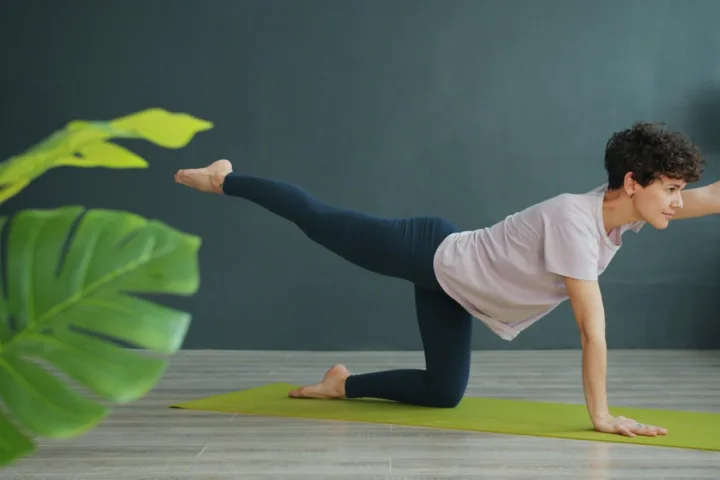
- Bird dog: 6 reps per side. On hands and knees, extend one arm and the opposite leg without rocking your hips.
- Kneeling plank: 20 to 30 seconds. Keep a straight line from knees to head.
Repeat for 2 rounds. Make it easier by keeping your feet on the floor during dead bugs and tapping one heel down at a time.
2. Standing Abs, No Floor Work
Choose this routine if getting down to the floor is hard or floor planks hurt your wrists.
- Standing march with brace: 40 seconds. Stand tall and lift one knee at a time to a comfortable height.
- Wall plank: 30 seconds. Place your forearms or hands on a wall, step back, and hold your body in one line.
- Standing cross-body knee lift: 8 reps per side. Bring one knee toward the opposite elbow slowly; do not yank your torso down.
- Standing side reach: 10 reps per side. Reach one hand down the side of your leg while the other arm reaches overhead. Keep the movement small and controlled.
Repeat for 2 rounds. Hold a chair or wall for balance if needed.
3. Low-Impact Morning Core
Use this on days when you feel stiff and want gentle movement before a harder session later in the week.
- Supine heel taps: 8 reps per side. On your back with knees bent, tap one heel to the floor and return.
- Bridge hold: 30 seconds. Lift your hips once and hold without letting them drop.
- Bird dog, arms only: 6 reps per side. Extend one arm forward while both knees stay down.
- Side-lying leg lift, short range: 8 reps per side. Keep the movement small to target the side core and hip together.
Repeat for 2 rounds. This routine should feel like waking the muscles up, not exhausting them.
4. No-Crunch Routine
Crunches are not required for core strength. This routine uses pressure and stability instead of repeated spinal flexion, which is repeated bending forward at the waist.
- Dead bug: 8 reps per side
- Kneeling plank: 30 seconds
- Pallof press alternative with no band — wall press: 8 reps per side. Stand side-on to a wall, press both palms into it at chest height, and hold your ribs down for 3 seconds per rep.
- Bird dog hold: 15 seconds per side
Repeat for 2 rounds. Make it easier by shortening the plank to 15 seconds and adding a rest in the middle.
5. Oblique Routine Without Hard Twisting
Your obliques work hardest when they control side bending and stop unwanted rotation. You do not need fast Russian twists to train them.
- Modified side plank on knees: 20 seconds per side. Prop on one forearm, knees bent, hips lifted.
- Standing side bend, slow: 10 reps per side. Slide one hand toward your knee and return upright using your side muscles.
- Dead bug with same-side reach: 6 reps per side. This version is harder to control, so move slowly.
- Suitcase march in place: 30 seconds. March while imagining you are carrying a heavy bag in one hand and must stay upright. Switch hands halfway.
Repeat for 2 rounds. If side plank bothers your shoulder, do it against a wall standing up instead.
6. Seated Chair Abs
This routine suits desk breaks, very small spaces, and anyone who needs a stable base. Use a firm chair without wheels, placed against a wall if possible.
- Seated brace and breathe: 5 slow breaths. Sit tall, feet flat, and tighten your midsection on each exhale.
- Seated knee lift: 8 reps per side. Lift one knee a few inches while staying tall. Do not lean back hard.
- Seated heel extension: 6 reps per side. Straighten one leg slowly, hold for 2 seconds, then bend it back.
- Seated side reach: 8 reps per side. Reach toward the floor beside the chair, then sit back up.
Repeat for 2 rounds. Stop if the chair shifts at all.
7. Slow Pilates-Style Flow
This floor routine links moves together with slow breathing. The goal is control, not range.
- Pelvic tilt: 10 reps. On your back, gently flatten your lower back toward the floor, then release.
- Toe taps: 8 reps per side. Keep your pelvis still as one foot taps down.
- Bridge to march preparation: 6 reps per side. Hold a bridge and lift one foot just an inch off the floor.
- Kneeling plank with shoulder tap preparation: 20 seconds. Hold the plank and shift your weight slightly side to side without lifting a hand yet.
Repeat for 2 rounds. If your lower back takes over, reset your pelvic tilt before the next rep.
8. Stability and Anti-Rotation Routine
Anti-rotation means your core works to stop your trunk from turning. This matters when you carry groceries on one side, lift a child, or catch your balance.
- Bird dog hold: 20 seconds per side
- Wall press: 10 reps per side, as described in Routine 4
- Kneeling plank: 30 to 40 seconds
- Standing march, single-arm overhead hold: 30 seconds per side. Hold one arm overhead with a light household object, like a water bottle, and march while staying tall.
Repeat for 2 rounds. Choose a very light object or no object at all until your balance is steady.
9. Beginner Strength Builder
Move to this routine after you can finish Routine 1 for two rounds without your form breaking down.
- Dead bug: 10 reps per side
- Forearm plank on knees or toes: 30 to 45 seconds. Use toes only if you can keep your hips level the whole time.
- Modified side plank: 25 seconds per side
- Slow mountain climber preparation: 6 reps per side. From a kneeling plank, bring one knee toward your chest slowly and return it. Do not run the movement.
Repeat for 2 to 3 rounds, resting 60 seconds between rounds. One clean extra round is progress. Do not add time and rounds in the same week.
10. Gentle Evening Wind-Down
This is a light routine for consistency on rest days. It should leave you breathing slower, not sweating hard.
- Supine brace and breathe: 6 slow breaths
- Heel taps: 8 reps per side
- Bridge: 8 slow reps
- Side-lying side plank preparation: 15 seconds per side. Lie on your side propped on your elbow with hips on the floor, and lift them just slightly.
Repeat for 2 rounds. Keep every rep at an effort you would rate 4 or 5 out of 10.
A Simple Week That Uses These Routines Without Overdoing It
Beginners usually do better with three core sessions a week and general activity on the other days than with daily hard abs work. Muscles need recovery time between harder sessions to adapt.
| Day | Plan |
|---|---|
| Monday | Routine 1 or 9 — strength focus |
| Tuesday | Walk or other light whole-body activity |
| Wednesday | Routine 2, 4, or 5 — standing, no-crunch, or obliques |
| Thursday | Rest or Routine 10 |
| Friday | Repeat Monday's routine |
| Saturday | Walk or other light whole-body activity |
| Sunday | Rest |
According to the WHO physical activity fact sheet, adults should aim for 150 to 300 minutes of moderate-intensity aerobic activity per week, or 75 to 150 minutes of vigorous activity, plus muscle-strengthening activities on 2 or more days a week. The Mistakes That Make Easy Routines Feel Hard — and How to Fix Them
Progress in one small step at a time so you can tell what worked. Add control before you add time. First, slow the tempo to 3 seconds out and 3 seconds back. Next, add 5 to 10 seconds to holds or 2 reps per side. After that, add one round. Only when those feel steady should you try a harder version, such as moving from a kneeling plank to a full plank. Keep a simple note after each session: routine name, rounds completed, and which move felt hardest. That record helps you progress on purpose instead of guessing. A limit to know: stronger abs do not, by themselves, change where your body stores fat. Visible change in the midsection, if it happens, depends on overall activity, food intake, sleep, genetics, and time, and it varies a lot between people. Judge these routines first by strength, posture, and how everyday tasks feel. Two to three times a week is a practical starting point for most healthy beginners. That spacing lets you work hard enough to progress and still recover. You can add a gentle routine like Routine 10 on another day if it stays easy. Yes, for the first few weeks, and repeating one routine helps you learn the form. After about three to four weeks, most people benefit from rotating in a standing, side, or stability routine so all the core muscles get work. Change one variable at a time. Your lower back is likely arching as your leg lowers, so the back muscles take over. Lift your legs less far, keep one foot on the floor, and press your lower back gently toward the floor as you exhale. If the feeling continues, choose heel taps instead. No, soreness is not a measure of a good workout. A useful session is one where your core worked, your form stayed clean, and you could repeat it after a day or two of rest. Mild muscle fatigue during the routine is enough. Rest 45 to 90 seconds between rounds for most routines here. Start the next round when your breathing has settled and you can brace properly again. Longer rest with better form will build more strength than short rest with sloppy reps. This guide is based on the WHO 2020 physical activity guidance summarized in its fact sheet and the Physical Activity Guidelines for Americans, 2nd edition, both linked above, and on standard beginner core progressions that prioritize stability, controlled range, and modifications. It does not claim testing, expert review, or personal results.How to Make a Routine Harder Without Equipment
Abs Training at Home Questions, Answered Straight
How often should a beginner do abs workouts?
Can I do the same routine every time?
Why do I feel dead bugs in my lower back instead of my abs?
Do I need to feel sore the next day for it to count?
How long should I rest between rounds?
Related Home Workouts
How This Guide Was Put Together
Sources