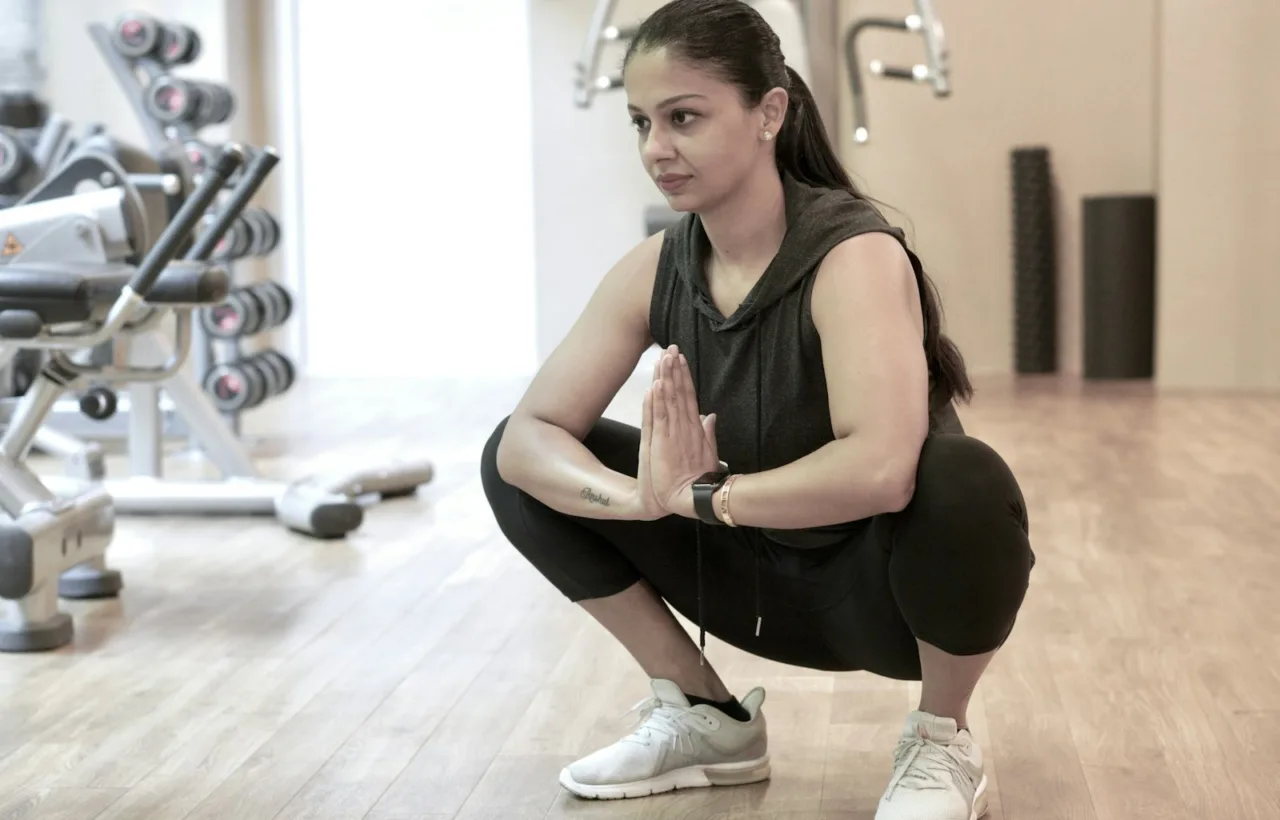

A leg day workout at home can build strong, functional legs using bodyweight exercises that target your quads, hamstrings, glutes, and calves. No gym membership or equipment required—just your body, a small space, and consistency.
Home leg training works because your legs already move your full bodyweight daily. By controlling tempo, adding volume, and using movement patterns that challenge balance and range of motion, you create enough stimulus for strength and muscle adaptation. This guide walks through exercise selection, workout structure, and progression methods that work in a living room.
Why Home Leg Training Is Harder Than Upper Body
Your legs are built to carry you. They adapt to your bodyweight quickly, which means bodyweight squats that felt hard in week one may feel easy by week four. Upper body exercises like push-ups remain challenging longer because most people rarely move their full bodyweight overhead or horizontally.
This adaptation speed means home leg workouts require deliberate progression. You'll need to manipulate variables like tempo, range of motion, stability, and volume to keep making progress. The WHO's 2020 physical activity guidelines recommend muscle-strengthening activities on two or more days per week for all major muscle groups, including legs, and these can be achieved through bodyweight resistance training at home.
Essential Home Leg Exercises
Each exercise below targets different parts of your legs. Choose 4–6 per workout based on your current ability and the equipment you have (even if that's none).
Squats (Quads, Glutes, Core)
Stand with feet shoulder-width apart, toes slightly out. Push your hips back, bend your knees, and lower until your thighs are parallel to the floor or as low as your mobility allows. Drive through your whole foot to stand. Keep your chest up and core tight throughout.
Progression: slow the descent to 3–4 seconds, pause at the bottom for 2 seconds, or elevate your heels on a book to increase quad emphasis.
Bulgarian Split Squats (Quads, Glutes, Balance)
Place the top of one foot on a chair or couch behind you. Step the front foot forward enough that when you lower down, your front knee stays over your ankle. Lower until your back knee nearly touches the floor, then drive through your front heel to stand.
This exercise is significantly harder than regular squats because one leg handles most of the load. It also challenges your balance, which increases core and stabilizer activation.
Progression: hold a backpack filled with books, water bottles, or cans for added resistance.
Reverse Lunges (Quads, Glutes, Hip Stability)
Step one foot back, landing on the ball of that foot. Lower your back knee toward the floor while keeping your front shin vertical. Push through your front foot to return to standing. Alternate legs or complete all reps on one side first.
Reverse lunges are easier on the knees than forward lunges because you're stepping into a controlled position rather than catching your weight.
Single-Leg Romanian Deadlifts (Hamstrings, Glutes, Balance)
Stand on one leg with a slight bend in the knee. Hinge at your hip, sending your free leg straight behind you as your torso lowers toward parallel with the floor. Keep your back flat. You should feel a stretch in the hamstring of your standing leg. Return to standing by driving your hip forward.
This is the primary hamstring-focused exercise you can do at home without equipment. Balance is challenging at first; touch a wall with one finger if needed, reducing contact as you improve.
Glute Bridges (Glutes, Hamstrings, Lower Back)
Lie on your back with knees bent and feet flat on the floor, heels close to your glutes. Push through your heels and squeeze your glutes to lift your hips until your body forms a straight line from shoulders to knees. Lower with control.
Progression: lift one foot off the floor for single-leg bridges, or place your feet on an elevated surface to increase range of motion.
Calf Raises (Calves)
Stand with the balls of your feet on the edge of a step, heels hanging off. Rise up onto your toes as high as possible, pause, then lower your heels below the level of the step. Use a wall for balance.
Progression: single-leg calf raises or holding a backpack for resistance.
Wall Sits (Quad Endurance, Mental Toughness)
Lean your back against a wall and slide down until your thighs are parallel to the floor, knees at 90 degrees. Hold this position. This isometric exercise builds endurance and teaches you to tolerate discomfort under tension.
Sample Home Leg Workout Plans
Choose a plan based on your current fitness level. Each workout should be done 2–3 times per week with at least one rest day between sessions.
Beginner Plan (20–25 minutes)
| Exercise | Sets | Reps | Rest |
|---|---|---|---|
| Bodyweight Squats | 3 | 12–15 | 60s |
| Glute Bridges | 3 | 15 | 60s |
| Reverse Lunges | 3 | 10 per leg | 60s |
| Wall Sit | 3 | 20–30s | 60s |
| Calf Raises | 3 | 15–20 | 45s |
Complete all sets of one exercise before moving to the next. Focus on learning the movement patterns and reaching full range of motion.
Intermediate Plan (30–35 minutes)
| Exercise | Sets | Reps/Time | Rest |
|---|---|---|---|
| Bulgarian Split Squats | 4 | 10–12 per leg | 75s |
| Single-Leg Romanian Deadlifts | 3 | 8–10 per leg | 60s |
| Tempo Squats (3s down) | 4 | 10–12 | 90s |
| Single-Leg Glute Bridges | 3 | 12 per leg | 60s |
| Single-Leg Calf Raises | 3 | 12–15 per leg | 45s |
At this level, tempo manipulation and single-leg variations provide the challenge. If exercises feel too easy, add a weighted backpack or slow the eccentric (lowering) phase further.
Advanced Plan (35–40 minutes)
| Exercise | Sets | Reps/Time | Rest |
|---|---|---|---|
| Pistol Squats (or progressions) | 4 | 5–8 per leg | 90s |
| Bulgarian Split Squats (weighted) | 4 | 8–10 per leg | 75s |
| Single-Leg RDLs (weighted) | 4 | 8–10 per leg | 75s |
| Jump Squats | 3 | 10–12 | 90s |
| Walking Lunges | 3 | 15 per leg | 60s |
| Single-Leg Calf Raises (weighted) | 3 | 10–12 per leg | 60s |
Advanced home training often includes plyometric variations like jump squats to add intensity. Land softly with bent knees and take adequate rest between sets.
Progression Methods When You Can't Add Weight
Bodyweight training requires creative progression because you can't simply add 5 pounds to the bar.
Increase time under tension: slow down the eccentric (lowering) phase to 3–5 seconds. A 5-second eccentric squat is substantially harder than a normal-tempo squat.
Add pauses: hold the bottom position of squats or lunges for 2–3 seconds. This removes the stretch reflex and forces your muscles to work harder.
Reduce stability: single-leg exercises are always harder than bilateral movements. Progress from squats to Bulgarian split squats to pistol squat progressions.
Add plyometrics: jump squats, split squat jumps, and box jumps (if you have a sturdy surface) increase power and intensity. These are high-impact, so build a base of strength first and limit plyometric work to 1–2 times per week.
Increase volume: more sets or reps per session, or an additional leg session per week. Research on resistance training volume suggests muscle growth tracks total weekly sets, so adding a third leg session can be a way to add volume when individual sessions are already as hard as you can make them. (source: Schoenfeld BJ et al., 2017, J Sports Sci)
Shorten rest periods: reducing rest from 90 seconds to 60 seconds or 45 seconds increases metabolic stress and cardiovascular demand.
Common Mistakes That Limit Results
Skipping the eccentric phase: lowering quickly wastes half the exercise. The eccentric phase creates more muscle damage and adaptation than the lifting phase. Control the descent on every rep.
Not reaching full range of motion: partial squats build partial strength. Unless an injury limits you, aim for thighs parallel to the floor or lower on squats, and back knee nearly touching the floor on lunges.
Ignoring single-leg work: bilateral exercises like squats mask strength imbalances. Your stronger leg compensates for your weaker one. Single-leg exercises expose and fix these imbalances, which improves overall strength and reduces injury risk.
Training legs once per week: legs can recover in 48–72 hours for most people. Two to three sessions per week allows more total volume and faster progress. Space sessions at least 48 hours apart.
Stopping when it burns: the burn is muscular fatigue, not damage. It's safe to work through the discomfort as long as your form stays intact. If you stop every set at the first burn, you're leaving adaptation on the table.
Neglecting hamstrings: home workouts often quad-dominant because squats and lunges are easier to load than hamstring exercises. Prioritize single-leg RDLs and glute bridges to balance the posterior chain.
How to Structure Your Week
Choose one of these patterns based on your recovery ability and schedule.
Option 1: Two leg days per week Monday: Full leg workout Thursday or Friday: Full leg workout
This is the minimum effective frequency for consistent progress. Leave at least 48 hours between sessions.
Option 2: Three leg days per week Monday: Quad-dominant (squats, Bulgarian split squats, lunges) Wednesday: Posterior-dominant (RDLs, glute bridges, single-leg RDLs) Friday: Full leg workout (mix of both)
This split allows higher weekly volume without excessive fatigue in a single session. It works well for intermediate and advanced trainees.
Option 3: Full-body with leg emphasis Three days per week: include 3–4 leg exercises alongside upper body and core work.
If you're training your whole body at home, this prevents leg training from being neglected. Many people under-train legs in full-body routines; dedicating half your exercise selection to lower body ensures balance.
Equipment Worth Adding (Optional)
Home leg training is effective with zero equipment, but these items expand options without requiring significant space or cost.
Resistance bands: loop a band around your thighs during squats or glute bridges to increase glute activation. Costs $10–20 for a set.
Backpack with weight: fill a backpack with books, water bottles, or bags of rice. Wear it during squats, lunges, and split squats. Free if you already own a backpack.
Sliders or towels on hard floors: place your back foot on a slider during Bulgarian split squats or use both feet on sliders for hamstring curls from a glute bridge position. Challenges stability and adds variety.
Sturdy chair or box: used for Bulgarian split squats, step-ups, elevated glute bridges, and single-leg box squats. Most people already own this.
None of these are required. A complete home leg program can be built with nothing but floor space.
What the Research Says About Training Legs Without Weights
Backed by research
Squat depth, loads and frequency
- A 2013 review of knee and spine loading concluded that deep squats, learned with good technique and progressed gradually, do not increase injury risk to passive tissues.Source: Hartmann H et al. (2013). Analysis of the load on the knee joint and vertebral column with changes in squatting depth and weight load. Sports Med
- A 2017 meta-analysis found that muscle growth was similar with light and heavy loads, while maximal strength benefited most from heavy loads. Hard bodyweight and single-leg sets taken close to your limit can keep your legs growing.Source: Schoenfeld BJ et al. (2017). Strength and hypertrophy adaptations between low- vs. high-load resistance training. J Strength Cond Res
- A 2016 meta-analysis found that training a muscle group twice a week led to more growth than once a week.Source: Schoenfeld BJ et al. (2016). Effects of resistance training frequency on measures of muscle hypertrophy. Sports Med
- The NHS recommends strengthening activities that work all major muscle groups, including the legs and hips, on at least 2 days a week.Source: NHS: Physical activity guidelines for adults aged 19 to 64
When to Expect Results
Strength improvements appear first, usually within 2–3 weeks, as your nervous system learns to recruit muscle fibers more efficiently. You'll complete more reps, hold positions longer, or progress to harder variations.
Visible muscle changes take longer, generally 6–8 weeks of consistent training with adequate protein intake. The WHO notes that muscle-strengthening activities should be performed on two or more days per week for health benefits, and studies on hypertrophy typically measure changes over 8–12 week periods.
Early soreness decreases after the first few sessions as your legs adapt to the stimulus. If you're sore for more than 3–4 days, you likely overdid volume or intensity; scale back and progress more gradually.
Individual response varies based on training history, genetics, age, sleep, and nutrition. Consistency matters more than any single workout.
What People Ask About Leg Day at Home
Can I build muscle without weights? Yes, especially if you're new to training or returning after time off. Progressive overload can be achieved through volume, tempo, and exercise difficulty, not just external load. Growth will eventually plateau without added resistance, but most people can make significant progress for 6–12 months using only bodyweight.
How do I train legs at home if I have knee pain? Start with exercises in a pain-free range of motion. Wall sits, glute bridges, and single-leg RDLs are typically knee-friendly. Avoid deep squats and lunges if they hurt. If pain persists or worsens, consult a physical therapist or doctor before continuing.
Should I train legs if I run or cycle regularly? Yes. Running and cycling build endurance but don't provide the same strength stimulus as resistance training. Adding strength work improves running economy, power output, and injury resilience. Keep leg sessions on the same day as hard runs to maximize recovery days.
How many reps should I do if I can do more than 20? Once you can complete 20+ reps easily, the set is building endurance more than strength or muscle. Progress to a harder variation, add weight, or use tempo manipulation rather than continuing to add reps indefinitely.
Do I need to train calves separately? Calves are worked during squats, lunges, and jumping, but direct calf work ensures full development. If calf size or strength is a priority, add 2–3 sets of calf raises at the end of your workout.
Can I train legs every day? Not recommended. Muscles grow during recovery, not during training. Daily leg work will lead to fatigue accumulation and plateau or regression. Two to three sessions per week with rest days in between allows for recovery and adaptation.
Safety Note for Home Leg Training
This guide is for generally healthy adults starting or continuing resistance training at home. If you have existing knee, hip, or back issues, cardiovascular conditions, or are new to exercise after a long break or injury, consult your doctor or a physical therapist before beginning a new training program. Some exercises, particularly single-leg movements and plyometrics, challenge balance and coordination—use a wall or stable surface for support until you're confident in the movement.
How This Guide Was Put Together
This guide is based on the WHO's 2020 physical activity guidelines for muscle-strengthening activities and principles of progressive overload documented in resistance training research. Exercise selection reflects movements that can be performed safely and effectively in a home environment without equipment.


