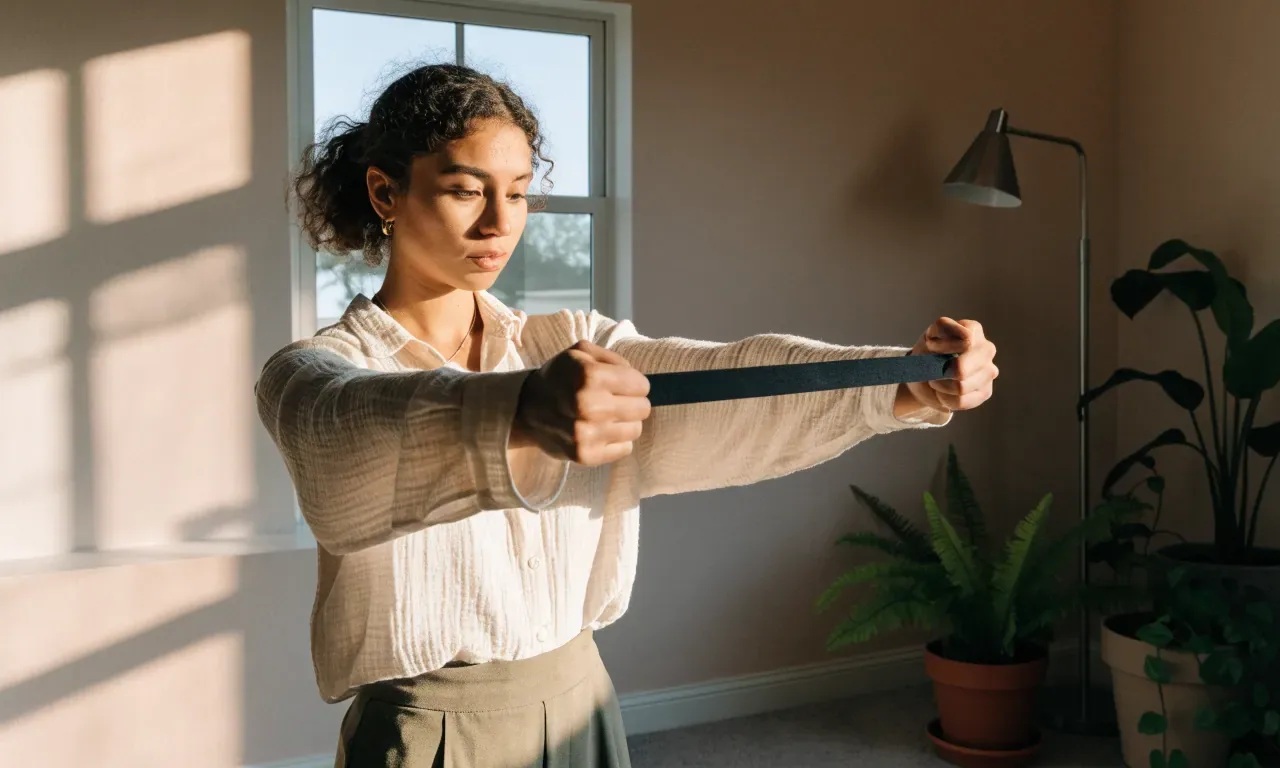

A toned body workout at home works by building muscle with resistance exercises, not by doing endless cardio or crunches. You can train every major muscle group with bodyweight moves, done two to three times a week, and progress them as you get stronger.
“Toned” is not a separate type of muscle. It usually means stronger, slightly more developed muscle that is easier to see. This plan gives you two clear sessions, exact reps, simple progressions when an exercise gets easy, and a weekly layout you can repeat.
What “Toned” Actually Means
Toning is the result of building muscle and, for some people, gradually reducing overall body fat. There is no special toning rep range, and light exercise done far from your limit will not challenge muscle enough to change much.
Muscle becomes firmer and stronger when you regularly ask it to work harder than usual. The NHS describes strength exercise in exactly those terms: an activity that makes your muscles work harder than normal, using body weight or resistance, according to the NHS guide to strength and flexibility.
You also cannot choose where fat comes off. Sit-ups can strengthen your abdomen, but they do not remove fat from your abdomen on their own. Train the whole body, eat in a way you can maintain, and judge progress by strength, measurements, photos, and how clothes fit, not the scale alone.
How Much Training Is Enough to Start?
Adults should do muscle-strengthening work for all major muscle groups on at least two days a week, alongside regular aerobic activity. That is the shared position of the major public health guidelines.
According to the World Health Organization physical activity recommendations, adults should aim for 150 to 300 minutes of moderate-intensity aerobic activity per week, or 75 to 150 minutes of vigorous activity, plus muscle-strengthening on two or more days. Moderate means you can talk but not sing comfortably. Brisk walking counts for most people.
You do not need to hit that full aerobic target in week one. Start with the two strength sessions below and a daily walk you can manage, then add minutes as your routine settles. Some activity is better than none, and the CDC notes that muscle-strengthening activity can help increase or maintain muscle mass and strength.
What You Need, and How Hard It Should Feel
You need floor space, a sturdy chair or step, a wall, and a towel. A filled backpack is optional later, once your form is solid. Wear shoes with grip or train barefoot on a non-slip surface.
Work at an effort where the last two or three reps feel hard but your form stays clean. That usually means you could do about two or three more reps if you had to. If you can finish a set easily and chat normally, the version is too easy. If your knees cave in, your back rounds, or you hold your breath throughout, it is too hard for now.
Rest 60 to 90 seconds between sets. Rest longer if you need it to repeat good form. Breathing out on the effort, for example as you stand up from a squat or push up from the floor, helps most beginners stay steady.
Safety note: stop and get checked promptly if you feel chest pain, severe breathlessness, dizziness, or sharp joint pain during a session. If you are pregnant, recovering from injury or surgery, or you have a heart, joint, blood pressure, or other long-term condition, get personal advice from a clinician or physiotherapist before starting. Mild muscle effort is expected; sharp, sudden, or worsening pain is not.
The Toned Body Workout at Home: Two Full-Body Sessions
Alternate Session A and Session B. Do A on Monday, B on Wednesday, and A again on Friday, then start the next week with B. Each session takes about 30 to 40 minutes including the warm-up.
Warm up for five minutes before either session. Walk on the spot for one minute, then do easy arm circles, hip circles, bodyweight good mornings, half-depth squats, and wall push-ups for about 30 seconds each. The goal is to feel warm and loose, not tired.
Session A: Squat, Push, Hinge, and Core
| Exercise | Sets and reps | How to do it |
|---|---|---|
| Bodyweight squat | 3 x 8-15 | Feet about shoulder width. Sit your hips back and down, knees tracking over your toes, chest up. Stand by pushing the floor away. Use a chair behind you as a depth guide if needed. |
| Push-up | 3 x 5-12 | Use the floor, a wall, or a sturdy counter, choosing the version you can control. Keep your body in one line, lower for two seconds, then push up. |
| Glute bridge | 3 x 10-15 | Lie on your back, feet flat. Push through your heels, lift your hips until your shoulders, hips, and knees line up, pause for one second, then lower slowly. |
| Calf raise | 3 x 12-20 | Stand holding a wall for balance. Rise onto the balls of your feet, pause, then lower slowly. Work through a full range you can control. |
| Bird dog | 3 x 6 each side | On hands and knees, slide one leg back and reach the opposite arm forward without rocking your hips. Return, then switch sides. |
Choose the push-up version honestly. A clean set of counter push-ups builds more strength than three sloppy floor push-ups with your hips sagging. Move to a harder surface only when you reach the top of the rep range with good form.
Session B: Single-Leg, Shoulders, Back, and Core
| Exercise | Sets and reps | How to do it |
|---|---|---|
| Reverse lunge | 3 x 6-10 each leg | Step back, lower until both knees are bent comfortably, then push through the front foot to stand. Hold a wall for balance at first. |
| Pike push-up | 3 x 5-10 | From a push-up position, walk your feet in and lift your hips so your body forms an upside-down V. Bend your elbows to lower the top of your head toward the floor, then push back up. Use wall push-ups instead if this is too hard. |
| Bodyweight hip hinge | 3 x 10-15 | Stand tall, soften your knees, and push your hips back with a flat back until you feel your hamstrings work. Stand by squeezing your glutes. Touch a wall behind you with your hips to learn the pattern. |
| Prone W raise | 3 x 8-12 | Lie face down, arms in a W shape beside you. Lift your chest slightly and pull your elbows down toward your ribs, squeezing your shoulder blades together. Lower slowly. Keep it small and pain-free. |
| Dead bug | 3 x 6-8 each side | Lie on your back, arms up, knees bent over your hips. Lower one arm and the opposite leg while keeping your lower back lightly pressed toward the floor. Return and switch sides. |
The prone W matters because pulling is the movement most home routines miss. Without a row or pull-up bar, people train chest and arms from push-ups but neglect the upper back. That imbalance can make posture work and shoulder control harder over time, so do not skip it just because it looks simple.
A Simple Week That Fits Real Life
A three-day strength layout with walking on the other days covers the guidelines without training the same tired muscles on back-to-back days.
| Day | Plan |
|---|---|
| Monday | Session A (30-40 minutes) |
| Tuesday | Walk 20-40 minutes at a pace you can sustain |
| Wednesday | Session B (30-40 minutes) |
| Thursday | Walk or rest |
| Friday | Session A (30-40 minutes) |
| Saturday | Walk, cycle, swim, or another activity you enjoy |
| Sunday | Rest |
The following week, start with Session B on Monday so both sessions get equal turns. If you can only manage two strength days at first, do A once and B once that week. Two done sessions beat a perfect plan you abandon by Thursday.
Add walking time gradually if you want more aerobic activity. For example, add five minutes to two walks per week until your total feels challenging but recoverable. Keep at least one full rest day.
How to Make Bodyweight Exercises Harder Without Weights
Progress by changing the exercise before you add endless reps. When a move gets easy, make it slower, harder, or less supported, in that order.
Use this order for most exercises:
- Add reps until you reach the top of the range for all sets.
- Slow the lowering phase to three seconds.
- Add a one-second pause at the hardest point.
- Move to a harder version from the table below.
- Only then add a loaded backpack, and only for squats, lunges, bridges, and calf raises where you can hold it safely.
| If this is easy | Try this next | Choose it if |
|---|---|---|
| Wall or counter push-up | Floor push-up, then feet elevated on a step | You can keep a straight body line for every rep |
| Chair squat | Full squat, then split squat | You can sit down and stand without pulling on your knees |
| Double-leg glute bridge | Single-leg glute bridge | Your hips stay level and do not twist |
| Reverse lunge holding a wall | Reverse lunge without support, then with a pause at the bottom | Your front knee stays steady and balance is no longer the limit |
| Bird dog | Dead bug with a slower reach, then longer holds | You can move without your lower back arching away from the floor |
Track your sessions in a notebook or phone note: exercise version, sets, reps, and effort. If you did squats for 3 sets of 12 last time and felt you had three reps left, aim for 13 or 14 next time. Small, recorded increases are how home training keeps working after the first few weeks.
For the first four weeks, keep it simple. Week 1: do only two sets of each exercise to learn the movements. Weeks 2 and 3: do three sets and aim to add reps. Week 4: keep three sets but try one harder version on one exercise per session, if your form allows it.
Eating, Sleep, and the Part Cardio Plays
Food and sleep do not replace training, but they decide how well you recover from it. Eat regular meals with a source of protein at each one, such as eggs, fish, meat, dairy, beans, lentils, or tofu, because protein is the nutrient your body uses to repair and build tissue. You do not need a special “toning” diet or supplement to start.
If seeing more muscle definition is also a goal, total food intake over weeks matters more than any single meal. A modest, steady change you can keep is better than a strict plan you quit. Avoid judging a week of training by daily weight changes, which move up and down with water, salt, and timing of meals.
Cardio helps heart fitness and adds to your weekly activity total, but it does not replace strength work for firmness. Walking is the easiest option at home because it needs no recovery planning and you can spread it across the day. Sleep matters for the same practical reason: tired people move less, train with worse form, and find hard sets harder to complete.
Mistakes That Keep People Stuck
Avoid the errors that make a reasonable plan look ineffective:
- Only doing cardio. Running and walking improve fitness, but by themselves they provide little resistance for arms, back, glutes, and core.
- Changing the workout every session. New exercises feel harder because they are unfamiliar, not because they are better. Repeat A and B for at least four weeks so you can measure progress.
- Stopping far too soon. A set that never gets challenging gives muscle little reason to adapt. Use the effort rule above.
- Rushing reps. Fast, bouncy squats and push-ups shift work away from the target muscle and make form harder to judge. Slow down the lowering phase.
- Training through soreness every day. A muscle group needs time between hard sessions. Alternate days, and use walking on the days between.
- Judging only by the mirror in week two. Strength, balance, and stamina usually improve before appearance changes in an obvious way. Keep your log.
Mild soreness one or two days after a new session is common, especially after lunges and hip hinges. It should ease as you repeat the routine. Reduce the range, reps, or difficulty if soreness changes how you walk or stops you training the next planned session.
Toned Body Questions, Answered Straight
How long before I look more toned?
There is no honest fixed timeline, because starting strength, body composition, consistency, food, sleep, and genetics all affect what you see. Many beginners notice they can do more reps within a few weeks, while visible change tends to be slower. Use your training log and monthly photos in the same light as your measures, rather than expecting a weekly change in the mirror.
Will this workout make me bulky?
It is unlikely to make you bulky by accident. Building large amounts of muscle takes a long period of progressively harder training and eating to support that growth. This plan is designed for moderate strength and muscle development using body weight, which most beginners find produces a firmer look rather than a large one.
Can I do this toned body workout at home every day?
Do not do both full sessions on consecutive days when you are training hard. Your muscles need recovery time between sessions that work the same groups. You can walk, stretch gently, or do light mobility work on the off days, and that pattern is easier to keep than daily hard training.
Do I need to feel sore for it to work?
No. Soreness is more a sign of novelty or a big jump in work than proof a session was effective. Better signs are adding reps, using a harder version, keeping better form at the same effort, or completing the same workout with less rest while keeping form clean.
What if I cannot do a floor push-up yet?
Start with wall push-ups, then move to a kitchen counter or sturdy table. Lower the surface gradually as you get stronger, rather than dropping to your knees and using a short range you cannot control. The right version is the hardest one you can do for at least five clean reps.
Can I swap an exercise because of a bad knee or shoulder?
Yes, and you should swap any move that causes joint pain. For knees, try a shallower chair squat or a glute bridge in place of lunges. For shoulders, use wall push-ups and skip pike push-ups until you have advice specific to your shoulder. A modified session you can repeat safely is better than copying a list that hurts.
Related Home Workouts
How This Guide Was Put Together
This guide was put together from public activity and strength guidelines published by the WHO, NHS, and CDC, linked above, combined with standard bodyweight progressions that require no specialist equipment. It does not claim personal testing, expert review, or individual medical assessment.
Sources
- World Health Organization. Physical activity.
- NHS. How to improve your strength and flexibility.
- Centers for Disease Control and Prevention. Benefits of physical activity.


