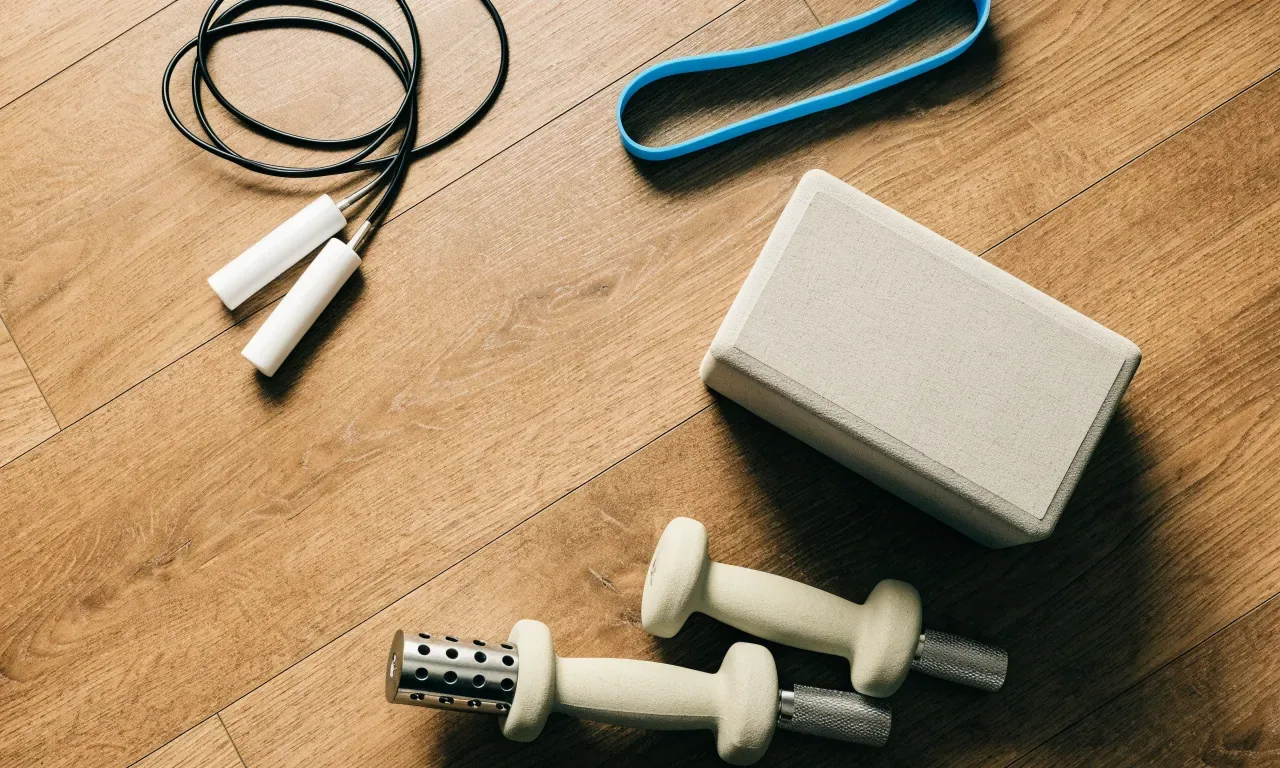

You do not need to do all 16 workout ideas at home in one session. Pick 4 to 6 that match your goal, time, and equipment, and rotate them across the week. That rotation is how you cover strength, cardio, and mobility without long workouts or a gym, and it gives each muscle group time to recover before you train it again.
After reading, you will be able to choose ideas by goal and impact, build a 20 to 40 minute session, and progress each move by adding reps, sets, or a harder version only when your form stays clean.
How to Use These 16 Workout Ideas at Home Without Doing Too Much
Use 2 to 4 ideas per category across a week, not all 16 every day. A good week has 2 to 3 strength days, some moderate cardio on other days, and short mobility work you can repeat often.
That structure fits the guidance for most healthy adults. According to the WHO physical activity fact sheet, adults aged 18 to 64 should do 150 to 300 minutes of moderate-intensity aerobic activity or 75 to 150 minutes of vigorous-intensity activity per week, plus muscle-strengthening activities involving all major muscle groups on 2 or more days a week.
For strength work, the CDC guide to what counts as muscle-strengthening activity says to work to the point where another repetition would be hard without help, try 8 to 12 repetitions per set, do at least 1 set, and do 2 to 3 sets for more benefit. It lists legs, hips, back, chest, abdomen, shoulders, and arms as the major groups to cover.
Start easier than you think you need to. If you have not exercised for some time, have a medical condition or concerns, are pregnant or recently postpartum, or get chest pain, severe breathlessness, dizziness, or sharp joint pain, stop and get medical advice first. The NHS physical activity guidelines for adults aged 19 to 64 advise speaking to a GP first in that situation and making sure the intensity is appropriate for your fitness. This article is general information, not personal medical advice.
Strength Ideas That Need No Gym
Strength ideas are the core of a home plan because they are the hardest part to replace with walking alone. Do them slowly, rest 60 to 90 seconds between sets, and stop a set when your form changes.
1. Sit-to-Stand
Sit-to-stand trains the legs and the pattern you use every time you get up from a chair. Use a solid, stable chair without wheels, as the NHS strength exercises recommend for chair-based work.
Sit near the edge, feet hip-width apart, lean slightly forward, and stand using your legs rather than pushing hard with your arms. Sit back down slowly. The NHS suggests aiming for 5 repetitions at first and building up slowly. Make it harder by crossing your arms or lowering the chair height only if it is stable. Make it easier by using your hands for guidance.
2. Mini-Squat to Full Bodyweight Squat
A squat trains the thighs, hips, and glutes in one move. Start with the NHS mini-squat if you are new: hold the back of a chair, bend your knees only as far as is comfortable, keep them facing forward, and stand while squeezing your glutes.
When that feels steady for 8 to 12 reps, progress to a full bodyweight squat without holding on. Do 2 to 3 sets of 8 to 12 reps. Choose the shallow version if your knees or balance limit you, and choose the full version if you can keep your heels down and your back neutral.
3. Wall, Counter, or Floor Push-Up
A push-up trains the chest, shoulders, and arms, and the wall version makes it accessible on day one. Place your hands on a wall, step back, and bend your elbows to bring your chest toward the wall, then press away.
Do 2 to 3 sets of 8 to 15 reps. Use a counter for more load, kneeling push-ups for more load again, and floor push-ups only when you can keep a straight line from head to heels. Mayo Clinic notes that for strength training, a resistance that tires the muscles after about 12 to 15 repetitions is a useful target for most healthy adults, so pick the version where the last 2 reps feel hard but controlled.
4. Glute Bridge
A glute bridge trains the glutes and hamstrings without loading your knees. Lie on your back, knees bent, feet flat, and lift your hips until your body forms a line from knees to shoulders.
Pause for 1 to 2 seconds at the top, then lower slowly. Do 2 to 3 sets of 10 to 15 reps. Make it harder with a single-leg bridge for a few reps per side, or easier by reducing the range and keeping both feet down.
5. Supported Reverse Lunge or Split Squat
A reverse lunge trains one leg at a time, which helps you notice and work on side-to-side differences. Hold a chair or wall for balance, step one leg back, lower under control, and return to standing.
Do 2 sets of 6 to 10 reps per side. Choose a short step and shallow depth if balance is the limit. Choose a split squat, where your feet stay in place, if stepping makes you wobble. Stop if you get sharp knee pain, and keep the front knee tracking in line with your toes.
6. Resistance Band Row or Backpack Row
Pulling is the movement most home plans miss, because bodyweight pushing is easier to set up. A row trains the back and arms and balances push-ups.
With a band anchored at chest height on a closed, secure door, sit or stand tall and pull your elbows back. Without a band, hinge forward with a flat back, hold a backpack with books in both hands close to the floor, and row it toward your ribs.
Do 2 to 3 sets of 8 to 12 reps. Choose the band if you want a joint-friendly option you can adjust quickly, and choose the backpack if you have no band but can hinge without rounding your back.
Cardio Ideas That Fit in a Living Room
Cardio ideas raise your heart rate and breathing. Moderate intensity means you can talk in short sentences but not sing, and you should build time gradually rather than starting with intervals.
7. March in Place and Low-Impact Circuit
Marching in place is a low-impact way to start cardio without jumping. March for 1 minute, rest for 30 seconds, and repeat, adding sit-to-stands or wall push-ups between rounds if you want a circuit.
Start with 10 minutes total and add 2 to 3 minutes per week as tolerated. This suits beginners, people returning after a break, and anyone who needs to avoid impact on sore joints.
8. Step-Up on a Sturdy Step
A step-up trains the legs and raises your heart rate at the same time. Use a low, sturdy step, place your whole foot on it, and stand up using that leg rather than pushing hard off the floor.
Alternate legs for 1 to 2 minutes, rest, and repeat for 3 to 5 rounds. Hold a wall or rail for balance. Choose a lower step if your knee feels unstable, and do not use a chair that can tip or slide.
9. Stair or Walk Intervals
Intervals are short harder efforts mixed with easy recovery, and walking is the simplest version at home. Walk briskly around your home, garden, or up and down a safe flight of stairs for 1 minute, then walk slowly for 2 minutes.
Repeat for 15 to 25 minutes. This counts toward vigorous work only if your breathing is hard and you can say only a few words at a time. Skip stair intervals if stairs aggravate your knees or you feel unsteady.
10. Shadow Boxing or Dance-Based Cardio
Shadow boxing and dancing raise your heart rate without equipment and without impact if you keep your feet low. Move for 2 to 3 minutes, rest for 1 minute, and repeat.
Use this when you want variety and will actually repeat it. Keep punches at shoulder height or lower if your shoulders tire quickly, and clear the floor first so you do not trip while moving sideways.
Core, Balance, and Posture Ideas
Core training at home should train stability, not just crunches. That means keeping your trunk still while your arms or legs move.
11. Dead Bug
A dead bug trains the deep abdominal muscles while teaching you to keep your lower back steady. Lie on your back, arms up, knees bent at 90 degrees, and slowly extend one arm and the opposite leg without letting your back arch.
Return and switch sides. Do 2 sets of 6 to 8 reps per side, exhaling as you extend. Make it easier by moving only the legs, keeping your arms still.
12. Bird Dog
A bird dog trains the core and back from a hands-and-knees position. Extend one arm and the opposite leg, pause without shifting your hips, then return.
Do 2 sets of 6 to 10 reps per side. This is a good choice if floor planks hurt your wrists or shoulders, because the load is lower and you can stop between reps.
13. Side Plank From the Knees or Feet
A side plank trains the side of the trunk and the hips. Lie on your side, prop up on your forearm, and lift your hips with your knees bent for the easier version or legs straight for the harder version.
Hold for 15 to 30 seconds per side, for 2 to 3 rounds, breathing normally. Stop if you feel shoulder pain rather than effort in your side. Build time before you build difficulty.
14. Calf Raises and Single-Leg Balance
Calf raises train the lower legs, and balance work trains control you use on stairs and uneven ground. Hold a chair, lift both heels slowly, pause, and lower, following the slow, controlled approach in the NHS strength exercises.
Do 2 sets of 10 to 15 calf raises. Then, still holding the chair, practise standing on one leg for 10 to 20 seconds per side. Reduce hand support only when you can stay steady without leaning.
Mobility and Full-Session Ideas
Mobility work does not replace strength or cardio, but it can make both feel better. Use it on rest days or as a warm-up.
15. 8-Minute Mobility Flow
A mobility flow is a short sequence for hips, ankles, and upper back. Move through ankle rocks, hip openers in a supported lunge, thoracic rotations on all fours, and shoulder wall slides, spending about 1 minute on each and repeating the circuit twice.
Move only through a pain-free range. This is a warm-up, not a stretch contest, so do not force end positions, especially first thing in the morning or after sitting for a long time.
16. Household-Weight Full-Body Session
A household-weight session turns several ideas above into one workout using a backpack or filled water bottles. The NHS notes that filled water bottles can be used for arm work in its home strength guidance, and the same principle applies to a goblet squat if the bottle is secure and not too heavy.
Do this circuit 2 to 3 times: goblet squat for 8 to 12 reps, backpack row for 8 to 12 reps, glute bridge for 12 to 15 reps, and counter push-ups for 8 to 15 reps, resting 60 seconds between moves. Choose this idea when you have 30 minutes and want one session that covers all major muscle groups. Choose separate upper and lower days if this leaves you too tired to keep good form.
Compare the Ideas and Build Your Week
Pick by goal first, then by equipment and impact. The best idea is the hardest one you can do with clean form and repeat next week.
| Idea | Main goal | Equipment | Impact | Typical dose |
|---|---|---|---|---|
| Sit-to-stand | Leg strength, function | Stable chair | Low | 2-3 sets of 5-12 |
| Squat | Legs and glutes | None or chair | Low | 2-3 sets of 8-12 |
| Push-up variation | Chest, shoulders, arms | Wall, counter, or floor | Low | 2-3 sets of 8-15 |
| Glute bridge | Glutes, hamstrings | Mat or floor | Low | 2-3 sets of 10-15 |
| Reverse lunge | Single-leg strength | Chair for balance | Low | 2 sets of 6-10 per side |
| Band or backpack row | Back and arms | Band or backpack | Low | 2-3 sets of 8-12 |
| March circuit | Beginner cardio | None | Low | 10-25 minutes |
| Step-up | Legs and cardio | Sturdy low step | Low to moderate | 3-5 rounds of 1-2 minutes |
| Walk or stair intervals | Cardio fitness | Stairs optional | Low to moderate | 15-25 minutes |
| Shadow boxing / dance | Cardio, variety | None | Low if no jumping | 15-20 minutes |
| Dead bug | Core stability | Mat or floor | Low | 2 sets of 6-8 per side |
| Bird dog | Core and back | Mat or floor | Low | 2 sets of 6-10 per side |
| Side plank | Side core and hips | Mat or floor | Low | 2-3 holds of 15-30 seconds |
| Calf raise + balance | Lower legs, balance | Chair | Low | 2 sets of 10-15 + holds |
| Mobility flow | Warm-up, stiffness | None | Low | 8 minutes |
| Household-weight session | Full-body strength | Backpack or bottles | Low | 2-3 circuits |
A simple weekly plan for a beginner could look like this:
| Day | Session | Ideas to use |
|---|---|---|
| Monday | Strength A | Sit-to-stand, push-up, glute bridge, dead bug |
| Tuesday | Easy cardio + mobility | March circuit, mobility flow |
| Wednesday | Rest or walk | Short walk if you feel fresh |
| Thursday | Strength B | Squat, row, reverse lunge, side plank |
| Friday | Cardio | Walk intervals or shadow boxing |
| Saturday | Optional full-body | Household-weight session or repeat Strength A |
| Sunday | Rest | Mobility flow only if it feels good |
Do not train the same muscle group hard on consecutive days. Mayo Clinic advises resting a muscle group before working it again, and the ACSM position stand on progression models in resistance training recommends 2 to 3 days per week for novice resistance training. When you can do 1 to 2 reps more than your target with good form, the ACSM stand suggests a small load increase of 2 to 10% where load can be adjusted, or moving to a harder bodyweight version.
Mistakes That Make Home Workouts Stop Working
Most home plans fail for repeatable reasons, not lack of effort. Fix the reason and the same ideas often start working again.
- Doing only cardio or only core. Walking helps, but it does not replace muscle-strengthening work for all major groups on 2 or more days, as the WHO recommends. Add push, pull, legs, and hinge work.
- Making every session an interval session. Hard sessions every day leave no recovery and form breaks down. Keep 1 to 2 harder cardio days and make the others moderate or easy.
- Progressing by adding reps forever. Once 15 controlled reps feel easy, make the move harder, slow the lowering phase, or add a set, rather than doing 30 sloppy reps.
- Using unstable furniture. A chair with wheels, a wobbly step, or a door anchor you have not checked is a safety problem, not a challenge. Use solid, stable support, as the NHS advises.
- Ignoring pain signals. Muscle effort and mild next-day soreness can be normal for beginners, but sharp pain, joint pain that alters your movement, chest pain, or dizziness are reasons to stop that exercise and seek advice if they persist.
If you miss a week, restart at about half your previous sets for the first session. That reduces soreness and lets you check form again before you build back up.
Home Workout Questions, Answered Straight
Do I need to do all 16 ideas every week?
No, you need coverage, not every idea. Cover legs, hips, chest, back, shoulders, arms, and abdomen across 2 to 3 strength days, add moderate cardio across the week, and use the other ideas to replace ones you dislike or cannot do safely.
How long should a home workout be?
A useful strength session is often 20 to 40 minutes, including a warm-up. Shorter sessions of 10 to 15 minutes can still help if they are focused and repeated, especially for marching circuits or mobility. Length matters less than completing the planned sets with good form.
Can I build strength with only bodyweight?
Yes, for most beginners, if the last reps are hard and you progress the difficulty over time. The CDC counts bodyweight exercises such as push-ups as muscle-strengthening activity when they are done to the point where another rep would be hard. When bodyweight becomes easy, use a harder version, slower tempo, or added household load.
What if I have sore knees?
Choose low-impact, pain-free options first, such as sit-to-stand to a higher chair, mini-squats, glute bridges, and calf raises. Reduce depth, slow down, and keep support nearby. If knee pain is sharp, persistent, or follows an injury, get it assessed rather than pushing through lunges, step-ups, or stair intervals.
How do I know I am progressing?
You are progressing if you can do more reps with the same form, use a harder version, complete an extra set, or finish the same session with less rest. Track sets, reps, and the version you used for 4 weeks before judging. Strength changes are gradual, and no timeline can be promised.
Related Home Workouts
- 7 Workout Room Ideas for Home Gyms That Actually Get Used
- 9 Home Gym Ideas for Workout Rooms That Actually Fit Your Life
- 7 Workout Room Ideas Home Basement Setups That Actually Get Used
How This Guide Was Put Together
This guide is based on the WHO 2020 physical activity recommendations as summarised in the WHO fact sheet, CDC muscle-strengthening guidance, NHS home strength and activity guidelines, Mayo Clinic strength training guidance, and the ACSM position stand on progression in resistance training, all linked above. No personal testing, expert interviews, or individual results were used.
Sources
- World Health Organization. Physical activity fact sheet.
- Centers for Disease Control and Prevention. What Counts as Physical Activity for Adults.
- NHS. Strength exercises and Physical activity guidelines for adults aged 19 to 64.
- Mayo Clinic. Strength training: Get stronger, leaner, healthier.
- American College of Sports Medicine. Progression models in resistance training for healthy adults, position stand, 2002.


