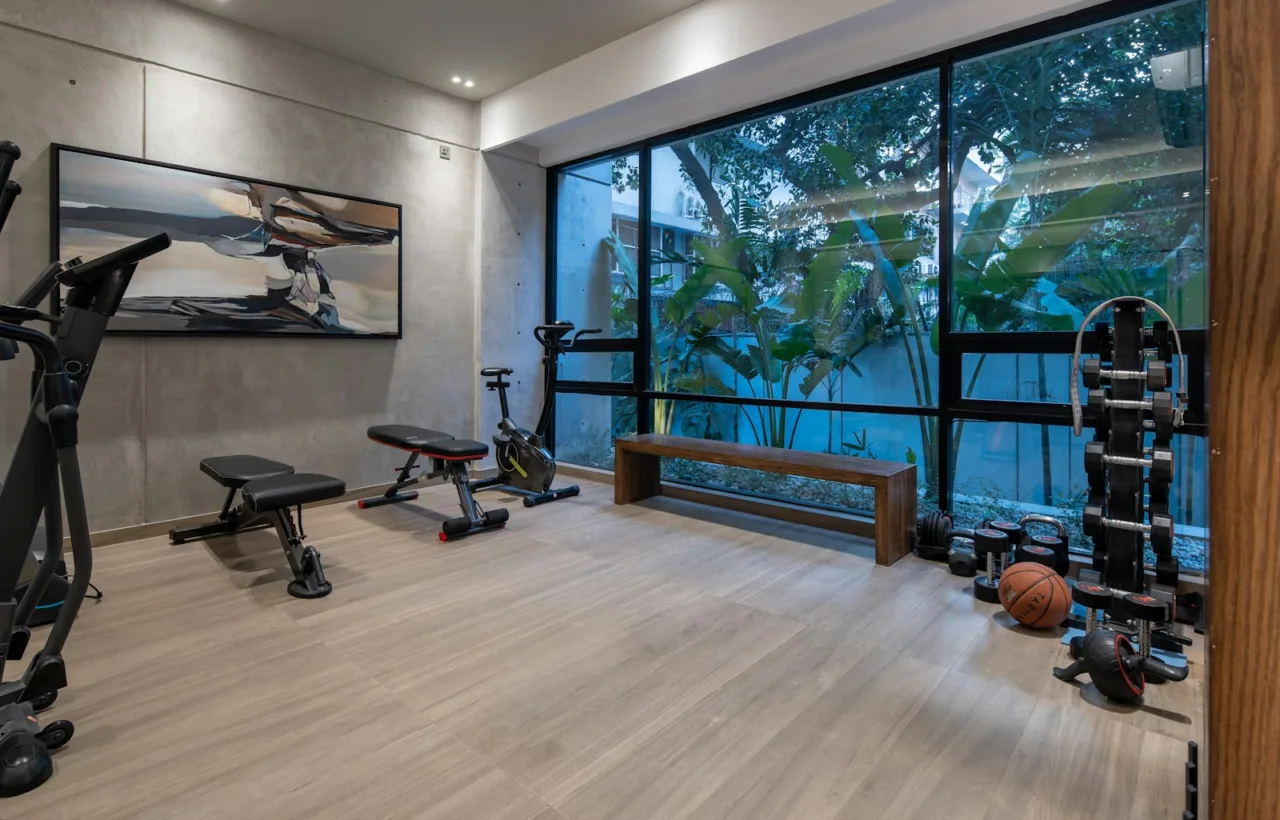

Want a home workout room you'll keep using after the novelty wears off? Start with the three things that matter most: enough clear floor space to move safely, a forgiving floor surface, and your equipment stored where you can reach it in seconds. Everything else—mirrors, paint, fancy racks—is optional decoration. This guide walks through seven workout room ideas for a home gym, with practical layouts, a build-order plan, and the mistakes that turn a spare room into a storage closet. You'll finish knowing which setup fits your space, your training, and your budget.
Start With the Space You Actually Have
Most people overestimate how much room a home gym needs. A safe training area gives you room to extend your arms and legs fully and to lie down without hitting furniture or walls. In practice, that means clearing a rectangle roughly the size of a yoga mat plus an arm's reach on each side—a corner of a bedroom can work for resistance bands and bodyweight training.
Walk your space and ask three questions before buying anything:
- Can I lie flat and stretch my arms overhead without touching a wall? If not, that corner is for storage, not training.
- Is the floor level and free of trip hazards? Rugs that slide, cables across walkways, and wobbly furniture are the first things to fix.
- Is there ventilation and decent light? A stuffy, dim room is a room you'll avoid. A window, a fan, or a lamp you can aim makes a real difference.
Garages, basements, spare bedrooms, and even a screened porch all work as home gyms. The constraint is rarely total square footage—it's the usable clear zone.
1. The Minimalist Corner: Bands, Mat, and a Wall
This is the highest-value setup for beginners, and it costs the least. A mat, a set of resistance bands, and a clear wall for anchoring bands cover a full-body program: squats, presses, rows, hinges, and core work.
Choose this if you're starting out, renting, or short on space. The trade-off is limited heavy loading—bands build strength but won't replicate a barbell for maximal lifts. Keep the kit in a basket or wall hooks so setup takes under a minute; friction is the main reason home routines fail.
2. The Floor-First Room: Protecting What's Underneath
Flooring is the most overlooked decision in a home gym. Concrete in a garage is unforgiving on joints and slippery when dusty; carpet in a bedroom traps sweat and shifts underfoot; hardwood scratches under dropped weights.
| Floor type | Good for | Watch out for |
|---|---|---|
| Interlocking rubber tiles | Weights, general training, garages | Cost; check thickness for dropped loads |
| Rolled rubber | Large areas, cardio machines | Heavy to move; seams can lift |
| Foam puzzle mats | Yoga, stretching, bodyweight | Compress under heavy weights |
| Horse-stall mats | Budget garage gyms | Strong rubber smell at first |
| Low-pile carpet + mat | Light training in living spaces | Slides; not for weights |
The general rule: match the surface to the load. Bodyweight and yoga need cushioning; free weights need dense rubber that won't compress or slide. If you train on a second floor, use mats that dampen sound and vibration for the people below.
3. The Wall-Mounted Gym: Vertical Storage That Saves Floor Space
When floor area is tight, go up. Wall-mounted racks, hooks, and fold-away benches let a small room hold serious equipment without permanent footprint. A folding squat rack or a wall-mounted pull-up bar turns a wall into a training station.
This approach suits renters who can't drill extensively only if the landlord agrees—otherwise choose freestanding versions. The key is anchoring: any wall-mounted load-bearing equipment must be fixed into studs or proper masonry anchors, following the manufacturer's instructions, because a pull-up bar that fails mid-rep is a safety hazard, not an inconvenience.
4. The Cardio Zone: Treadmill, Bike, or Rower
Cardio machines dominate floor space, so decide based on your actual habit, not aspiration. The machine you'll use is the one that fits your room and your motivation.
- Treadmill: best for walkers and runners who want to train indoors year-round; needs the most space and a dedicated outlet.
- Indoor bike: compact, quiet, low impact—good for apartments and shared rooms.
- Rower: full-body, stores upright, but has a learning curve.
- Jump rope and step: cheapest cardio with almost no footprint.
Before buying, measure the machine's footprint plus clearance for getting on and off, and check the ceiling height if you'll run or jump. Place cardio near ventilation and a screen or window—boredom, not fitness, is what kills cardio habits.
5. The Strength Room: Rack, Bench, and Platform
If you train with a barbell, the layout becomes a safety decision. A power rack with safety arms lets you squat and press alone without a spotter. A lifting platform protects the floor under deadlifts. A bench sits inside or just outside the rack.
Organize around a single lifting station so you never carry plates across the room. Keep the heaviest plates at waist height on a tree or storage pegs; lifting plates off the floor repeatedly is an easy way to strain your back before you've even trained. If you're new to barbell work, learn the lifts with a qualified coach or reputable program before loading heavy—technique, not equipment, prevents most injuries.
6. The Calm Studio: Light, Air, and a Room You Want to Enter
A workout room's atmosphere quietly decides whether you show up. You don't need a designer budget; you need light, air, and a little order.
- Light: aim for daylight or bright, even artificial light. Dark rooms feel like storage; bright rooms feel like training spaces.
- Air: a fan or open window; stale air makes hard efforts miserable.
- Sound: a small speaker beats headphones for floor work, and music is a proven motivator for many people.
- A "landing zone": one hook or basket for the clothes and shoes you train in, so getting ready takes seconds.
- No clutter: the room's job is training. If it's also the laundry room, dedicate one clear zone and keep it clear.
This is the idea most listicles skip: the best home gym is the one that's pleasant enough to walk into on a bad day.
7. The Multi-Use Room: Making One Space Do Two Jobs
Most homes can't spare a whole room. The workable pattern is a "clear and store" room: a home office or guest room that switches to a gym in minutes.
Use folding benches, wall hooks, a storage cabinet on casters, and a designated mat that lives rolled in a corner. Set a rule that the training zone is cleared after each session—shared rooms fail when exercise gear colonizes the desk. A simple check: if you can switch the room between uses in under two minutes, the setup will survive.
A Build-Order Plan That Keeps Costs Sane
Buy in the order that earns the most use per dollar. This sequence works for almost any room.
- Clear and measure the space (clear zone plus arm's reach).
- Fix the floor with matting matched to your training.
- Add the basics: mat, bands, and one wall anchor if useful.
- Add cardio or strength equipment based on which you'll actually do, not both at once.
- Add storage so everything has a home.
- Upgrade the room's feel—light, fan, paint, mirror.
Spending on equipment before dealing with the floor and storage is the classic mistake: you end up with gear you can't use comfortably and nowhere to put it.
Mistakes That Turn a Home Gym Into a Storage Room
- Buying before measuring. Check footprints, door widths, and ceiling height. A machine that doesn't fit is an expensive coat rack.
- Ignoring the floor. Slipping and joint strain are the first complaints in badly surfaced rooms.
- Skipping safe anchoring. Wall-mounted bars and racks must fix into studs or proper anchors per the manufacturer's guidance.
- Building a "showroom" instead of a training space. Mirrors and racks are fine; they don't replace space to move.
- No storage plan. Loose plates and bands on the floor make the room feel chaotic, and chaotic rooms get avoided.
- Overbuying on day one. Start with what you'll use weekly, then add gear as habits prove themselves.
What the Evidence Says About Training at Home
The good news: you don't need a commercial gym to get fit. The World Health Organization's 2020 guidelines recommend adults get 150–300 minutes of moderate-intensity aerobic activity (or 75–150 minutes vigorous) per week, plus muscle-strengthening activity on at least two days a week. Those targets can be met with bodyweight work, bands, and a modest amount of equipment—the guidelines describe the amount and type of activity, not the facility.
The ACSM’s position stand on resistance training similarly stresses progression, meaning you gradually increase load, reps, or difficulty over time, to keep building strength. (source: American College of Sports Medicine (position stand), 2009, Med Sci Sports Exerc) That's the real function of your home gym room: it removes the barriers (travel, cost, waiting for equipment) that stop people training consistently.
Safety note: this article gives general room-planning advice, not medical or exercise prescription. If you have a health condition, are pregnant, or are returning from injury, check with a qualified health professional before starting a new program, and get instruction on technique for loaded lifts. Stop any exercise that causes sharp pain.
How this guide was put together: the room-planning advice reflects practical space, flooring, and safety considerations, and the activity recommendations are based on the WHO 2020 physical activity guidelines and the American College of Sports Medicine position stand on resistance training.
Planning a Workout Room: Common Questions
How much space do I need for a home workout room?
Enough clear floor to lie down and extend your arms and legs without touching walls or furniture is the practical minimum—often a corner of a room for bands and bodyweight work. Add more for cardio machines or a rack, measuring the equipment footprint plus clearance to get on and off.
What's the best flooring for a home gym?
Dense rubber tiles or rolled rubber for weights and general training, foam mats for yoga and bodyweight work, and low-pile carpet with a mat only for very light sessions. Match the surface to the load you'll place on it, and use vibration-damping mats on upper floors.
Do I need a mirror in my home gym?
No—but it can help. A mirror lets you check form on lifts and makes a small room feel larger. If you add one, mount it securely and keep it out of the path of equipment and dropped weights.
Can I build a home gym in a small apartment?
Yes. Focus on a clear corner, interlocking or rollout mats that protect the floor and reduce noise, resistance bands, and compact equipment like an indoor bike or adjustable dumbbells. Choose quiet activities and check your lease and building rules about noise and floor protection.
What should I buy first for a home gym?
A mat, a set of resistance bands, and a place to store them—then flooring suited to your training. Add cardio or strength equipment only once you know which one you'll use weekly. Starting small keeps costs down and prevents a room full of unused gear.
Sources
- World Health Organization, WHO Guidelines on Physical Activity and Sedentary Behaviour, 2020.
- American College of Sports Medicine, Progression Models in Resistance Training for Healthy Adults (position stand), Medicine & Science in Sports & Exercise, 2009. (source: American College of Sports Medicine (position stand), 2009, Med Sci Sports Exerc)


