
A 20 minute workout at home can cover your whole body if you use a simple circuit: warm up for 2 minutes, rotate through five strength moves for 15 minutes, and cool down for 3 minutes. You need no gym and, for the starter version, no equipment.
That short session will not by itself meet weekly activity targets, but repeated 3 to 5 times a week it can build strength, raise your heart rate, and make daily movement easier. Below is the exact timing, form cues for each move, easier and harder options, and how to progress without turning a short workout into a rushed one.
What a 20 Minute Workout at Home Should Include
A good 20-minute session includes a warm-up, strength work for all major muscle groups, and a short cool-down. The CDC lists the major muscle groups as legs, hips, back, chest, abdomen, shoulders, and arms, and this plan touches each one in five moves.
The limiting factor in 20 minutes is not effort, it is coverage. If you spend the whole session on one area, such as core work alone, you miss the legs, pushing, and pulling muscles that carry most daily tasks. A full-body circuit solves that problem without needing a longer session.
If you have not exercised for some time, have a medical condition or concerns, are recovering from injury, or get chest pain or dizziness during activity, check with a clinician first. The NHS advises speaking to a GP first in those situations and making sure the intensity is appropriate for your fitness. Stop an exercise if you feel sharp or shooting pain, and choose the easier version or a different move that day.
The 20-Minute Plan, Minute by Minute
Do the circuit three times. Work for 40 seconds on each move, then use 20 seconds to rest and set up for the next one.
| Time | Part | What to do |
|---|---|---|
| 0:00–2:00 | Warm-up | March in place for 60 seconds, then do easy sit-to-stands, arm circles, and gentle hip swings for 60 seconds |
| 2:00–7:00 | Circuit, round 1 | Sit-to-stand or squat, push-up, glute bridge, row, dead bug — 40 seconds each |
| 7:00–12:00 | Circuit, round 2 | Repeat the same five moves in the same order |
| 12:00–17:00 | Circuit, round 3 | Repeat the same five moves, using an easier version if your form fades |
| 17:00–20:00 | Cool-down | Walk slowly for 60 seconds, then stretch calves, thighs, chest, and back gently for 2 minutes |
Rest is built into the 20 seconds between moves, so you do not need extra breaks if your breathing recovers in that time. If it does not, pause for one full move, walk in place, and rejoin the next round. Missing part of a round is better than holding your form together with momentum.
1. Sit-to-stand or bodyweight squat
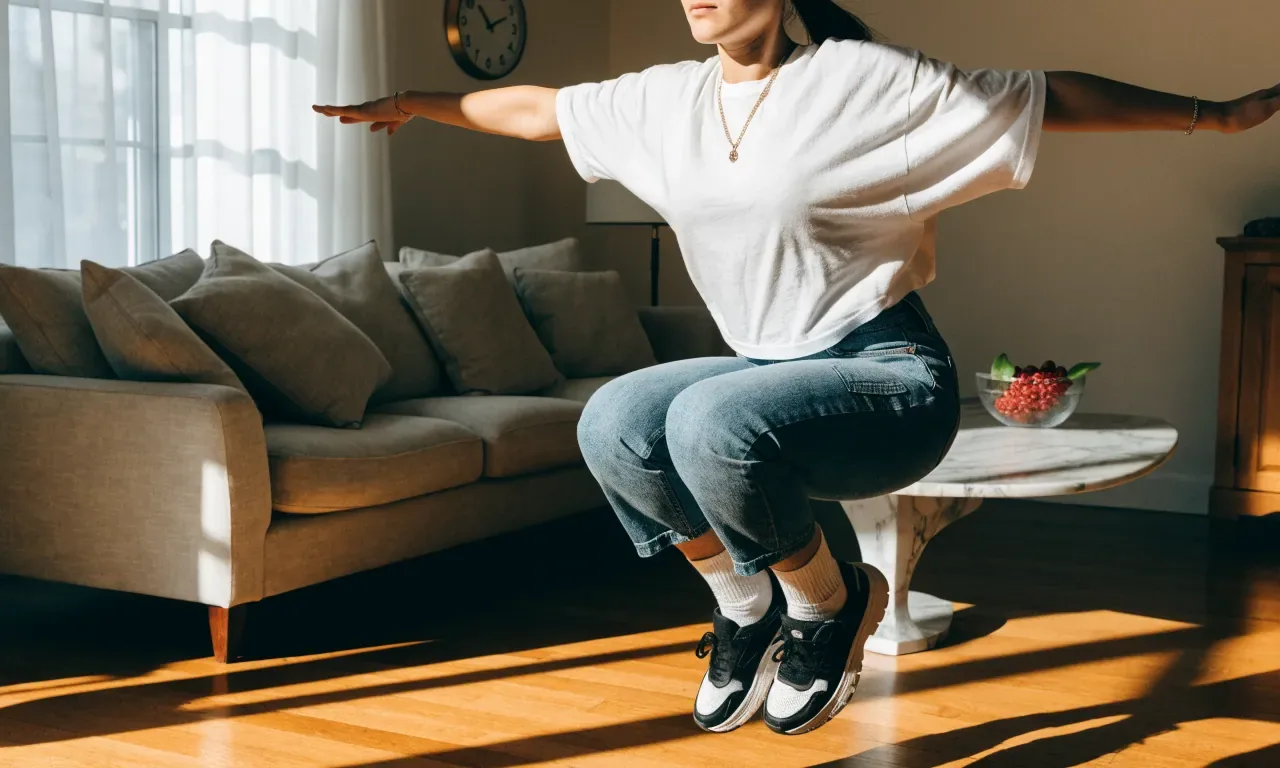
Sit on the edge of a solid, stable chair with your feet hip-width apart, lean slightly forward, and stand up using your legs. The NHS describes this same sit-to-stand setup and advises aiming for 5 slow repetitions to start, using a chair that does not have wheels. If a chair is not needed, do a bodyweight squat to a depth that feels comfortable, keeping your knees facing forward and your back straight.
Make it easier by using your hands lightly on the chair to guide you. Make it harder by slowing the lowering phase to three seconds, or by holding a backpack or dumbbell close to your chest.
2. Push-up at your level
Place your hands under your shoulders against a wall, on a counter, on your knees, or on the floor, and keep your body in one line as you bend and straighten your arms. Choose the angle where you can do steady reps for 40 seconds without your hips sagging.
Make it easier by moving to a wall. Make it harder by moving to a lower surface or to your toes, but only when the easier version stays controlled for the full round.
3. Glute bridge
Lie on your back with your knees bent and feet flat, then lift your hips until your shoulders, hips, and knees form a line. Lower slowly without letting your lower back arch hard at the top.
This move works the hips and the back of the thighs, areas that are hard to load well with squats alone. Make it harder by pausing for two seconds at the top, or by marching one foot slightly off the floor at a time while keeping your hips level.
4. Row with a backpack, band, or dumbbells
Hinge forward from your hips with a flat back, holding a loaded backpack, a resistance band anchored under your feet, or dumbbells. Pull the weight toward your ribs, then lower it slowly.
Pulling is the part most home plans leave out because there is no natural bodyweight equivalent for most beginners. A backpack filled with books gives you a practical option without buying equipment. If you have no load at all, replace this move with a prone press-up to a slow snow-angel motion on the floor, and add a row on your next session when you have something safe to pull.
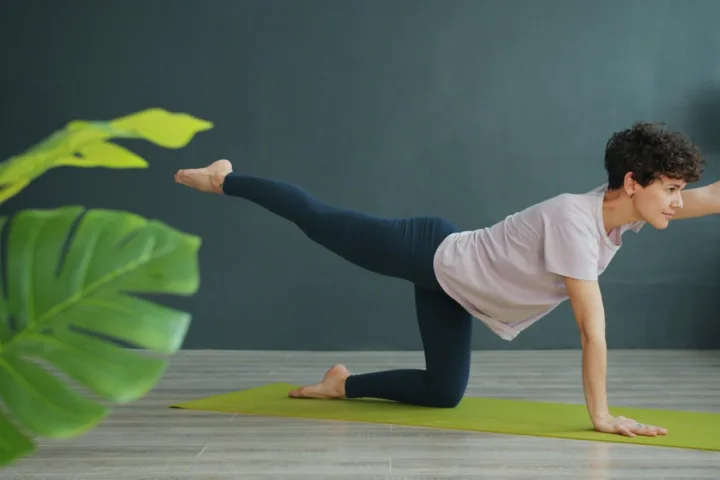
5. Dead bug
Lie on your back with your arms up and knees bent over your hips. Lower one arm and the opposite leg slowly while keeping your lower back pressed lightly into the floor, then return and switch sides.
Dead bug is a core exercise where control matters more than speed. If your back lifts off the floor, shorten the reach. Make it harder by straightening the moving leg more, not by moving faster.
How Hard Should It Feel?
The last few seconds of each 40-second block should feel challenging, while your form still holds. The CDC describes muscle-strengthening work as done to the point where it is hard to do another repetition without help, with 8–12 repetitions counting as one set.
Use that as your guide inside the timed format. If you finish 40 seconds easily and could keep going with good form, the version is too easy for progression. If you cannot reach 20 seconds before your form breaks, the version is too hard for today.
Fatigue is expected, pain is a stop signal. Muscles feeling tired or warm by the end of a set is normal for strength work. Sharp pain, joint pain that gets worse with each rep, or numbness is not, and that move should stop.
Choose Your Version: No Equipment, Added Load, or Low-Impact
Pick the version that matches your joints, equipment, and current strength, not the version that sounds most advanced.
| Version | Choose it if | Changes to make |
|---|---|---|
| No equipment | You are starting out or have no weights at home | Use sit-to-stand, wall or knee push-ups, glute bridge, backpack row only if you have a bag, and dead bug |
| Dumbbells or backpack | You can finish all three rounds with good form and want to progress | Hold a light load for squats, bridges, and rows; keep push-ups and dead bug as bodyweight |
| Low-impact / joint-friendly | Jumping, kneeling, or getting to the floor is a problem | Use sit-to-stand instead of squats, wall push-ups, standing marches instead of floor core work, and keep all moves standing or chair-supported |
All three versions use the same timing, so you can switch mid-workout. For example, do floor push-ups in round 1, knee push-ups in round 2, and wall push-ups in round 3 if your shoulders tire. The plan still counts because the muscle groups and effort stay similar.
A Simple Week That Makes 20 Minutes Add Up
Three sessions a week is a practical starting point for this full-body plan. That gives you a rest day between sessions for the same muscles, which matters because Mayo Clinic advises resting at least one full day between exercising each specific muscle group.
| Day | Session |
|---|---|
| Monday | 20-minute full-body circuit |
| Tuesday | Walk or other moderate activity, 20–30 minutes if you can |
| Wednesday | 20-minute full-body circuit |
| Thursday | Rest or gentle walk |
| Friday | 20-minute full-body circuit |
| Saturday | Walk, cycle, swim, or other activity you enjoy |
| Sunday | Rest |
That week gives you three strength days, but it may still fall short on aerobic activity. According to the WHO, adults should do at least 150–300 minutes of moderate-intensity aerobic activity, or 75–150 minutes of vigorous-intensity activity per week, plus muscle-strengthening activities involving all major muscle groups on 2 or more days a week. Use the walks and other activity days to build toward that total gradually, rather than trying to turn every 20-minute circuit into a vigorous session.
Mistakes That Make a Short Workout Work Less Well
Short sessions punish rushing, because there is little time to waste on reps that do not count.
- Going too fast to fit more reps in. Slow, controlled reps are safer and harder for the muscle than fast reps done with momentum.
- Holding the same hard version when form fades. Drop to the easier push-up or squat version for the last round instead of forcing poor reps.
- Training the same muscles hard every day. Use rest days or alternate with walking, as in the weekly plan above.
- Skipping the warm-up to save time. Two minutes of marching and easy movement prepares you for the circuit and uses only a small part of the session.
- Chasing soreness as proof it worked. Soreness after a new workout is common, but it is not required for progress and severe soreness is a reason to reduce the load next time.
- Doing only the moves you like. If you skip the row, your back and arms get no pulling work, and the plan stops being full-body.
How to Progress When the Same Routine Gets Easier
Progress in small steps, in this order:
- Add reps inside the 40 seconds while keeping the same form and tempo.
- Slow the lowering phase of squats, push-ups, and rows to three seconds.
- Move to the harder version of one move at a time, for one round first.
- Add a small amount of load to squats, bridges, or rows.
That order follows the principle in the American College of Sports Medicine position stand on progression models in resistance training, which recommends 8–12 repetition maximum loads for novice training and a 2–10% increase in load when a person can do one to two repetitions over the desired number. At home, that small increase might mean one extra book in the backpack or the next dumbbell you own, not a large jump.
Progress only one variable a week. If you add load, a harder push-up, and a fourth round in the same week, you will not know which change caused a problem if your joints feel worse.
Mayo Clinic also notes that a weight or resistance heavy enough to tire your muscles after about 12 to 15 repetitions can build strength efficiently in a single set for many people. In this timed plan, use that same test: by the end of a block, the last reps should be difficult but still clean.
What the Guidelines Say About Short Workouts
A 20-minute workout is a useful building block, not a separate category in the guidelines. The WHO recommends regular activity for all adults and muscle-strengthening on 2 or more days a week, and the NHS gives the same core targets for adults aged 19 to 64: at least 150 minutes of moderate activity or 75 minutes of vigorous activity a week, plus strengthening activities on at least 2 days.
The CDC adds the practical detail for strength work: try at least one set per activity, and do two or three sets to gain even more benefit. This plan uses three rounds, which covers that range, but a beginner who can only manage one or two good rounds in the first week is still doing useful work and can build up.
The NHS also advises building up slowly and gradually increasing repetitions over time for home strength exercises. That is the right expectation for a 20-minute plan: consistency first, progression second.
20-Minute Workout Questions, Answered Straight
Can a 20-minute workout be enough for one day?
Yes, for that day it can be a complete strength session if it covers all major muscle groups and feels challenging by the end of each move. It does not replace a full week of activity on its own, so pair it with walking or other movement across the week to move toward guideline totals.
How many times a week should I do this plan?
Start with 2 to 3 times a week on non-consecutive days. That frequency matches the muscle-strengthening guidance from the WHO and leaves rest days for the same muscles. Add a fourth day only if you recover well and your form stays consistent.
What if I cannot finish all three rounds?
Stop after one or two rounds and note where you stopped. A shorter session done with good form is more useful than a finished session done with poor form, and you can try to add one more round the following week. If you repeatedly cannot get past round 1, make every move one level easier.
Do I need equipment to make it harder later?
No, you can progress by slowing the tempo, using a harder bodyweight version, or adding pauses first. Equipment helps most for squats, bridges, and rows, where a backpack or dumbbells let you add load in small steps. Buy equipment only if you are using the plan regularly and bodyweight versions no longer challenge those moves.
Will a 20 minute workout at home help me lose weight?
It may support weight management as part of a larger pattern of regular activity, but no single short workout can promise weight loss for an individual. Total weekly activity, daily movement outside workouts, food, sleep, and health factors all affect the outcome. Treat this plan first as a way to get stronger and more active, which is a benefit you can judge in weeks by reps, load, and how daily tasks feel.
Related Home Workouts
How This Guide Was Put Together
This guide is based on the WHO physical activity recommendations, CDC guidance on what counts as muscle-strengthening activity, NHS home strength exercises and adult activity guidelines, and the Mayo Clinic and ACSM guidance on repetitions and progression linked above. It does not claim personal testing, expert review, or individual medical assessment.
Sources
- World Health Organization, Physical activity
- Centers for Disease Control and Prevention, What Counts as Physical Activity for Adults
- NHS, Strength exercises
- NHS, Physical activity guidelines for adults aged 19 to 64
- Mayo Clinic, Strength training: Get stronger, leaner, healthier
- American College of Sports Medicine, Progression models in resistance training for healthy adults, 2002