
For most people with an uncomplicated pregnancy, a pregnancy workout at home 2nd trimester plan can be safe and useful, built around moderate walking, bodyweight strength, and pelvic floor work. The goal is not to chase pre-pregnancy personal records.
It is to keep your heart, lungs, hips, and back working while your centre of gravity shifts. Start with short sessions, use the talk test to set intensity, and check the plan with your obstetrician or midwife before you begin, especially if this is new exercise for you.
What Changes in the Second Trimester, and Why Your Training Should Too
The second trimester changes the workout because your bump, balance, and circulation have changed, even if your energy feels better than in the first trimester.
Your uterus is growing upward out of the pelvis, your weight is shifting forward, and joints may feel looser. That is why exercises that were comfortable lying flat, standing on one leg without support, or twisting hard through the middle often need a different version now.
The key change is position, not effort alone. After the first trimester, the CDC advises avoiding activities that require lying flat on your back. The NHS gives a more specific home rule: do not lie flat on your back for prolonged periods, particularly after 16 weeks, because the weight of the bump can press on the main blood vessel returning blood to the heart and make you feel faint, according to the NHS exercise in pregnancy guidance.
That does not mean you stop training your glutes, back, or deep core. It means you swap long supine sets for standing, seated, side-lying, incline, and all-fours versions.
Safety note for this topic: This article is general information for uncomplicated pregnancies and is not medical advice for your pregnancy. Do not start, continue, or progress this plan if your clinician has told you to limit activity because of bleeding, placenta problems, a short or stitched cervix, pre-eclampsia, preterm labour risk, severe anaemia, heart or lung disease, or another medical or obstetric complication. Get individual clearance first.
How Much Exercise Do You Need in the Second Trimester?
Aim for at least 150 minutes of moderate-intensity aerobic activity a week if your clinician has not restricted you, for example 30 minutes on five days.
That target comes from the CDC recommendation for pregnant and postpartum women, which also notes that some activity is better than none. The American College of Obstetricians and Gynecologists (ACOG) Committee Opinion on physical activity and exercise in pregnancy states that, in the absence of medical or obstetric complications, physical activity in pregnancy is safe and desirable and women should be encouraged to continue or start safe activities.
Moderate intensity is an effort where you are breathing harder and warm, but you can still speak in full sentences. That is the talk test. If you can sing easily, you can probably walk a little faster or add a set. If you cannot finish a sentence, slow down, reduce the range of motion, or rest.
Use this split for a home week:
- Aerobic work: brisk walking outdoors, marching in place, low-impact step touches, or a short walk after meals
- Strength work: 2 to 3 non-consecutive days a week
- Pelvic floor and breathing: most days, in short sets you can do well
If you were inactive before pregnancy, do not jump to 150 minutes in week one. Start with 5 to 10 minutes of easy walking and one short strength circuit, then add a few minutes or one exercise at a time as long as you have no warning signs and you recover well the next day.
What You Need at Home, and What to Skip
You need a clear floor space, a sturdy chair that does not slide, a wall, and water. Everything else is optional.
| Option | Choose it if | Skip or change it if |
|---|---|---|
| No equipment | You are a beginner, you have pelvic pain with load, or you want the lowest fall risk | You cannot feel your glutes and back working with bodyweight alone after a few weeks |
| Resistance band with handles | You want back and hip work without holding weights, and you can anchor it safely to a closed door | The band pulls you off balance or you have to hold your breath to control it |
| Light dumbbells or filled water bottles | You did strength training before pregnancy and your form stays steady | Your belly changes the path of the weight, you feel abdominal bulging, or your lower back takes over |
| Chair or countertop | You need balance support for squats, hinges, and calf raises | The chair tips, slides, or is too low for a comfortable sit-to-stand |
Do not buy a programme based on equipment. A chair and a band cover every muscle group in this plan. Save money and space unless you already own dumbbells and know how to use them.
Wear supportive shoes for walking and strength work, even indoors, because your feet and balance are changing. Keep the room cool, avoid hot workouts, and stop to drink water rather than trying to finish a set while overheated or dizzy.
The Core Moves: A Pregnancy Workout at Home 2nd Trimester Strength Session
Do these moves slowly, with a full breath out on the hard part. Never hold your breath and bear down to lift, because that spikes pressure through your abdomen and pelvic floor when both are already under more load.
Warm up first for 5 minutes:
- Walk or march in place for 2 minutes, building pace gradually.
- Do 6 easy sit-to-stands from a chair.
- Do 8 shoulder rolls and 8 gentle standing hip circles each way.
- Take 4 slow breaths, expanding your ribs to the sides, then exhaling fully.
1. Chair squat or sit-to-stand
This trains the quads and glutes you use for stairs, getting off the sofa, and lifting later.
Stand in front of a chair with feet hip-width apart and a counter or second chair nearby if you need balance help. Sit back until your bottom lightly touches the chair, then stand by pushing through your whole foot. Keep your knees tracking over your toes, not caving inward.
Do 1 to 3 sets of 8 to 12 reps. Make it easier by using a higher chair or holding support. Make it harder only by slowing the lowering to 3 seconds, not by adding a jump.
2. Standing hip hinge
This trains the glutes and hamstrings that support your pelvis and lower back as your bump grows.
Stand tall holding a chair back. Soften your knees, push your hips back as if closing a car door with your bottom, and keep your back flat until you feel a stretch in the back of your thighs. Drive your hips forward to stand. Add a light dumbbell or band only if you can keep the same flat back and breathing pattern.
Do 1 to 3 sets of 8 to 10 reps. Stop the set if your back rounds, you feel pulling in the front of your pelvis, or you need to hold your breath.
3. Incline push-up against a wall or counter
This trains chest, shoulders, and arms without lying flat or dropping to the floor.
Place your hands on a wall or sturdy counter, shoulder-width apart, and walk your feet back until your body forms a straight line from head to heels. Bend your elbows to bring your chest toward the surface, then press away. The higher the surface, the easier the exercise.
Do 1 to 3 sets of 6 to 12 reps. Choose the counter if wall push-ups feel too easy and floor transitions feel awkward, and choose the wall if your wrists or shoulders ache on the counter.
4. Band row or supported one-arm row
This trains the upper back, which helps counter the forward pull on your posture as breast and belly weight increase.
Anchor a band at chest height, hold it with both hands, step back until there is light tension, and pull your elbows back while squeezing your shoulder blades together. Or, stand in a staggered stance with one hand on a chair and row a light weight with the other hand.
Do 1 to 3 sets of 8 to 12 reps. Keep your ribs down and your neck long. If you see a ridge or dome rise along the middle of your abdomen, reduce the load and exhale before you pull.
5. Side-lying leg lift and clamshell
These train the outer hip muscles that help stabilise your pelvis when you walk and stand on one leg to dress.
Lie on your side with a pillow under your head and, if it feels better, a pillow between your knees. For the leg lift, lift the top leg to about hip height without rolling your top hip backward, then lower slowly. For the clamshell, bend both knees, keep your feet together, and open the top knee only as far as your pelvis stays still.
Do 1 to 2 sets of 8 to 12 reps per side for one of these, not both at full volume on the same day if your hips fatigue quickly. Side-lying is a useful replacement for long flat-back glute bridge sets in this trimester.
6. Bird dog on all fours
This trains deep core and back stability without crunches, sit-ups, or lying on your stomach.
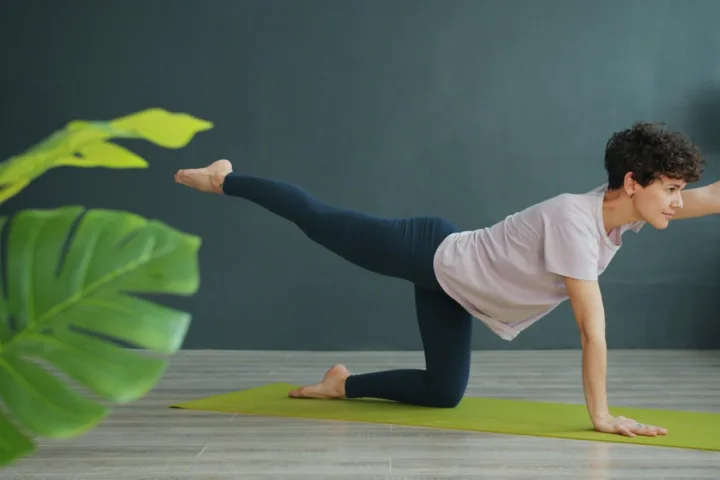
Start on hands and knees with hands under shoulders and knees under hips. Slide one arm forward and the opposite leg back until they are level with your body, keeping your pelvis still and your back flat. Pause for one breath out, then return and switch sides.
Do 1 to 3 sets of 5 to 8 reps per side. Think of balancing a glass of water on your lower back. If your back sags or twists, shorten the reach.
7. Standing calf raise with support
This trains calves and ankle stability, and the muscle pump in your lower legs helps you feel less heavy after long sitting, though it does not treat swelling on its own.
Hold a chair or counter. Rise onto the balls of both feet, pause at the top without leaning forward, then lower slowly.
Do 1 to 3 sets of 10 to 15 reps. Keep both feet on the floor version for this trimester at home. Single-leg calf raises add balance risk for little extra benefit here.
8. Pelvic floor connection breath
The pelvic floor is the sling of muscles that supports the bladder, uterus, and bowel. Pregnancy increases the load on it, so training means both contracting and fully relaxing, not holding a squeeze all day.
Sit tall on a chair with feet flat. Inhale and let your ribs and belly soften. As you exhale, gently lift the pelvic floor as if you are stopping wind and urine at the same time, and feel your lower abdomen draw in lightly. Hold for 3 to 5 seconds while breathing stays easy, then relax completely for at least as long as you held.
Do 5 to 10 quality reps, once or twice a day. If you cannot feel a clear release, you are squeezing too hard or for too long. Persistent leaking, heaviness, pelvic pain, or a feeling of bulging is a reason to ask for referral to a pelvic health physiotherapist, not to squeeze harder.
Cool down for 3 to 5 minutes with easy walking, calf stretches against a wall, a chest opener holding a door frame, and slow breathing. Stretch only to mild tension. Looser joints in pregnancy are not a reason to push for more range.
A Repeatable Weekly Plan That Adds Up Without Exhausting You
Use Workout A and Workout B on alternate strength days. Keep at least one rest day between them at first.
| Day | Session | Time |
|---|---|---|
| Monday | Workout A + easy walk | 20 to 30 minutes strength, 10 to 20 minutes walk |
| Tuesday | Brisk walk or marching in place | 20 to 30 minutes |
| Wednesday | Workout B + pelvic floor breaths | 20 to 30 minutes |
| Thursday | Rest, gentle mobility, or short walk | 10 to 20 minutes optional |
| Friday | Workout A (week 1) or B (week 2) + walk | 20 to 30 minutes strength, 10 minutes walk |
| Saturday | Brisk walk | 30 minutes, split into two 15-minute walks if needed |
| Sunday | Rest | — |
Workout A: chair squat, incline push-up, side-lying leg lift, connection breaths Workout B: hip hinge, band row, bird dog, calf raise
That schedule can reach roughly 120 to 170 minutes of aerobic activity depending on your walk lengths, plus strength. If your total is below 150 minutes at first, that is a starting point, not a failure. Add 5 minutes to two walks before you add load to strength work, because aerobic volume is the guideline target and it is easier to recover from.
Progress only one thing every one to two weeks: one extra set, two extra reps, or five extra walking minutes. Do not progress on a week when sleep is poor, pelvic pain is increasing, or you are still sore after 48 hours.
Exercises and Positions to Avoid or Replace at Home
Avoid the exercise if the risk comes from the activity itself, not just from doing it too hard.
- Prolonged flat-back exercise after 16 weeks: replace floor glute bridges, flat bench press, and long supine stretches with incline, side-lying, seated, standing, or all-fours versions
- Crunches, sit-ups, and hard front planks: these can increase abdominal doming and are hard to scale well at home; use bird dog, incline push-ups, and connection breaths instead
- Prone lying on your stomach: replace with all-fours or side-lying work once your bump makes it uncomfortable
- Deep twists, end-range back bends, and hot yoga or hot Pilates: ACOG lists hot yoga and hot Pilates among activities to avoid because of overheating risk, and deep closed twists compress the abdomen rather than training it
- Contact, fall-risk, and impact activities: contact sports, downhill skiing, horse riding, gymnastics, off-road cycling, scuba diving, and skydiving are listed by ACOG as activities to avoid in pregnancy
- Breath-holding heavy lifts and maximal efforts: if you need to strain, grunt through a held breath, or rush a rep to finish it, the load is too high for this plan
A brief roll through your back to get up from the floor is different from staying flat for a set. If you feel dizzy, nauseated, short of breath, or faint while on your back, roll to your side and sit up slowly, and do not return to that position.
Mistakes That Make Home Workouts Feel Worse, and How to Fix Them
You copy your pre-pregnancy workout and change nothing
The fix is not to train as if you are fragile. The fix is to change position, support, and load first. Keep the pattern, squat, hinge, push, pull, but use a chair, a wall, and a slower tempo before you reduce the whole workout to stretching only.
You judge intensity by sweat or heart rate alone
Pregnancy changes heart rate and temperature responses, so a number that meant moderate before pregnancy may not mean the same now. Use the talk test and your breathing as the main gauge because you can apply them to every exercise in this article, with no device.
You feel coning or doming and push through it
Coning is a visible bulge or ridge along the centre of your abdomen during an effort. It is a sign the load or position is more than your abdominal wall can manage in that moment. Exhale before the effort, reduce the load or range, choose an easier version, and stop that exercise for the day if the bulge does not settle with those changes.
Pelvic or pubic bone pain gets sharper with single-leg work
Reduce wide stances, lunges, and long side-lying sets first. Keep your knees closer together when rolling in bed or getting out of a chair, choose both-feet squats and hinges over step-ups, and shorten your walking stride. Pain that alters how you walk, persists after the session, or is severe needs assessment by your maternity team or a physiotherapist, not more reps.
You are sore, swollen, or exhausted the next day
Treat that as dose information. Cut the last session by one set or five minutes, keep the same exercises for another week, and check sleep, food, and fluids before you add anything. Regular moderate activity may help, but a home plan that leaves you depleted every time is set too high.
Warning Signs: Stop the Session and Contact Your Clinician
Stop exercising and contact your obstetrician, midwife, or maternity unit the same day if you have any warning sign listed by ACOG.
- Vaginal bleeding
- Fluid gushing or leaking from the vagina
- Regular, painful contractions
- Abdominal pain
- Shortness of breath before you start exercising
- Dizziness or feeling faint
- Headache
- Chest pain
- Muscle weakness that affects your balance
- Calf pain or swelling
Do not finish the workout to see if the symptom passes, and do not restart the same session later that day. Some symptoms need urgent assessment, so follow your maternity unit's advice on where to be seen.
Also seek advice promptly for reduced fetal movements, fever, illness, a fall or blow to the abdomen, or pelvic pain that does not settle with rest. Your individual plan from your clinician overrides any general plan, including this one.
Second-Trimester Home Workout Questions, Answered Straight
Can I train my core in the second trimester?
Yes, train your core for stability and breathing, not with crunches and sit-ups. Bird dog, connection breaths, incline push-ups, and rows train the deep abdomen and back in positions you can control. Stop and modify any move that causes visible doming, pain, leaking, or a feeling of heaviness.
Can I lift weights at home while pregnant?
You may be able to lift light to moderate weights if you were cleared, you can breathe out on the effort, and your form stays steady. There is no single safe weight in pounds or kilograms for everyone in the second trimester. Choose a load you can lift for 8 to 12 controlled reps with two good reps left, and reduce it as your bump changes the movement.
What if I did no exercise before pregnancy?
Start, but start small and build gradually rather than taking up strenuous exercise suddenly, as the NHS advises. Begin with short walks and Workout A with one set of each exercise, twice a week. Add time before load, and tell your clinician what you have started so the plan can be adjusted to your history.
Is a short time on my back ever okay?
Brief transitions are different from prolonged flat-back exercise. The concern grows after 16 weeks and with longer time flat, especially if you feel faint or sick. For training, pick another position from the start so you do not have to guess how long is too long.
How do I know if a walk counts toward the 150 minutes?
It counts if it is brisk enough that your breathing is harder and you can talk but not sing, and you can keep it up safely. Slow strolling is still movement and can help you feel better, but it may not be moderate intensity. Split walks into 10-minute blocks if that is what fits your energy and schedule.
Should I do pelvic floor exercises every day?
Short, good-quality sets on most days are more useful than long holds you cannot release. Contract on the exhale, relax fully, and keep your glutes and inner thighs quiet. If you leak, feel pressure or bulging, or have pelvic pain, get assessed rather than adding more squeezes.
Related Home Workouts
How This Guide Was Put Together
This guide is based on the ACOG Committee Opinion on physical activity and exercise during pregnancy and the postpartum period and the CDC and NHS recommendations linked above. The home exercises were selected and modified for the second trimester using those guidelines on intensity, position after the first trimester, activities to avoid, and warning signs, not on personal testing or individual medical review.
Sources
- American College of Obstetricians and Gynecologists, Physical Activity and Exercise During Pregnancy and the Postpartum Period, Committee Opinion No. 804, 2020
- Centers for Disease Control and Prevention, Pregnant and Postpartum Activity: An Overview
- NHS, Exercise in Pregnancy