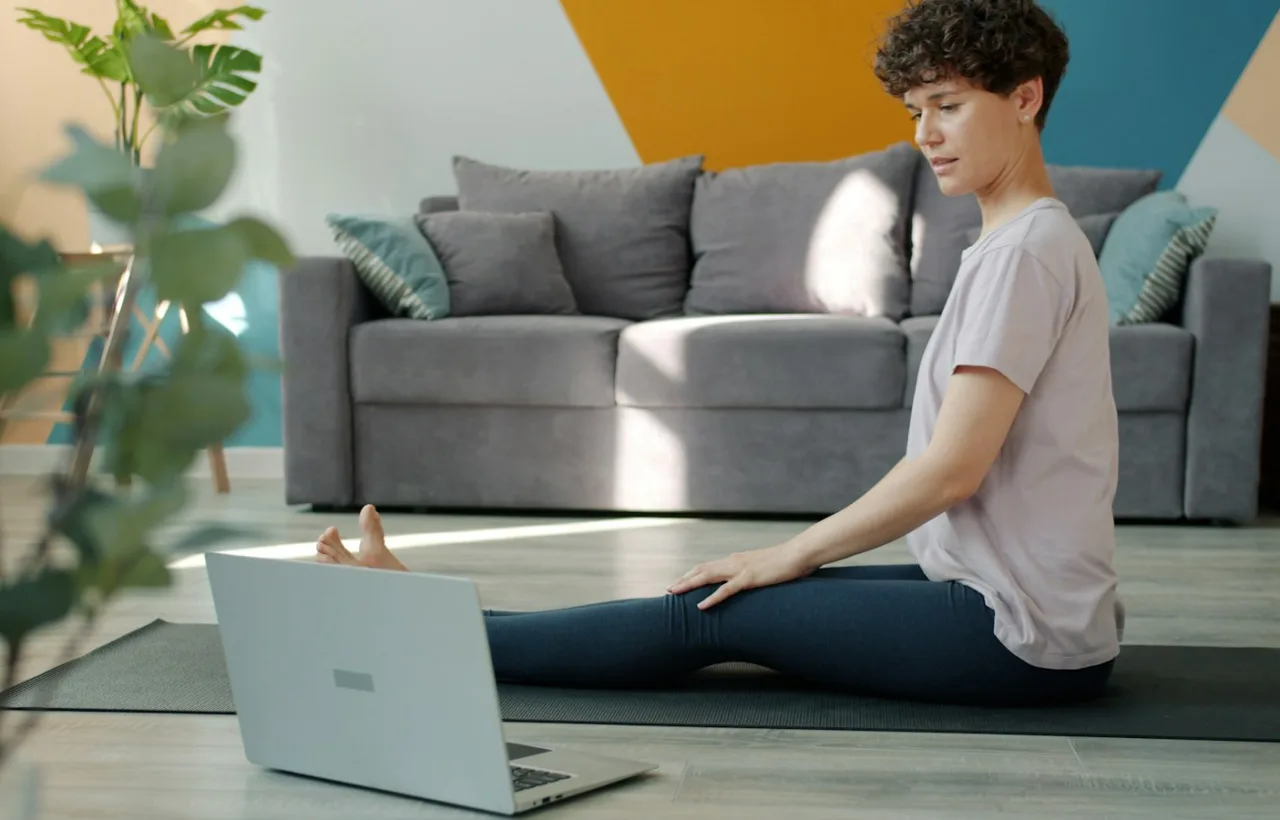

This home workout guide starts from one rule: a home workout only works if two things are true. It has to train something specific, and you have to be able to repeat it twice a week for months. Most people fail the second part — not because the exercises are wrong, but because the routine lives in their head instead of on a calendar. This guide covers how to build a home workout that fits your space and your goal, sample ways to structure a week, and the small decisions that separate people who stick with training from people who quit in February.
What Makes a Home Workout Actually Work
Three ingredients matter more than which exercises you pick:
- A clear goal: strength, stamina, or general health. The format changes depending on which one you choose.
- An effort rule: each session should feel genuinely challenging in its last few reps, or your body has no reason to adapt.
- A time and a place: the same time slot and the same corner of a room do more for consistency than motivation does.
A useful test before blaming motivation: can you describe your workout and when you will do it in one sentence? If not, the plan is the problem, not your willpower. Everything else — exact exercises, order, rest times — is secondary and can be adjusted as you go.
Pick the Format That Fits Your Goal
Home workouts come in three basic formats. Choose based on what you want, not what looks impressive on social media:
- Strength sets: three sets of each exercise, resting 60 to 90 seconds between sets. Best when the goal is muscle or strength, and it takes 30 to 40 minutes.
- Circuits: five or six exercises back to back with short rests, repeated two to four times. Best when the goal is stamina or fitting a lot into very little time. 15 to 25 minutes.
- Follow-along sessions: a video pacing you through everything. Best when deciding what to do next is the thing that stops you. Pick sessions where the coach explains form, not just counts reps.
If you are unsure, start with strength sets. Strength is the foundation that makes circuits feel easier, and it translates best when you eventually add weights. You don’t have to choose one forever — many people rotate one strength day, one circuit day, and one easy day through the week.
| Format | Best for | How it runs | Time |
|---|---|---|---|
| Strength sets | Muscle and strength | 3 sets per exercise, 60–90 s rest between sets | 30–40 min |
| Circuits | Stamina, or very little time | 5–6 exercises back to back, repeated 2–4 times | 15–25 min |
| Follow-along | When deciding what to do next is what stops you | A video paces every exercise | Depends on the video |
Not sure which to pick? Start with strength sets. They make circuits feel easier later.
A Sample Week You Can Copy
Here is a balanced home workout week that needs nothing beyond a floor and a sturdy table. The days are flexible; the only rule is not stacking hard sessions back-to-back:
- Day 1 — Strength: squat, push-up, row, glute bridge, plank. Three rounds, controlled reps.
- Day 2 — Off: walk 20 to 30 minutes.
- Day 3 — Circuit: pick five moves, 40 seconds of work, 20 seconds of rest, three rounds.
- Day 4 — Off or easy: stretching, mobility, or another walk.
- Day 5 — Strength: the same structure as Day 1, one or two reps harder.
- Weekends: rest, or movement that doesn’t feel like training — a long walk, a bike ride, a swim.
If a week goes sideways or you travel, do the Day 1 list wherever you are. A hotel room floor and a bed frame cover most of it.
How to Make Any Home Workout Harder Over Time
A workout repeated unchanged stops producing results after a few weeks. When the last set feels easy, adjust one thing:
- More reps: work toward the top of the rep range, then switch to a harder variation.
- Slower lowering: take three seconds on the way down of every rep.
- Tougher leverage: elevate your feet, lower your hands, or use one limb instead of two.
- Less rest: trim 15 seconds at a time between sets or rounds.
- Extra load: a backpack with books, worn or held.
Change one variable, not all five at once. And write down what you did — a notes-app line like ‘squat 15, push-up 10, row 8’ is enough. Without that line, you’re guessing; with it, progress becomes visible.
What the Research Says About Training at Home
Backed by research
Why this approach works
- Adults are advised to get 150–300 minutes of moderate activity (or 75–150 minutes of vigorous activity) each week, plus muscle-strengthening work for all major muscle groups on two or more days.Source: Bull FC et al. (2020). World Health Organization 2020 guidelines on physical activity and sedentary behaviour. Br J Sports Med; World Health Organization: Physical activity fact sheet
- You don’t need heavy weights to build muscle. A 2017 meta-analysis found that muscle growth was similar with light and heavy loads, while maximal strength benefited most from heavy loads. Hard bodyweight sets and a loaded backpack are a legitimate way to grow.Source: Schoenfeld BJ et al. (2017). Strength and hypertrophy adaptations between low- vs. high-load resistance training. J Strength Cond Res
- The American College of Sports Medicine recommends progressive overload (gradually increasing the demand) and 2–3 resistance sessions a week for beginners. That is exactly what the sample week and the “make it harder” levers above do.Source: American College of Sports Medicine (2009). Progression models in resistance training for healthy adults. Med Sci Sports Exerc
- The WHO guidelines stress that any amount of physical activity is better than none, which is why a 10-minute minimum session on a bad day still counts.Source: World Health Organization: Physical activity fact sheet
Why Home Workouts Fail — and the Fix for Each Reason
Most failed home workouts die for one of four reasons. Each has a practical fix:
- All-or-nothing thinking. A skipped 40-minute plan feels like failure, but it beats nothing. Fix: define a 10-minute minimum version, and do that on bad days.
- No visible progress. Fix: track one number per exercise — reps or seconds — and check it once a month.
- Boredom. Fix: keep the structure, swap the exercises every six to eight weeks. Structure creates results; variety creates interest, and you need both in that order.
- Waiting for motivation. Fix: treat sessions like appointments. Same time, same corner of the room, reminder on the calendar. Motivation usually follows action rather than preceding it.
Your First Week, Step by Step
Don’t design the ideal plan before you start. Do this instead:
- Pick the format that matches your goal — one of the three above.
- Book two sessions in your calendar this week, at least a day apart.
- Do those sessions well short of failure. The goal of week one is showing up and noticing what feels hard, not exhausting yourself.
- After each session, write one line: what you did and what felt hardest.
- Next week, keep the same times and make the hardest exercise slightly harder.
Home Workout Questions, Answered
How long should a home workout be?
Twenty to forty minutes covers most goals. Shorter sessions work if the effort is high and rest is short; longer is not automatically better if the extra length is what makes you skip days. Consistency beats duration every time.
Can you build muscle working out at home?
Yes — muscles respond to hard, progressively demanding effort, not to a gym membership. Bodyweight variations and a loaded backpack can drive progress for a long time. The ceiling is real, though: eventually the strongest people need heavier resistance than a backpack offers.
What if I live in a small apartment?
You need roughly the space of a yoga mat plus a wall. Choose quiet movements — squats, push-ups, rows, and bridges make almost no noise — and put a towel under anything that might slide. None of the exercises in this guide require jumping.
Do I need any equipment?
No. A floor, a wall, and a sturdy table cover everything here. Worth adding later, in order of usefulness: a mat for floor work, a backpack for load, and a resistance band.
How do I warm up for a home workout?
Two to three minutes is plenty: march in place, circle your arms, do ten easy squats, and move your hips in slow circles. The warm-up exists to raise your temperature and practice the positions, not to tire you out.
What happens if I miss a week?
Nothing meaningful. Fitness fades over weeks, not days. Restart with an easy session instead of trying to make up missed ones — turning a small gap into a debt is how people end up quitting entirely.
How this guide was put together: This guide was written to help people build a home routine they can keep. Exercise selection, weekly volume and progression rules follow published guidance, mainly the WHO 2020 physical activity guidelines and the American College of Sports Medicine position stand on resistance training, plus the studies linked in this article. Last reviewed October 2026.
Safety note: This article is general fitness information, not medical advice. If you have an injury, a heart or blood-pressure condition, are pregnant or postpartum, or have not exercised in a long time, check with a doctor or physiotherapist before starting. Stop and get advice if you feel chest pain, dizziness, unusual breathlessness, or sharp joint pain.


