
Yes, you can train your back at home with no equipment, using floor and wall exercises that work your upper back, lower back, and the muscles that support your spine. A back workout for women at home with no equipment will not replace a heavy row or pull-up, but it can build strength and endurance if you use slow tempo, holds, and good form.
This routine takes about 20 to 25 minutes. After it, you will know how to train each part of your back, how to make the moves harder over time, and when to modify an exercise.
Why Pulling Is the Hard Part at Home
The hard part is load. Most back training in a gym is pulling weight toward you, and there is no true bodyweight pull that matches that without a bar, band, or sturdy surface to row from.
This routine solves a different, useful problem. It trains back extension, shoulder blade control, and spine stability, which are the parts of back strength you can load well on the floor. Prone raises work the muscles that draw your shoulder blades together and down. Bird dogs and hinges train the muscles that keep your spine steady while your arms and legs move.
That honesty matters for expectations. If your main goal later becomes maximum lat size or pull-up strength, you will eventually need something to pull against. For general strength, posture support, and starting training at home, this is a complete place to begin.
What Muscles a No-Equipment Back Workout Actually Trains
Your back is not one muscle. Training it well means covering three areas in the same session, so one area does not do all the work.
The upper and mid-back include the trapezius and rhomboids. These muscles sit between and above your shoulder blades and help you pull your shoulders back and down instead of shrugging them toward your ears.
The latissimus dorsi, often called the lats, are the broad muscles that run from your mid-back down and out to your upper arms. Floor pull-down motions can teach them to work, though with less resistance than a cable or row.
The lower back and posterior chain include the erector spinae, glutes, and hamstrings. The posterior chain is the group of muscles along the back of your body. These muscles help you hinge, stand tall, and support your spine during daily lifting and carrying.
Before You Start: Form Rules That Protect Your Spine
Start on a mat or carpet where your hip bones and ribs feel supported. Move slowly enough that you can stop at any point in the rep, because speed usually means momentum is doing the work instead of muscle.
Keep these rules for every exercise:
- Keep your neck in line with your spine. Look at the floor in prone moves, not forward.
- Brace your abdomen lightly, as if you are about to cough. This helps keep your ribs and pelvis steady.
- Lift only as high as you can without pinching in your lower back.
- Breathe out as you lift or reach, and breathe in as you return.
This workout is for generally healthy adults. Stop and seek medical advice promptly if you feel sharp pain, numbness, tingling, or weakness, and talk to a clinician or physiotherapist first if you have a current back injury, osteoporosis, are pregnant or recently postpartum, or have pain that travels down a leg. This article is general information, not personal medical advice.
The Back Workout for Women at Home With No Equipment
Do this session as a straight circuit of exercises, resting between moves. Warm up first for 3 to 4 minutes with marching in place, shoulder rolls, cat-cow on hands and knees, and 8 slow bodyweight hinges with no load.
The key rule for this session is tempo: lift for 2 seconds, hold for 1 to 2 seconds, and lower for 3 seconds.
| Exercise | Main area | Sets and reps | Rest |
|---|---|---|---|
| Prone Y-T-W raise | Upper back, rear shoulders | 2 rounds of 5 reps in each position | 45 seconds after each round |
| Reverse snow angel | Mid-back, shoulder blades | 2 sets of 8 to 10 reps | 45 seconds |
| Prone lat pull | Lats, mid-back | 2 sets of 10 to 12 reps | 45 seconds |
| Superman hold with pull | Lower back, lats | 2 sets of 6 reps with a 3-second hold | 45 seconds |
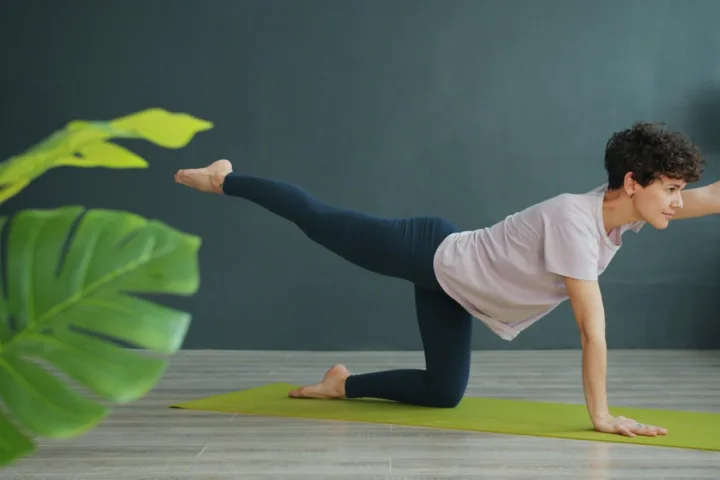
| Bird dog | Lower back, core stability, glutes | 2 sets of 6 to 8 reps per side | 30 seconds |
| Bodyweight good morning | Lower back, glutes, hamstrings | 2 sets of 10 to 12 reps | 45 seconds |
| Wall angel | Upper back, posture control | 2 sets of 8 to 10 reps | 30 seconds |
| Glute bridge | Glutes, hamstrings, lower-back support | 2 sets of 12 reps with a 2-second hold | 45 seconds |
Finish by walking around for a minute, then do child's pose and a gentle chest opener against a wall for 20 to 30 seconds each. Neither stretch should pull on your lower back.
Prone Y-T-W Raise
Lie face down with your forehead resting lightly on the backs of your hands, then lift your head just enough to look at the floor. Raise both arms into a Y shape, thumbs toward the ceiling, lift for 2 seconds, and lower slowly.
Move to a T shape with arms out to the sides, then to a W shape by bending your elbows and drawing them down toward your ribs. Keep the lift small. If your shoulders shrug or your lower back arches, lower your arms and reduce the height.
Reverse Snow Angel
Stay face down with arms by your sides, palms down. Lift your chest slightly and sweep your arms in a wide arc toward your head, then reverse the arc back to your sides.
Keep your arms just off the floor for the whole set if you can. Choose a smaller arc if that keeps your lower back calm and your neck relaxed.
Prone Lat Pull
Reach both arms overhead while lying face down, as if holding a wide bar. Brace your abdomen, lift your arms slightly, then pull your elbows down toward your ribs while squeezing your shoulder blades together.
Straighten your arms slowly to return. This move teaches the pulling pattern and lat engagement, but it provides light resistance, so the slow tempo and the squeeze at the bottom are what make it useful.
Superman Hold With Pull
Lie face down with arms overhead and legs straight. Lift your arms, chest, and thighs a small amount off the floor, hold for 3 seconds, pull your elbows toward your ribs, push them back overhead, then lower everything with control.
Keep the lift low. A high lift that feels like a pinch in your lower back is too much range for this exercise, and a smaller lift with your glutes tight is the better option.
Bird Dog
Start on hands and knees, wrists under shoulders and knees under hips. Reach your right arm forward and your left leg back until both are in line with your torso, hold for 2 seconds, and return without letting your hips shift.
Switch sides on the next rep. If balance is difficult, slide the toe along the floor instead of lifting the leg, and reach the arm only partway forward.
Bodyweight Good Morning
Stand with feet hip-width apart, knees soft, and hands crossed over your chest. Push your hips back and hinge forward with a flat back until you feel a stretch in the backs of your thighs, then stand by pushing the floor away and tightening your glutes.
Your torso angle will vary. Stop the hinge before your back rounds, even if that means a shorter movement at first, because the hinge pattern matters more than depth.
Wall Angel
Stand with your back, head, and hips lightly against a wall and your feet a short step away from it. Bend your elbows to about 90 degrees, keep the backs of your hands near the wall if comfortable, and slide your arms up and down slowly.
Keep your ribs down as you raise your arms. If your lower back arches away from the wall or your shoulders feel pinched, use a smaller range and stop before that point.
Glute Bridge
Lie on your back with knees bent and feet flat, hip-width apart. Push through your whole foot, lift your hips until your knees, hips, and shoulders form a straight line, hold for 2 seconds, and lower slowly.
Bridges do not isolate the back, and that is their value here. Strong glutes share work with the lower back during lifting, walking, and standing, which may help the back do less work alone.
A Simple Weekly Plan You Can Repeat
Adults should do muscle-strengthening activities that involve all major muscle groups on 2 or more days a week, according to the WHO physical activity fact sheet. Two back-focused sessions a week fit that guidance when the rest of your week also includes work for legs, chest, arms, and abdomen.
| Day | Session | Focus |
|---|---|---|
| Day 1, for example Monday | Full routine above | Strength and form practice |
| Day 2, for example Thursday | Full routine, 1 extra set on your weakest move | Endurance and progression |
| Other days | Walking or other aerobic activity, plus other muscle groups | Balanced weekly training |
Leave at least one rest day between back sessions. Mild effort the next day is common when training is new, but joint pain, sharp back pain, or pain that gets worse with each session is a sign to stop that move and get advice.
The NHS also presents home strength exercises as work to build up slowly, gradually increasing repetitions over time, in its NHS strength exercises guidance. That slow build is the right pace for this routine too.
How to Make It Harder Without Adding Weight
Progressive overload means making a task a little harder over time so your muscles have a reason to adapt. Without weight, you change the lever, the tempo, the hold, or the number of quality reps.
Use one change at a time for two weeks:
- Choose slower tempo if a set feels easy but your form is solid. Lower for 4 to 5 seconds instead of 3.
- Choose longer holds if you shake early in a hold. Work from 2 seconds toward 5 seconds on bird dog and superman pull holds.
- Choose more reps if you finish a set with 3 or 4 clean reps still in you. Add 2 reps per set, up to the top of the range in the table.
- Choose a harder variation if you hit the top of every range for two sessions. Try single-arm prone raises, a slower reverse snow angel with a pause overhead, or a single-leg bridge if your balance and form allow it.
Do not add reps by speeding up. A set of 10 slow reps where the target muscle does the work is a better progression than 20 fast reps driven by swinging.
Mistakes That Turn Back Work Into Lower-Back Strain
Most problems in this workout come from range and speed, not from the choice of exercise itself. Fix the cause first, then continue with a smaller, cleaner version.
- Arching to lift higher: Your lower back takes over when you chase height in prone moves. Reduce the lift, tighten your glutes, and press your pubic bone gently into the floor.
- Looking forward on the floor: This cranes the neck and often increases the arch. Look down and keep the back of your neck long.
- Holding your breath: Breath holding can make bracing feel rigid and uncomfortable. Exhale on the lift and keep breathing during holds.
- Rushing the lowering phase: Dropping back to the floor removes half the work. Count the lowering phase out loud if it helps.
- Training through pinching pain: Muscle effort and a deep stretch are different from a pinch, sharp pain, or symptoms down a leg. Stop that exercise for the day if those appear.
Home Back Training Questions, Answered Straight
Can a no-equipment workout build a stronger back?
Yes, it can build strength and endurance, especially if you are a beginner or returning after a break. It has a ceiling for the lats and for maximum pulling strength because there is little external resistance, so your long-term progress will be slower than with rows, bands, or pull-up progressions.
Will this workout fix my posture or back pain?
No workout can be promised to fix posture or pain, and posture has many causes beyond strength. This routine may help you build the back and glute endurance that supports comfortable standing and lifting in daily life, but ongoing or worsening pain needs an individual assessment, not a general routine.
How long before I notice a change?
You may notice better control of the movements within a few sessions because skill improves quickly when you practise a pattern. Strength changes take longer and vary by starting point, consistency, sleep, and overall activity, so judge progress by cleaner reps, longer holds, and extra sets rather than by a set date.
What if getting on the floor is hard for me?
Use the wall angel and standing good morning as your main session, and skip the floor moves until you can get down and up safely and comfortably. A clinician or physiotherapist can suggest seated or supported alternatives that fit your mobility, which a general article cannot choose safely for you.
What should I do if one side feels weaker on bird dog?
Do the weaker side first while you are fresh, match its clean rep count on the stronger side, and use the toe-slide version until both sides feel steady. A small side-to-side difference is common. A large difference paired with pain, numbness, or weakness is a reason to get checked.
When do I actually need equipment?
Consider adding a band, weights, or a row option when you can complete every exercise at the top of its range, with slow tempo and long holds, for two full sessions and it still feels moderate. At that point extra resistance gives you a clearer way to keep progressing, particularly for the lats.
Related Home Workouts
How This Guide Was Put Together
This guide is based on the WHO recommendations for weekly muscle-strengthening activity and the NHS guidance to build home strength work up gradually, both linked above, and on standard bodyweight patterns for back extension, hinge, and spine stability. It does not claim testing, expert review, or personal results.
Sources
- World Health Organization, Physical activity fact sheet
- World Health Organization, Physical activity
- NHS, Strength exercises