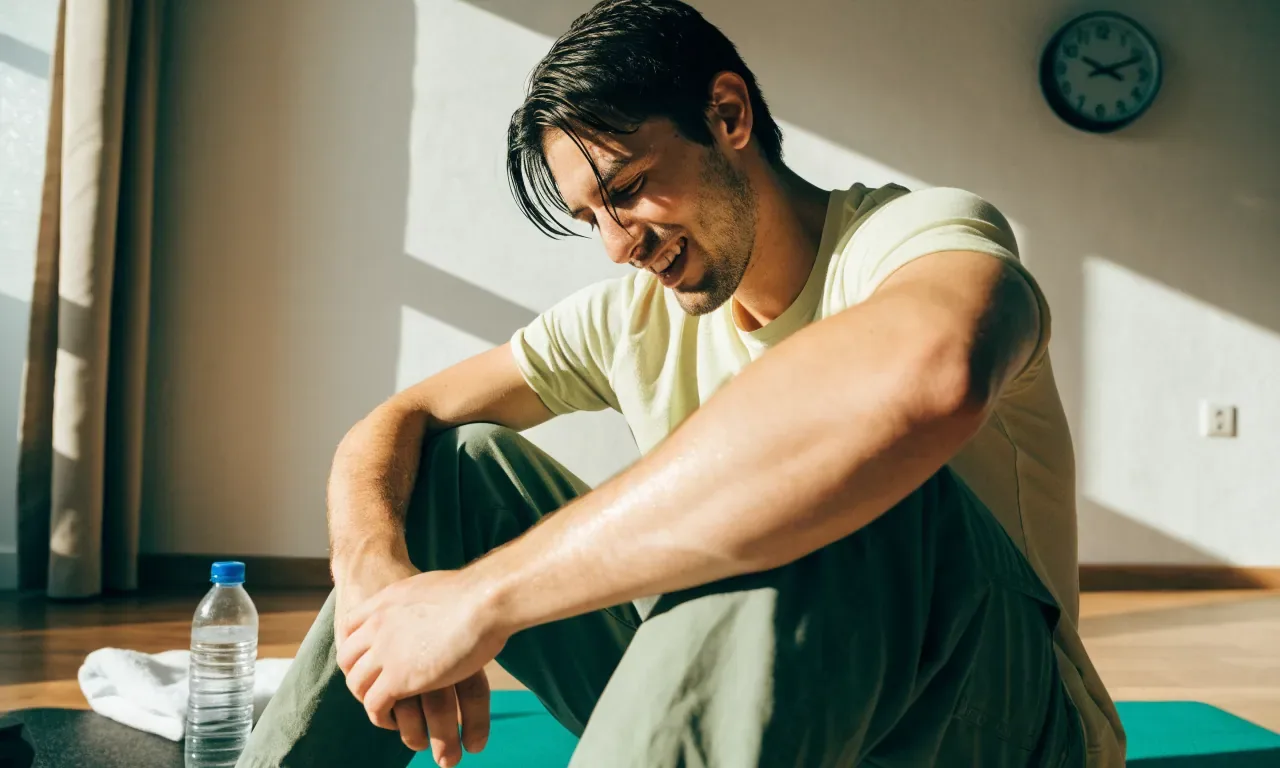

A 1 hour workout at home can train your whole body in one session: 5 minutes to warm up, 36 minutes of strength work, 9 minutes of low-impact cardio, 5 minutes of core work, and 5 minutes to cool down. That structure covers your legs, chest, back, shoulders, arms, and core without a gym. After reading, you will have a minute-by-minute plan, easier and harder versions of each move, and a weekly schedule that leaves room to recover.
What a 1 Hour Workout at Home Should Actually Include
A complete hour should train all the major muscle groups, not just burn calories for 60 minutes. Strength work should take most of the hour, because it is the hardest part to replace with daily activity.
According to the CDC guide to what counts as muscle-strengthening activity, muscle-strengthening should work the legs, hips, back, abdomen, chest, shoulders, and arms. Walking, marching, and step work can raise your heart rate, but they do not replace pushing, pulling, squatting, and hinging.
That is why this plan is built around six patterns:
- Squat: sit-to-stand or bodyweight squat
- Push: push-up at an angle you can control
- Pull: row with a band, backpack, or sturdy table
- Hinge: glute bridge or hip hinge
- Single-leg work: step-up or supported reverse lunge
- Core brace: dead bug and side plank
Cover those patterns well, and you do not need 15 different exercises to fill the hour.
Who This Hour Is Right For, and Who Should Split It
This full hour suits healthy adults who can already move for 20 to 30 minutes without pain and want one longer session on 2 or 3 days a week. If you are new, deconditioned, or returning after a long break, splitting it is often the better choice.
Choose the full hour if you have the time in one block, you can keep good form in the last 15 minutes, and you have at least one rest day before you train the same muscles hard again.
Choose two 30-minute sessions if your form falls apart after 30 minutes, your joints ache for more than a day afterward, or a full hour makes you skip workouts altogether. Two shorter sessions that happen beat one long session that does not.
Safety first: If you have been inactive for a long time, have a heart condition, chest pain, uncontrolled blood pressure, a recent surgery, or a joint problem that changes how you move, speak to a clinician before starting. The NHS physical activity guidelines for adults give the same advice for people who are unsure if exercise is safe for them. Stop a session for chest pain, dizziness, or sharp joint pain, and do not try to finish the clock through those symptoms.
Equipment: What Helps, What You Can Skip
You can do the whole plan with body weight alone. One load you can hold safely, such as a backpack with books, a pair of dumbbells, or a resistance band, makes pulling and hinging much easier to progress at home.
| Option | Best for | Limits to know |
|---|---|---|
| Body weight only | Beginners, no storage space, travel | Pulling is hard without a table or door frame row; leg work may get too easy |
| Backpack or filled water bottles | Adding load to squats, hinges, rows, and presses | Grip and comfort limit how much load you can use |
| Resistance band | Rows, presses, and pull-aparts in small spaces | Resistance changes through the movement, so reps feel uneven |
| One or two dumbbells | The clearest progression for hinge, press, and row | Choose a weight that makes the last 2 reps hard with good form |
Use a solid, stable chair without wheels for sit-to-stands and step support. The NHS strength exercises guide uses the same setup and advises building up slowly. Do not hang from doors, curtain rails, or furniture that was not built to hold your weight.
The 60-Minute Plan, Minute by Minute
Follow the clock loosely, not rigidly. The timings stop one block from eating the whole hour, which is the main reason home workouts run long or get cut short.
| Time | Block | What you do |
|---|---|---|
| 0:00–5:00 | Warm-up | Easy marching, joint circles, and practice reps |
| 5:00–23:00 | Strength Block A | Squat, push, row — 3 sets |
| 23:00–41:00 | Strength Block B | Hinge, single-leg, press — 3 sets |
| 41:00–50:00 | Low-impact conditioning | 2 rounds, 40 seconds work / 20 seconds rest |
| 50:00–55:00 | Core | Dead bug and side plank — 2 rounds |
| 55:00–60:00 | Cool-down | Breathing and mobility |
Rest 60 to 90 seconds between strength sets. The CDC advises working a muscle to the point where another rep would be hard to do without help, using 8 to 12 reps for most strength moves, with 2 to 3 sets giving more benefit than 1 set.
Warm-up: 0 to 5 minutes
March in place for 1 minute, raising the effort gradually. Spend the next 2 minutes on shoulder rolls, hip circles, ankle rocks, and easy knee bends.
Use the last 2 minutes for practice reps: 5 sit-to-stands, 5 push-ups against a wall, and 5 hip hinges with your hands on your hips. The warm-up should leave you warm and ready, not tired.
Strength Block A: 5 to 23 minutes
Do 3 sets of this circuit, resting between sets.
1. Sit-to-stand or bodyweight squat — 8 to 12 reps Stand in front of a chair, feet about hip width. Sit back until you touch the chair, then stand by pushing through your whole foot. If you do not need the chair, squat to a depth you can control with your heels down.
2. Push-up — 6 to 12 reps Use a wall, a counter, a chair seat, your knees, or the floor. Pick the angle that lets you keep a straight line from head to knees or heels. Lower slowly, then push the surface away from you.
3. Row — 8 to 12 reps Use a band anchored at chest height, a backpack held in both hands while hinged forward, or a sturdy table you can hold from underneath with your body straight. Pull your elbows back, pause, and lower slowly. The pull is the pattern most home plans miss, so do not swap this for more push-ups.
Strength Block B: 23 to 41 minutes
Do 3 sets of this circuit, resting between sets.
1. Hip hinge or glute bridge — 8 to 12 reps For the hinge, hold a backpack at your chest or in your hands, push your hips back, keep your back flat, and stand by squeezing your glutes. For the bridge, lie on your back, push through your heels, and lift your hips until your body forms a line from knees to shoulders.
2. Supported reverse lunge or step-up — 6 to 10 reps per leg Hold a chair or wall for balance. Step back into a short lunge, or step up onto a low, stable step and lower slowly. Shorten the range if your knee or hip complains, and stop if you feel sharp pain.
3. Overhead press or extra push — 8 to 12 reps Press light dumbbells or filled bottles overhead, ribs down and glutes tight. If you have no safe load for pressing overhead, do a second, easier set of push-ups instead and slow the lowering phase to 3 seconds.
Conditioning: 41 to 50 minutes
Do 2 rounds of 4 moves, 40 seconds each with 20 seconds to change moves: march in place with high knees, low step-ups or step touches, standing punches across the body, and fast sit-to-stands from a chair.
You should be able to speak in short phrases, but not hold a full conversation easily. That effort check matches the NHS description of moderate activity, where you can talk but not sing. Swap jumping moves for these low-impact options if your knees, ankles, or floor situation make impact a poor choice.
Core: 50 to 55 minutes
Do 2 rounds of dead bug and side plank. For dead bug, lie on your back, brace as if you are about to cough, and lower one arm and the opposite leg slowly without your back arching, 6 to 8 reps per side.
For side plank, use your knees if the full version is too much, 20 to 40 seconds per side. Quality matters more here than time, so stop a set when you can no longer hold position.
Cool-down: 55 to 60 minutes
Walk slowly in place for 1 minute until your breathing settles. Then spend about 1 minute each on calf stretches, a standing hamstring stretch, a chest opener in a doorway, and slow neck and shoulder movement.
Finish with 1 minute of slow breathing. You should leave the session feeling worked, not wrecked.
How Hard Should the Hour Feel?
Most of the hour should feel like a 5 to 7 out of 10 effort. The last 2 reps of a strength set should be hard, while the first half of the set should look clean and controlled.
If your form changes to finish a set, the load or version is too hard for today. Reduce the range, use a higher surface for push-ups, hold support for balance, or cut the third set.
If every set feels easy and you could do 5 more reps, it is too light to build much strength. Add a small load, slow the lowering phase, use a harder version, or add reps before you add more exercises.
A Weekly Schedule That Uses This Hour Without Overdoing It
You do not need this workout every day. Muscle groups need recovery time, and Mayo Clinic strength training guidance advises resting each specific muscle group for at least one full day before training it again.
| Day | Plan |
|---|---|
| Monday | 1 hour full-body workout |
| Tuesday | Walk or other light activity |
| Wednesday | Rest or gentle mobility |
| Thursday | 1 hour full-body workout |
| Friday | Walk or other light activity |
| Saturday | Optional third hour, or a shorter 30-minute version |
| Sunday | Rest |
Two hours a week of this plan give you 120 minutes of activity, much of it muscle-strengthening. Add walking on other days to reach the weekly aerobic total described below, rather than adding a fourth hard session.
What the Guidelines Say About an Hour a Day
An hour is a useful session length, not a daily requirement. According to the WHO physical activity fact sheet, adults should do 150 to 300 minutes of moderate-intensity aerobic activity, or 75 to 150 minutes of vigorous-intensity activity, per week, plus muscle-strengthening activities on 2 or more days a week.
That means 2 or 3 of these hour-long sessions, plus walking or other moderate activity, can cover the strength part and a large share of the aerobic part. Doing 60 hard minutes every day is not required to meet the guidelines, and for most beginners it leaves too little recovery.
For progression, the ACSM position stand on progression models in resistance training recommends 8 to 12 reps for novice lifters and a small load increase of about 2 to 10% when you can do 1 to 2 reps over your target. At home, that increase can mean a heavier backpack, a slower tempo, or a harder body-weight version, not just a bigger dumbbell.
How to Make It Easier or Harder Without Adding Time
Change the version before you change the length of the workout. That keeps the session at 60 minutes while the difficulty moves up or down.
Make it easier by raising your hands for push-ups, using a higher chair for sit-to-stands, cutting Block A and Block B to 2 sets, and turning the conditioning block into steady marching. This turns the plan into a 40 to 45 minute session, which is a sensible first step for the first 2 weeks.
Make it harder by adding load to the squat and hinge, using a split squat instead of a reverse lunge, pausing for 2 seconds at the hardest point, or moving to feet-elevated push-ups. Change one variable at a time, so you know what caused the change in soreness or performance.
If you only have 30 minutes one day, do the warm-up, Block A, Block B for 2 sets only, and the cool-down. Do not cut the warm-up and keep all the hard work.
Mistakes That Waste a Full Hour at Home
Small timing and choice errors cost more in a long session than in a short one. These are the ones that matter most:
- Starting without a clock plan. Rest periods stretch, one exercise takes 25 minutes, and core and cool-down disappear.
- Filling the hour with cardio only. You finish tired but miss the pulling, squatting, and hinging work that builds strength.
- Skipping the pull. Push-ups without rows leave the back of the shoulders and upper back undertrained.
- Going to failure on every set. Form breaks, later blocks suffer, and soreness can spoil the next session.
- Training the same muscles hard every day. Soreness is not a sign you must train daily; recovery is part of the process.
- Adding exercises instead of progressing them. Ten easy moves are less useful than six moves done at the right effort.
1-Hour Home Workout Questions, Answered Straight
Is a 1 hour workout at home too much for a beginner?
It can be, if every minute is hard. A beginner should start with the easier versions, use 2 sets instead of 3 for the first sessions, and stop a block when form drops, even if the clock says otherwise.
Should I do this workout every day?
No, not in this full form. Do it on 2 or 3 non-consecutive days, and use other days for walking, light activity, or rest, so the same muscles get at least a day to recover.
Will doing an hour a day guarantee weight loss?
No. This workout can help you build strength and add to your weekly activity, but weight change depends on your total activity, food intake, sleep, and health over time. No home workout can promise a result or a timeline.
What if I cannot finish the whole hour?
Finish what you can with good form and note where you stopped. Next time, start with 2 sets per block or use the 30-minute cut version, and build the missing block back in when the shorter version feels steady.
Is it better to do the hour in the morning or evening?
The better time is the one you will repeat. Pick a time that does not regularly clash with work, meals, or sleep, and give yourself at least a few minutes after the cool-down before you need to rush to the next task.
Do I need to be sore the next day for it to count?
No. Soreness often appears when an exercise is new, and it fades as you adapt, even while you are still getting stronger. Judge the plan by whether your reps, load, or control improve over several weeks.
Sources
- World Health Organization. Physical activity fact sheet.
- Centers for Disease Control and Prevention. What Counts as Physical Activity for Adults.
- NHS. Physical activity guidelines for adults aged 19 to 64.
- NHS. Strength exercises.
- Mayo Clinic. Strength training: Get stronger, leaner, healthier.
- American College of Sports Medicine. Progression Models in Resistance Training for Healthy Adults, position stand.
Related Home Workouts
How This Guide Was Put Together
This guide was put together from the WHO physical activity recommendations, CDC and NHS guidance on muscle-strengthening activity, Mayo Clinic strength training guidance, and the ACSM position stand linked above. It does not claim personal testing, expert review, or individual medical advice.


