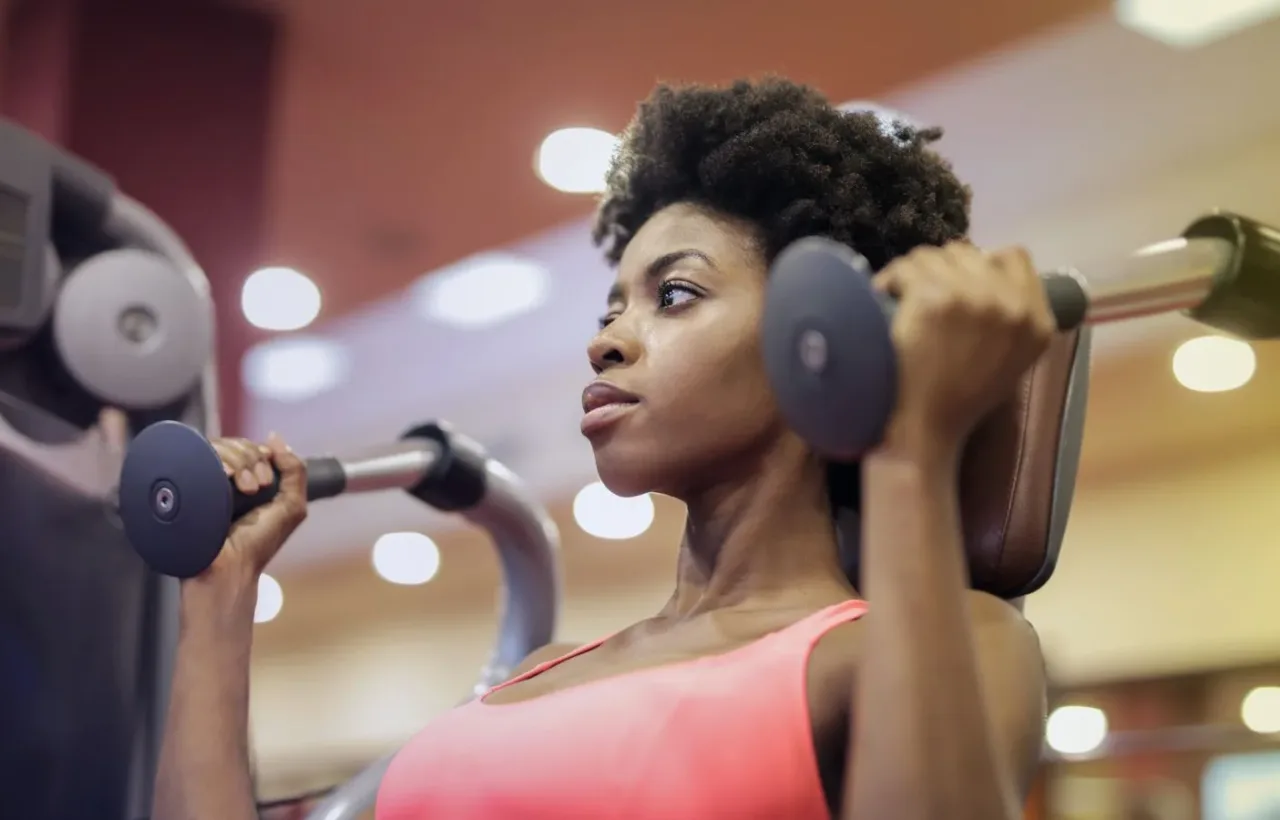

You can follow a muscle gain workout women at home plan and build real muscle without a gym, if the workouts are hard enough, progress over time, and cover every major muscle group. Home training works when you train legs, glutes, back, chest, shoulders, and arms two to three times a week, finish sets close to fatigue with good form, and add reps, resistance, or harder variations as you get stronger.
Food and rest matter as much as the exercises. This article gives you a three-day plan for dumbbells or body weight, clear progression rules, and protein targets, so you know exactly how to start and how to keep improving.
Can You Actually Gain Muscle at Home Without a Gym?
Yes. Muscle grows in response to challenging resistance training, not in response to a gym building. The equipment changes how you create that challenge, but body weight, bands, and dumbbells can all provide it, especially in your first year of training.
Muscle gain is also called hypertrophy. Hypertrophy is an increase in the size of muscle fibres after repeated training, adequate food, and recovery.
The limit at home is usually load, not effort. A bodyweight squat may become too easy for your legs long before a push-up becomes too easy for your chest. That is why the plan below uses single-leg work, pauses, slower lowering, and household or dumbbell load to keep lower-body exercises challenging.
According to the WHO physical activity fact sheet, adults should do muscle-strengthening activities involving all major muscle groups on two or more days a week. That is a health minimum. For visible muscle gain, you will usually need a structured plan, progressive difficulty, and enough total hard sets for each muscle.
What Muscle Gain Needs: Load, Progression, Food, and Rest
Four conditions have to be present at the same time. Missing one of them is the most common reason home training produces fitness, but little change in muscle size.
Load close to fatigue. A set builds the most muscle when the last few reps are difficult while your form stays controlled. The CDC guide to muscle-strengthening activities describes choosing a weight or resistance that makes another repetition hard to complete, using about 8 to 12 repetitions per set, with two or three sets giving more benefit than one.
Progression over weeks. Progressive overload means making training slightly harder over time as your body adapts. You can add a rep, add a small amount of weight, add a set, pause longer at the hardest point, or move to a harder variation. Without one of those changes, your body has little reason to adapt further.
Enough food, especially protein. Training provides the signal to build muscle. Food provides the energy and amino acids to do it. Eating far below your needs makes gaining muscle slower and harder.
Rest between sessions for the same muscle. Muscles do not need complete inactivity, but they do need time to recover. Mayo Clinic strength training guidance recommends resting one full day before exercising the same muscle group again. The three-day plan below spaces similar work across the week for that reason.
Choose the Equipment That Can Still Challenge You in Three Months
Start with what you have, but be honest about how long it will stay challenging. Adjustable dumbbells are the most practical long-term option for home muscle gain because they solve the load problem for legs, back, and glutes.
| Equipment | Best for | Main limit | Choose it if |
|---|---|---|---|
| Body weight only | Push-ups, split squats, planks, hip work for beginners | Legs and back get hard to load heavily | You are starting now and want no cost or setup |
| Resistance bands | Rows, press-downs, hip and shoulder work, travel | Resistance is hardest at the end of the movement and harder to track | You want low-cost load for upper-body pulling and glutes |
| One pair of dumbbells | Floor press, rows, Romanian deadlifts, goblet squats | One weight rarely fits both legs and arms well | You can pick a weight that challenges your lower body safely |
| Adjustable dumbbells | Every movement in this plan, for months | Higher upfront cost and more storage space | Muscle gain is the main goal and you plan to train at home long term |
| Backpack with books | Squats, split squats, rows, push-ups | Load shifts, fit is awkward, and heavy loads are unsafe | You need a short-term way to add weight this week |
Whichever option you choose, you also need a stable chair or step without wheels, a clear floor, and shoes or bare feet with a grip on the floor. Do not use a door, shelf, or piece of furniture for pulling or hanging unless it is built and rated for that load.
Muscle Gain Workout Women at Home: The 3-Day Plan
Train on three non-consecutive days, such as Monday, Wednesday, and Friday. Each workout trains the whole body, but with a different emphasis, so every major muscle gets hard work more than once a week without being trained on back-to-back days.
| Day | Emphasis | Main result you are after |
|---|---|---|
| Workout A | Squat and push | Quads, glutes, chest, shoulders, triceps |
| Workout B | Single-leg and hinge | Glutes, hamstrings, back, arms |
| Workout C | Step-up and press | Glutes, quads, shoulders, back, core |
Warm up for five minutes before each workout. March or walk briskly, then do easy sit-to-stands, arm circles, hip hinges with no weight, and one easy set of the first exercise. A warm-up is not a workout. Its job is to raise your temperature and let you rehearse the movements while you are fresh.
Safety first: This plan is for healthy adults who can exercise without pain. If you are pregnant, recently postpartum, returning after an injury, or you have pelvic floor symptoms, joint problems, high blood pressure, or another medical condition, check with your clinician or a physiotherapist before starting, and follow their limits over this plan. Stop a set for sharp pain, chest pain, dizziness, or numbness, not just tired muscles. This article is general education, not medical advice for your situation.
Workout A: Squat and Push
Rest 60 to 90 seconds between sets, and up to two minutes after squats if you need it to keep good form.
| Exercise | Sets and reps | How to make it fit your level |
|---|---|---|
| Goblet squat or sit-to-stand | 3 sets of 8-12 | Hold one dumbbell at your chest, use a backpack, or start from a chair and remove the chair as you improve |
| Push-up or dumbbell floor press | 3 sets of 6-12 | Use a counter for an easier push-up, the floor for a standard version, or a slow floor press with dumbbells |
| Dumbbell Romanian deadlift | 3 sets of 8-12 | Push your hips back with soft knees and a flat back, lowering the weights along your legs |
| One-arm dumbbell row or band row | 3 sets of 10-15 per side | Support your free knee and hand on a stable chair, pull to your ribs, and lower slowly |
| Dead bug | 2 sets of 8 per side | Keep your lower back gently pressed toward the floor and move only as far as you can control |
Workout B: Single-Leg and Hinge
Single-leg work is how you keep leg training effective without very heavy weights. One leg doing the work roughly doubles the demand on that leg, which is why split squats feel hard with a light dumbbell.
| Exercise | Sets and reps | How to make it fit your level |
|---|---|---|
| Reverse lunge or split squat | 3 sets of 8-10 per leg | Hold a wall or chair for balance at first, shorten the range if your knee is uncomfortable, then add load |
| Glute bridge or hip thrust | 3 sets of 10-15 | Pause for one second at the top, use a backpack or dumbbell on your hips when body weight feels easy |
| Overhead press | 3 sets of 8-12 | Use dumbbells, bands, or filled bottles, press without arching your lower back, and stop if you have shoulder pain |
| Chest-supported row or backpack row | 3 sets of 10-15 | Lean over a stable chair or hinge forward with a flat back, squeeze your shoulder blades, and avoid shrugging |
| Side plank | 2 sets of 20-40 seconds per side | Start from your knees, progress to your feet, and keep your hips stacked |
Workout C: Step-Up and Press
Use a low, stable step to start. Your whole foot should fit on it, and it should not move when you press into it.
| Exercise | Sets and reps | How to make it fit your level |
|---|---|---|
| Step-up | 3 sets of 8 per leg | Push through the top leg instead of bouncing off the floor, and hold dumbbells when body weight is easy |
| Dumbbell floor press or push-up | 3 sets of 8-12 | Choose the version that lets you finish with one to three good reps left in reserve |
| Hip hinge with one dumbbell or backpack | 3 sets of 10-12 | Hinge, do not squat, and keep the load close to your body through the whole rep |
| Band pull-apart or prone Y raise | 3 sets of 12-15 | Use light resistance and slow control, because this work targets the upper back and rear shoulders |
| Glute bridge hold or calf raise | 2 sets of 12-15 | Use the bridge hold on a glute-focused week, or calf raises if your calves get no other direct work |
If three full workouts feel like too much in week one, do two sets of each exercise for the first two weeks. Add the third set when you can finish the sessions without soreness that changes how you move for more than two days.
How to Progress When the Last Reps Get Easier
Progress in small steps, in a set order. Change only one variable at a time, so you know what worked and you do not jump to a load your joints are not ready for.
- Add reps first. Stay with the same weight until you reach the top of the rep range on every set with good form.
- Add a small amount of load. The ACSM position stand on progression models in resistance training recommends a load increase of about 2 to 10 percent for novice trainees when they can perform one to two repetitions over the target number.
- Drop back to the lower end of the rep range with the new load, then build the reps up again over the next sessions.
- If you have no heavier weight, add a one-second pause at the hardest point, slow the lowering phase to three seconds, or add a fourth set.
- Record the exercise, weight, sets, and reps after every workout. Memory is not reliable enough to guide progression over months.
Leave one to three good repetitions in reserve on most sets. That means you stop while you could still do one to three more reps with solid form. Training every set until you cannot move the weight is tiring, raises the risk of sloppy form, and is not required for muscle gain.
Reassess every four weeks. If your reps or loads have not moved at all, and you are sleeping and eating enough, the usual problem is that your sets are too easy, your sessions are too inconsistent, or the same muscles are not being trained often enough.
How Much Protein and Food Support Muscle Gain?
You do not need a special diet, supplements, or six small meals. You need enough total food to train hard and recover, and protein spread across the day in normal meals you will actually eat.
The International Society of Sports Nutrition position stand on protein and exercise states that 1.4 to 2.0 grams of protein per kilogram of body weight per day is sufficient for building and maintaining muscle mass for most exercising individuals. Beginners usually do well starting near the lower to middle part of that range and adjusting based on hunger, training, and results.
| Body weight | At 1.4 g per kg | At 1.6 g per kg | At 2.0 g per kg |
|---|---|---|---|
| 55 kg (121 lb) | 77 g per day | 88 g per day | 110 g per day |
| 65 kg (143 lb) | 91 g per day | 104 g per day | 130 g per day |
| 75 kg (165 lb) | 105 g per day | 120 g per day | 150 g per day |
| 85 kg (187 lb) | 119 g per day | 136 g per day | 170 g per day |
Use foods you already buy: eggs, Greek yogurt, milk, cheese, chicken, fish, lean meat, tofu, tempeh, lentils, beans, and protein powder if it makes the target easier. Protein powder is a convenience, not a requirement, because the total amount you eat over the day matters more than the source of any single serving.
If your weight has been stable and your strength is stuck, eat a little more at meals for two to three weeks and watch training performance, not just the scale. Muscle gain is slow, and a large calorie surplus mostly adds fat faster, not muscle faster.
If you have a history of an eating disorder, diabetes, kidney disease, or another condition that affects protein or calorie needs, get personal nutrition advice from a registered dietitian or your clinician instead of using a general target.
Mistakes That Slow Muscle Gain at Home
Most stalled plans fail for ordinary, fixable reasons. Random workouts feel varied, but they make progression almost impossible to track.
- Changing exercises every session. Keep the same main movements for at least four to six weeks, so you can get better at them and add load in a measurable way.
- Stopping sets when they start to burn. Muscle burn and muscle fatigue are not the same thing. The set should end because the weight feels hard to move with good form, not because the first hard rep appeared.
- Training only glutes and abs. Visible shape comes from balanced muscle across the legs, back, shoulders, and arms. Back and shoulder training also supports posture and makes rows, presses, and daily lifting easier.
- Adding cardio to cancel the food needed to gain. Walking and moderate cardio support health and do not need to be removed. Problems start when long, exhausting sessions leave you too tired to lift hard or eat enough.
- Chasing soreness. Soreness tells you a session was new or hard, not that it was productive. Steady progression over weeks is a better sign than being sore after every workout.
- Using momentum on rows and presses. Swinging turns a muscle exercise into a whole-body heave. Slow the lowering phase, pause briefly, and use a load you can control.
If a movement hurts the same joint in the same way for two sessions in a row, change the range, the grip, or the exercise. Do not push through joint pain to complete a plan as written.
Home Muscle Gain Questions, Answered Straight
Will this training make me bulky?
Unlikely to happen quickly or by accident. Muscle grows slowly, over months of consistent hard training and enough food, and you control the process the whole way. If you reach a level of muscle you like, you can train to maintain it by holding your loads and food steady.
Can I gain muscle with body weight only?
Yes, at first, especially for push-ups, split squats, and core work. Over time, legs and back usually need added load, harder single-leg versions, or much higher reps to keep progressing. Body weight is a starting point for most women, not a lifetime ceiling.
Do I need to train to failure to gain muscle?
No. Finishing most sets with one to three good reps left gives you a hard training signal with better form and less fatigue. Take the last set of a safe exercise, such as a glute bridge or band row, closer to failure if you want to check what true fatigue feels like.
What if I cannot do a floor push-up yet?
Start with a wall or kitchen counter and lower the surface as you get stronger. This works because a higher surface reduces the load your chest, shoulders, and arms have to press. You are building the same pattern, at a level you can progress from.
Can I gain muscle and lose fat at the same time?
It can happen for beginners, for people returning after a break, and for people with more body fat to lose, because their bodies can use stored energy while they adapt to new training. Progress is usually slower in both directions than focusing on one goal. Keep protein high, train progressively, and judge results over eight to twelve weeks, not week to week.
What should I do if I miss a week?
Resume the plan where you left it, using slightly lighter loads for the first session back if your reps have dropped. One missed week does not erase muscle. Long gaps matter because they break the habit and the progression record, not because your body resets in seven days.
Related Home Workouts
- Weight Gain Workout at Home
- Build Muscle Women Workout Home Plan
- Back Workout for Women at Home With No Equipment
How This Guide Was Put Together
This guide is based on the WHO physical activity recommendations, CDC guidance on muscle-strengthening activities, the ACSM position stand on progression in resistance training, and the International Society of Sports Nutrition position stand on protein and exercise, all linked above. It does not claim personal testing, expert review, or results from any individual trainee.
Sources
- World Health Organization. Physical activity fact sheet.
- Centers for Disease Control and Prevention. What Counts as Physical Activity for Adults.
- American College of Sports Medicine. Progression Models in Resistance Training for Healthy Adults. Medicine and Science in Sports and Exercise, 2009.
- Jäger, R., et al. International Society of Sports Nutrition Position Stand: Protein and Exercise. Journal of the International Society of Sports Nutrition, 2017.
- Mayo Clinic. Strength Training: Get Stronger, Leaner, Healthier.


