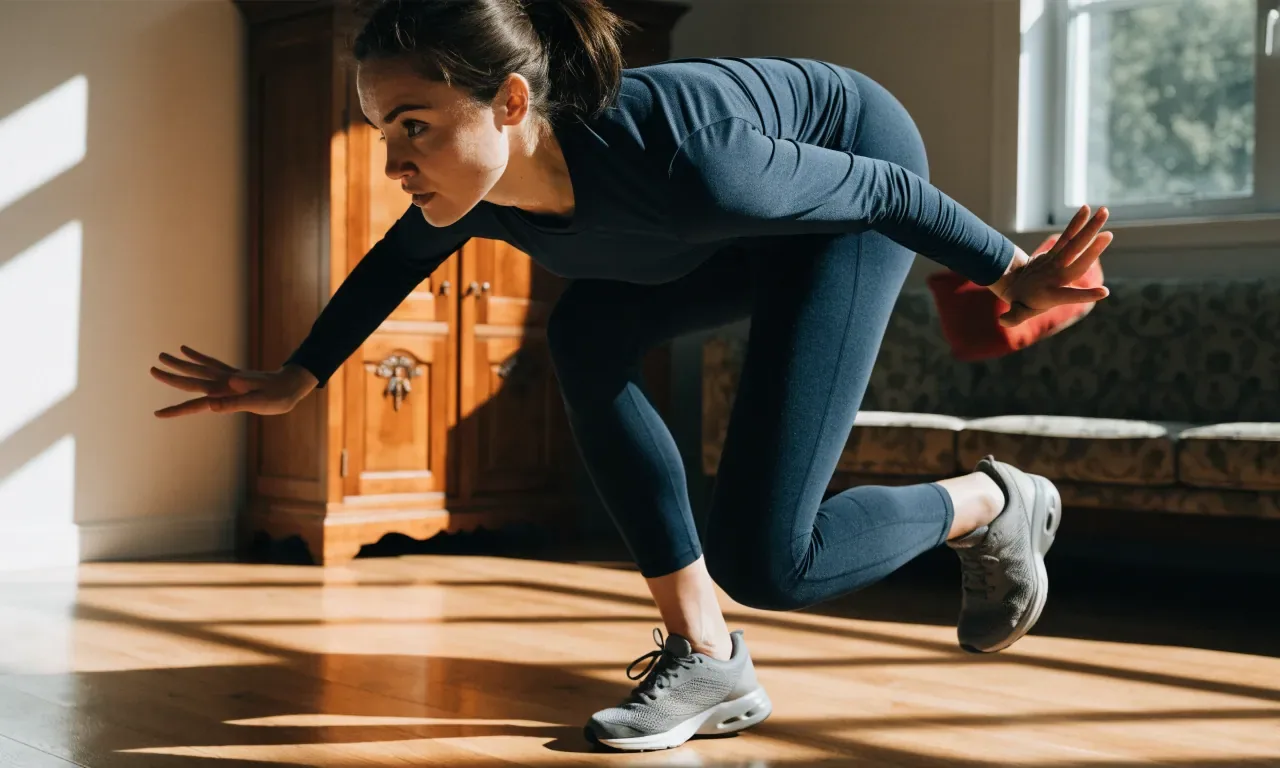

A workout for losing weight at home works best when it combines full-body strength training on 2 to 3 days a week with regular moderate cardio, such as brisk walking, on other days. That mix uses more energy than a short ab or arm routine alone, and it helps you keep muscle while you lose fat overall.
You do not need a gym or a large set of weights to start. You need a plan you can repeat, exercises you can make gradually harder, and enough weekly activity to build toward public health guidelines.
What a Workout for Losing Weight at Home Actually Has to Do
Fat loss happens when, over time, you use more energy than you take in, and your body draws on stored fat. A workout helps because it increases the energy you use during the session and, for strength work, helps preserve the muscle that gives your body shape.
No single home exercise removes fat from one area. A 2022 systematic review and meta-analysis by Ramirez-Campillo and colleagues pooled 13 studies with 1,158 participants and found that training a specific muscle had no effect on the fat around it — there was no spot reduction, regardless of the program according to Ramirez-Campillo et al. in Human Movement.
That is why this plan trains legs, hips, back, chest, abdomen, shoulders, and arms together. Big, full-body sessions are a better use of limited time than spending 30 minutes on crunches alone.
Why Strength Training Belongs in a Weight-Loss Plan, Not Just Cardio
Cardio burns energy while you do it, which matters. Walking, marching in place, cycling, and low-impact circuits all count toward your weekly aerobic total and are easier to do often.
Strength training adds something cardio alone does not do as well: it challenges muscle. According to Mayo Clinic guidance on strength training, you should choose a weight or resistance heavy enough to tire your muscles after about 12 to 15 repetitions, work all major muscle groups, and rest a muscle group before training it again.
Keeping muscle while you lose weight is the reason to lift, push, and pull, not just walk. If you only cut food and add light cardio, some of the weight you lose may be muscle. Strength work gives your body a reason to keep it.
The CDC explains muscle-strengthening in the same practical way: work to the point where another repetition would be hard, aim for 8 to 12 repetitions per set, do at least 1 set, and do 2 or 3 sets for more benefit, on at least 2 days a week according to the CDC guide to what counts as physical activity for adults.
How Much Activity to Build Toward Each Week
You do not need to hit a full guideline total in week one. You need a starting point you can repeat, then a clear target to build toward over several weeks.
The WHO physical activity guidance recommends that adults do at least 150 minutes of moderate-intensity activity a week, or at least 75 minutes of vigorous-intensity activity, and muscle-strengthening activities involving major muscle groups on 2 or more days a week. The WHO guidelines summary puts the moderate range at 150 to 300 minutes a week, with additional benefits toward the upper end according to the WHO guidelines on physical activity and sedentary behaviour.
Moderate intensity means you breathe harder, feel warm, and your heart beats faster, but the effort still feels controlled. Vigorous intensity feels much harder and is not required for this beginner plan.
A practical build looks like this:
- Week 1 to 2: 2 strength days, plus 20 to 30 minutes of walking or low-impact cardio on 2 other days
- Week 3 to 4: 3 strength days on non-consecutive days, plus walking or cardio on 2 other days
- After that: keep the strength days and add 10 minutes a week to your cardio until you are near 150 minutes of moderate activity in total
Walking between workouts counts. So does breaking activity into shorter bouts across the day, because the weekly total is what the guidelines describe.
Choose Your Equipment by What You Will Actually Use
Start with bodyweight if you have nothing. Add load only when a move feels too easy for the rep range and your form stays clean, because load is a progression tool, not a starting requirement.
| Option | Best if | Limits to know | Cost pattern |
|---|---|---|---|
| No equipment | You are a complete beginner or returning after a break | Pulling your back is hard, and leg moves get easy more quickly | Free, using a chair, wall, and floor |
| Backpack with books or water bottles | You want load for squats, hinges, and rows without buying weights | Weight is uneven and hard to measure exactly, so increase it slowly | Free to low cost |
| Resistance bands | You need a pulling option and have little space | Resistance changes through the movement, and bands can snap if damaged | Usually low cost |
| Adjustable dumbbells or a pair of dumbbells | You plan to train at home long term and want clear progression | Takes space and costs more upfront | Higher upfront cost |
Choose no equipment for the first two weeks if you are unsure. If sit-to-stands, push-ups, bridges, and split squats are already hard at 8 to 12 reps, equipment is not your limiting factor yet.
For any chair work, the NHS strength exercises guide advises choosing a solid, stable chair without wheels, sitting with your feet flat and knees bent at right angles, and building up slowly. That same setup works for sit-to-stands in this plan.
Before You Start: A Short Safety Check for Weight-Loss Training
This plan is for generally healthy adults. If you have not exercised for some time, have a medical condition or concern, are pregnant or recently postpartum, or take medicine that affects your heart rate, blood pressure, or blood sugar, talk to your doctor or clinician first — the NHS physical activity guidelines for adults aged 19 to 64 give that same advice.
Stop a session and seek medical advice for chest pain, severe breathlessness, dizziness, or sharp joint pain. Muscle effort and mild next-day soreness can be normal when you start, but sharp, shooting, or worsening pain is a signal to stop that exercise, not push through it.
This article is general information, not personal medical or diet advice. If weight loss is medically important for you, or you have tried repeatedly without progress, a clinician or registered dietitian can check for factors this workout cannot address.
The Weekly Plan: 3 Strength Days Plus Movement Days
Train strength on non-consecutive days, such as Monday, Wednesday, and Friday, because the same muscles need recovery time. Put walking or low-impact cardio on the days between, and keep at least one full rest day.
| Day | Session | Time |
|---|---|---|
| Monday | Workout A: full-body strength | 30 to 40 minutes |
| Tuesday | Walk or low-impact cardio | 20 to 40 minutes |
| Wednesday | Workout B: full-body strength | 30 to 40 minutes |
| Thursday | Walk, easy cardio, or rest | 20 to 40 minutes |
| Friday | Workout A or B: alternate each week | 30 to 40 minutes |
| Saturday | Walk or low-impact cardio | 30 to 45 minutes |
| Sunday | Rest | — |
Warm up for 5 minutes before each strength session. March in place, walk around your home, do easy sit-to-stands, and move your arms and shoulders gently, because warm muscles are easier to control than cold ones.
Do each exercise for 2 sets in weeks 1 to 2, then 3 sets when you can finish 2 sets with good form. Rest 60 to 90 seconds between sets, and move to the next exercise only when you can keep your form.
Workout A
1. Sit-to-stand or bodyweight squat — 8 to 12 reps Sit on the edge of a stable chair, feet hip-width apart, and lean slightly forward. Stand up using your legs, then sit down slowly. The NHS version of this move aims for 5 repetitions to start and says slower repetitions are better, so use the chair version until 12 reps feel controlled, then move to a free squat.
2. Push-up progression — 6 to 12 reps Use a wall if you are starting out, a counter or chair seat if that feels easy, your knees on the floor next, and a full floor push-up only when you can keep a straight line from head to knees or heels. Pick the version that makes the last 2 reps hard without your hips sagging.
3. Glute bridge — 10 to 15 reps Lie on your back, knees bent, feet flat. Push through your heels, lift your hips until your knees, hips, and shoulders form a line, squeeze your glutes for a second, then lower slowly. This trains hips and the back of your thighs without load on your knees.
4. Backpack or band row — 8 to 12 reps per side, or 8 to 12 reps with both arms Hinge forward slightly with a flat back, or sit and anchor a band in front of you. Pull your elbow back toward your ribs, pause, then return slowly. Rows matter at home because pushing is easy to train with push-ups, but pulling needs a deliberate setup.
5. Dead bug — 6 to 10 reps per side Lie on your back, arms up, knees bent at 90 degrees. Lower one arm and the opposite leg slowly while keeping your lower back gently pressed toward the floor, then return and switch sides. Stop the set if your back arches strongly, because control is the point of the move.
Workout B
1. Supported reverse lunge or split squat — 6 to 10 reps per leg Hold a chair or wall for balance. Step one foot back and lower straight down, or keep both feet planted in a split stance and move up and down. Use the supported version first, because balance should not be what limits a leg exercise for beginners.
2. Romanian deadlift hinge with a backpack or dumbbells — 8 to 12 reps Stand tall, soften your knees, and push your hips back while keeping the weight close to your legs and your back flat. Stand up by pushing your hips forward. You should feel this in your glutes and the back of your thighs, not as a sharp pull in your lower back.
3. Overhead press or extra push-up set — 8 to 12 reps Press light dumbbells, bottles, or a backpack overhead, or do a second, easier push-up variation if you have no load. Keep your ribs down and press without leaning back, because leaning turns a shoulder exercise into a back strain.
4. Calf raise — 10 to 15 reps Stand with a hand on a chair for balance, lift both heels as high as is comfortable, pause, then lower slowly. The NHS includes this move in its home strength routine and advises a slow, controlled movement.
5. Side plank from the knees — 20 to 40 seconds per side Lie on your side, knees bent, elbow under your shoulder. Lift your hips so your body forms a line from head to knees. Move to straight legs only when the knee version feels steady for 40 seconds.
Optional 8-Minute Low-Impact Finisher
Add this after a strength session once or twice a week only, not every day. It raises the energy cost of the session without jumping, which keeps it usable in an apartment and kinder to sore knees.
Work for 30 seconds, rest for 30 seconds, and repeat for 8 minutes:
- March in place with arm swings
- Step-ups on a low, stable step, alternating legs
- Sit-to-stand at a steady pace
- Standing punches or fast arm reaches
Choose the low-impact version if you have joint pain, live above neighbours, or are carrying a lot of extra weight at the start. Jumping is not required for a session to count as cardio.
How to Progress Without Making Every Week Harder in Every Way
Progress one variable at a time: reps first, then sets, then load or a harder version. That order keeps the jump small enough to repeat next week.
The ACSM position stand on progression models in resistance training recommends novice loads in the 8 to 12 repetition maximum range, training 2 to 3 days a week, and increasing load by 2 to 10% when you can do 1 to 2 repetitions over your target according to the ACSM position stand on progression models. At home, that translates to a simple rule.
If you hit 12 clean reps on both sets, make the next session slightly harder. Add 1 to 2 reps, add a set, slow the lowering phase to 3 seconds, or add a small amount of weight to the backpack. Do not change all four at once.
If your form breaks down, your joints hurt, or you cannot finish the session, you progressed too fast. Drop back to the last version you could do well for a week, because consistent moderate sessions support weight loss better than one very hard session followed by a week off.
Weight Loss Is Not Only the Workout: Food, Sleep, and Pace
The CDC describes healthy weight loss as a lifestyle that includes healthy eating patterns, regular physical activity, enough sleep, and stress management, not a workout alone The CDC also notes that people who lose weight at a gradual, steady pace of about 1 to 2 pounds a week are more likely to keep it off than people who lose weight more quickly. That is a general pattern, not a promise for any one person, and your rate may be slower, especially as you get closer to your goal.
Even modest loss can matter. The CDC gives the example that a 5% weight reduction for a person who weighs 200 pounds is 10 pounds, and that this change could lower the risk for some chronic diseases. Use that as perspective when the scale moves slowly: a small, kept-off loss is more useful than a large, short-lived one.
Track more than the scale once a week, at a similar time of day:
- Waist measurement at the navel, once a week
- How many reps or which push-up version you can do
- Total walking or cardio minutes for the week
- How clothes fit and how sessions feel
If the scale does not move for 3 to 4 weeks but your waist, strength, and weekly minutes are improving, keep going and review food portions and sleep before you add more exercise. If nothing is changing and you are following the plan, that is a reason to seek personal advice, not to cut food drastically on your own.
Mistakes That Quietly Stall Home Weight-Loss Workouts
- Doing only small-muscle or ab workouts. They burn little energy compared with full-body strength work, and they do not create spot reduction.
- Making every session a test. If you train to exhaustion daily, form slips and recovery suffers. Leave 1 to 3 good reps in reserve on most sets.
- Never adding resistance. Bodyweight is enough at first, but when 15 easy reps no longer challenge you, the stimulus has dropped. Progress using the rule above.
- Skipping the pulling work. A plan with only squats and push-ups leaves your back undertrained. Rows with a band, table, or backpack fix that gap.
- Counting only workout minutes. A 30-minute session helps, but sitting for the rest of the day limits your total. Short walks and breaking up sitting time add useful movement.
- Changing the plan every week. New exercises feel harder because they are unfamiliar, not because they work better. Keep the same A and B sessions for at least 4 weeks and progress them.
Weight-Loss-at-Home Questions, Answered Straight
How many days a week should I do a workout for losing weight at home?
Start with 2 strength days and build to 3 on non-consecutive days, plus walking or low-impact cardio on 2 to 3 other days. That structure matches the CDC and WHO guidance for muscle-strengthening on at least 2 days and regular aerobic activity across the week.
Can I lose weight with only 20-minute home workouts?
Yes, 20-minute sessions can contribute, especially if you do them often and they are full-body. They work best when they add up across the week and are paired with daily walking and eating changes, rather than being your only activity.
Do I need to do fasted workouts or train in the morning?
No. Timing and training before eating are not required for fat loss in this plan. Choose the time you can repeat most consistently, because a regular afternoon session you actually do beats a morning plan you skip.
Why is the scale not moving even though my clothes feel looser?
Your waist and clothing can change while total weight moves slowly, in part because strength training helps you keep or build muscle as fat decreases. Keep tracking waist, strength, and weekly activity for several weeks before judging the plan only by the scale.
Should I do cardio or strength first if I do both in one session?
Do strength first when both are in the same session, because you will have better form and more energy for lifting, pushing, and hinging. Put the short finisher at the end, as this plan does, and keep longer cardio for separate days when you can.
Related Home Workouts
How This Guide Was Put Together
This guide is based on the WHO physical activity guidance, the CDC guidance on what counts as muscle-strengthening activity and on gradual weight loss, NHS home strength and activity guidance, Mayo Clinic strength training guidance, the ACSM position stand on progression in resistance training, and the Ramirez-Campillo et al. 2022 systematic review on spot reduction linked above. It does not claim personal testing, expert review, or individual results.
Sources
- World Health Organization. Physical activity. https://www.who.int/initiatives/behealthy/physical-activity
- World Health Organization. WHO guidelines on physical activity and sedentary behaviour: at a glance, 2020. https://www.who.int/europe/publications/i/item/9789240014886
- Centers for Disease Control and Prevention. Steps for Losing Weight. https://www.cdc.gov/physical-activity-basics/adding-adults/what-counts.html
- NHS. Strength exercises. https://www.nhs.uk/live-well/exercise/strength-exercises/
- NHS. Physical activity guidelines for adults aged 19 to 64. https://www.nhs.uk/content-widgets/live-well/exercise/physical-activity-guidelines-for-adults-aged-19-to-64
- Mayo Clinic. Strength training — get stronger, leaner, healthier. https://sportsmedicine.mayoclinic.org/news/strength-training-get-stronger-leaner-healthier/
- American College of Sports Medicine. Progression models in resistance training for healthy adults, position stand, 2002. http://www.ncbi.nlm.nih.gov/pubmed/11828249
- Ramirez-Campillo R, et al. A proposed model to test the hypothesis of exercise-induced localized fat reduction (spot reduction), including a systematic review with meta-analysis. Human Movement, 2022. https://hummov.awf.wroc.pl/A-proposed-model-to-test-the-hypothesis-of-exercise-induced-localized-fat-reduction%2C143162%2C0%2C2.html


