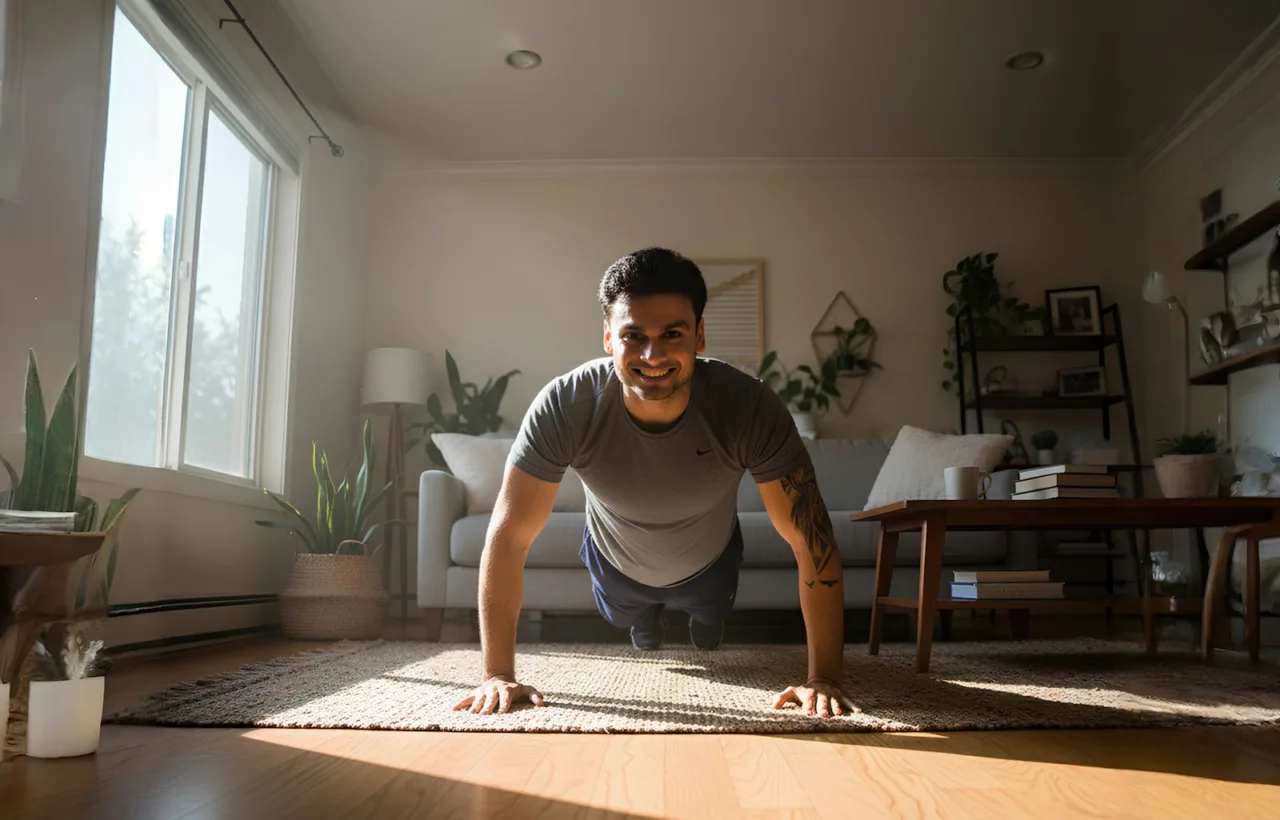

An effective upper body workout at home comes down to balancing two forces: pushing and pulling. Pushing is easy to train with no equipment — everyone can regress or progress a push-up. Pulling is where home plans quietly collapse, because the natural options want a bar you may not own. Skip pulling and you get the classic home-training shape: rounded shoulders, stalled progress, and a stubborn ceiling on every upper-body goal. This guide covers a complete push menu, three practical pull options that need nothing but furniture, ready-to-run sessions, and the setup rules that keep improvised anchors safe.
Why Pulling Is the Hard Part (and Why It Matters)
Pushing movements train the chest, front shoulders, and triceps. Pulling movements train the upper back, rear shoulders, and biceps — the muscles that hold your posture together and keep the shoulders healthy under all that pushing.
Training two pushes for every pull is common in gyms and nearly universal in home plans. The fix is not complex: find any stable horizontal edge at roughly waist height, and you can row. A sturdy table, a towel anchored in a closed door, and a loaded backpack cover every pull variation you need to start.
The Push Menu: Chest, Shoulders, Triceps
One exercise family covers each area. Progress by the ladder in each bullet:
- Chest — push-ups: start with hands elevated on a couch or table, move to the floor, then raise your feet on a chair. Keep your body in one straight line.
- Shoulders — pike push-ups: from a push-up position, walk your feet in and pike your hips high so the movement presses overhead. Elevate the feet to make it harder.
- Triceps — diamond push-ups: hands together under your chest, thumbs and index fingers forming a diamond. Move to your knees to make it easier.
- Triceps and shoulders — chair dips: hands on the edge of a stable chair, knees bent. Bend the elbows to lower your hips and press back up. Skip this if your shoulders dislike it.
The Pull Menu: Rows Without a Bar
All three options are rows, meaning you pull your chest toward a fixed edge. The more horizontal your body, the harder the row:
- Table row: lie under a sturdy table, grip the edge with an overhand grip, and pull your chest up to it. Test the table’s stability with partial weight before trusting it fully.
- Towel row: drape a thick towel over the top of a closed, latched door so both ends hang down on your side. Grip both ends, lean back with straight arms, and pull yourself upright. Check that the door is genuinely secure before every set.
- Backpack row: load a backpack with books and hold one strap in each hand or the top handle with both. Hinge forward with a flat back and pull the bag to your ribs, elbows brushing past your sides.
For biceps specifically, rows do most of the work. If you want a direct finisher, slow towel curls — standing on one end of a towel and curling the other end while resisting with the free hand — add focused tension with zero equipment.
| Exercise | Push or pull | Main muscles | Make it harder |
|---|---|---|---|
| Push-up | Push | Chest, front shoulders, triceps | Lower the hands, then raise the feet on a chair |
| Pike push-up | Push | Shoulders | Feet elevated on a chair |
| Diamond push-up | Push | Triceps | Move from knees to toes |
| Chair dips | Push | Triceps, shoulders | Skip if your shoulders dislike them |
| Table row | Pull | Upper back, rear shoulders, biceps | Body more horizontal |
| Towel row | Pull | Upper back, biceps | Lean back further |
| Backpack row | Pull | Upper back, lats | More books in the bag |
Match pushing and pulling sets roughly one to one.
Two Ready-to-Run Upper Body Sessions
Session A: The Balanced 25-Minute Session
Three rounds, resting about a minute between exercises. Alternate a push and a pull where you can, so one half of your body recovers while the other works:
- Push-up, any variation — 8 to 12 reps
- Table, towel, or backpack row — 8 to 12 reps
- Pike push-up — 6 to 10 reps
- Row variation number two — 10 to 12 reps
- Diamond push-up or chair dips — 6 to 10 reps
- Plank — 40 seconds
Session B: The Quick Pump Circuit
When time is short: work 45 seconds, rest 15, and cycle through push-up (your level), row (your anchor), pike push-up, and backpack row three times through. Roughly 15 minutes, and the shoulders will notice.
Anchor Setup Rules That Keep You Safe
Improvised pulling is as safe as the anchor you choose. Before adding resistance, apply these rules:
- Test every anchor gently first. Load a row with 20 percent effort before full effort. If the table slides, the door flexes, or the towel shifts, stop.
- Tables: prefer heavy wooden tables. Position yourself so you pull down and toward you, never sideways. Keep your feet planted to reduce side-to-side force.
- Doors: confirm the door is closed, latched, and opens away from you. Never anchor on a door someone might open mid-set.
- Backpacks: zip everything shut and check straps are sewn, not clipped, at the stress points. Books shift — that’s fine; a failing zipper is not.
- Stop rules: shoulder pinching during dips or pike push-ups means change the angle or skip the movement, not push through.
Can Push-Ups Really Match the Gym? What Studies Found
Backed by research
What the research says about bodyweight upper-body training
- When muscle activation was matched, elastic-band push-ups and the bench press produced similar strength gains.Source: Calatayud J et al. (2015). Bench press and push-up at comparable levels of muscle activity results in similar strength gains. J Strength Cond Res
- A 2017 training study found that push-ups and low-load bench pressing increased chest and triceps muscle thickness and strength by similar amounts.Source: Kikuchi N, Nakazato K (2017). Low-load bench press and push-up induce similar muscle hypertrophy and strength gain. J Exerc Sci Fit
- A 2017 meta-analysis found that muscle growth was similar with light and heavy loads, while maximal strength benefited most from heavy loads. Push-up and row progressions taken close to your limit fit that picture.Source: Schoenfeld BJ et al. (2017). Strength and hypertrophy adaptations between low- vs. high-load resistance training. J Strength Cond Res
- The American College of Sports Medicine recommends making an exercise harder once you can do one or two reps more than your target. Without weights, the equivalent is moving to the next variation on the ladder.Source: American College of Sports Medicine (2009). Progression models in resistance training for healthy adults. Med Sci Sports Exerc
How Often, and How Hard
Two or three upper-body sessions per week with at least a day between them is plenty for most people. Inside a session, finish each exercise with one or two good reps left in reserve — that’s the effort level that grows strength without wrecking recovery. Match your pushing and pulling volume roughly one to one: if you do three push-up sets, do three row sets.
Upper Body Training Questions
Can you build upper body muscle at home without equipment?
Yes, for most people, for a long time. Push-up, row, and pike progressions plus honest effort drive real muscle growth. The ceiling arrives when the hardest variations feel easy — at that point, a loaded backpack extends the runway, and beyond that, external weights become the practical choice.
What if I cannot do a single push-up yet?
Start with your hands elevated on a table or couch: the higher the hands, the easier the angle. Lower the surface a few inches whenever 12 reps feel manageable. It works the same muscles through the same pattern, just at a weight you can currently handle.
Are pike push-ups enough for shoulders?
For beginners and intermediates, yes — they train the pressing that builds shoulder strength and size. If you eventually find them easy, elevate your feet on a chair to shift even more body weight overhead.
How do I train biceps without dumbbells?
Rows train the biceps hard, especially with a palms-facing grip. Slow towel curls add direct work. The honest limit: maximal biceps growth wants heavier resistance than towels provide — a backpack progressively stuffed with books is the natural upgrade.
Is the towel-in-door row actually safe?
It can be, with checks: a solid, closed, latched door that opens away from you, a thick towel with both ends under your grip, and a gentle load test before a real set. If any part of the setup feels flimsy, treat the table row or backpack row as your default instead.
How this guide was put together: This guide was written to fix the most common gap in home upper-body training: pulling. Exercise selection, weekly volume and progression rules follow published guidance, mainly the WHO 2020 physical activity guidelines and the American College of Sports Medicine position stand on resistance training, plus the studies linked in this article. Last reviewed October 2026.
Safety note: This article is general fitness information, not medical advice. If you have an injury, a heart or blood-pressure condition, are pregnant or postpartum, or have not exercised in a long time, check with a doctor or physiotherapist before starting. Stop and get advice if you feel chest pain, dizziness, unusual breathlessness, or sharp joint pain. Stop any pulling exercise if your anchor shifts, flexes or creaks, as described in the anchor rules above.


