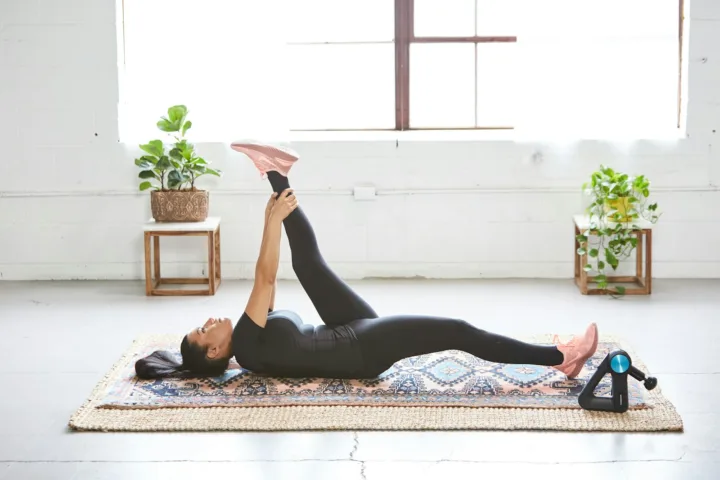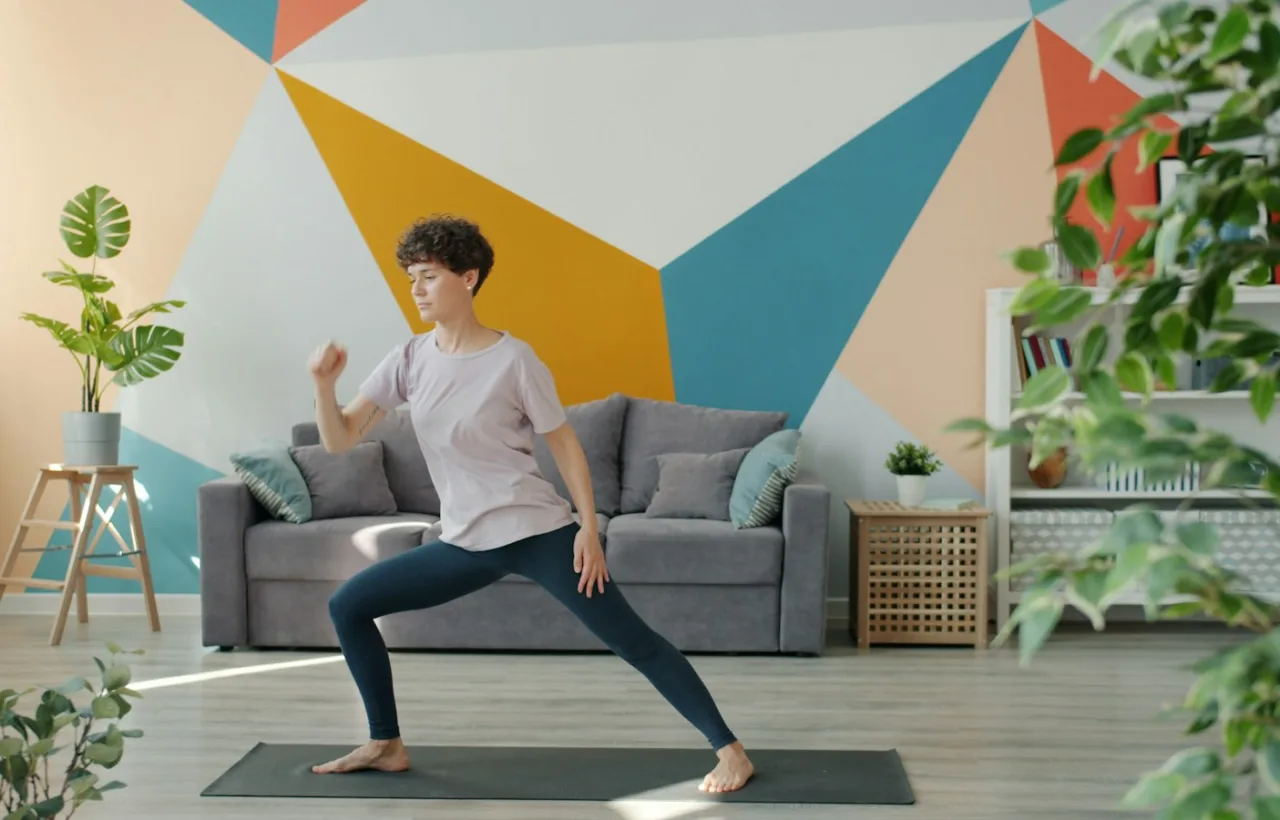

A lower body workout at home is defined by four movement patterns — squat, hinge, single-leg, and calf — not by the machines you are missing. Sequence them correctly and train them twice a week, and your legs and glutes get a genuinely complete stimulus with nothing but a floor, a wall, and a backpack. The plan below splits the work into two shorter sessions instead of one long slog: a squat-emphasis day and a hinge-emphasis day. Two different days beat one repetitive day for both recovery and progress.
What Makes a Lower Body Day Complete
- Squat pattern: knees bending under load — squats, split squats, step-ups. This covers your quads and a large share of your glutes.
- Hinge pattern: hips folding back — hip hinges and bridges. This is the hamstring and glute driver, and the pattern home routines skip most.
- Single-leg work: the home multiplier. One leg doing the work doubles the load per limb without adding a single plate.
- Calf raises: the finishing touch almost nobody trains until they notice their calves never changed.
Miss the hinge and your hamstrings stay the weak link in every run, jump, and lunge. Miss single-leg work and your balance — and the weaker side of your body — never catch up.
Session A: The Squat-Emphasis Day
Warm up with three minutes of marching, hip circles, and a set of easy bodyweight squats. Then:
- Squat variation of your level — 3 sets of 10 to 12 reps
- Split squat — 3 sets of 8 to 10 reps per leg
- Glute bridge — 3 sets of 12 to 15 reps
- Slow calf raise — 3 sets of 15 to 20 reps
- Wall sit — 2 sets of 30 to 45 seconds
Rest 60 to 90 seconds between sets. Choose the hardest squat variation you can own for clean reps — chair sit-to-stands for a beginner, bodyweight squats, or elevated split squats as you advance.
Session B: The Hinge-Emphasis Day
Same three-minute warm-up, then the other half of the picture:
- Backpack hip hinge — 3 sets of 10 to 12 reps
- Single-leg bridge — 3 sets of 10 reps per side
- Sliding leg curl — 3 sets of 10 to 12 reps
- Step-up onto a sturdy stair — 3 sets of 8 reps per leg
- Single-leg calf raise — 3 sets of 12 to 15 reps per side
Lower slowly on every rep — a three-second descent turns these from movement into training. The backpack in the hip hinge doubles as your adjustable load: books in, books out.
| Slot | Session A (squat emphasis) | Session B (hinge emphasis) |
|---|---|---|
| 1st | Squat variation: 3 × 10–12 | Backpack hip hinge: 3 × 10–12 |
| 2nd | Split squat: 3 × 8–10 per leg | Single-leg bridge: 3 × 10 per side |
| 3rd | Glute bridge: 3 × 12–15 | Sliding leg curl: 3 × 10–12 |
| 4th | Slow calf raise: 3 × 15–20 | Step-up: 3 × 8 per leg |
| 5th | Wall sit: 2 × 30–45 s | Single-leg calf raise: 3 × 12–15 per side |
Rest 60–90 seconds between sets. Warm up for three minutes before either session.
How to Order Exercises (and Why It Matters)
- Hardest and most technical first. Squats and hinges lead the session while your form is fresh; a tired body does sloppy hinges.
- Single-leg in the middle. It demands balance and control, so it wants you fresh but does not need to be first — after the main lift is the productive slot.
- Isolation and calves last. Calf raises add finishing volume. They can be done tired; the compound lifts cannot.
- Never sandwich heavy work between two fatigue-heavy pieces. The order above deliberately alternates demanding and less demanding work.
The Science Behind This Order and Schedule
Backed by research
Why the sessions are built this way
- The American College of Sports Medicine recommends ordering exercises large before small muscle groups, multiple-joint before single-joint, and higher intensity before lower. That is why squats and hinges lead each session and calves come last.Source: American College of Sports Medicine (2009). Progression models in resistance training for healthy adults. Med Sci Sports Exerc
- A 2016 meta-analysis found that training a muscle group twice a week led to more growth than once a week. Two lower-body sessions a week hits that mark.Source: Schoenfeld BJ et al. (2016). Effects of resistance training frequency on measures of muscle hypertrophy. Sports Med
- A 2013 review concluded that deep squats with good technique and gradual progression do not increase injury risk to passive tissues.Source: Hartmann H et al. (2013). Analysis of the load on the knee joint and vertebral column with changes in squatting depth and weight load. Sports Med
- ACSM advises progressing when you can do one or two reps more than your target, which is the logic behind the 12-week path below.Source: American College of Sports Medicine (2009). Progression models in resistance training for healthy adults. Med Sci Sports Exerc
The Weekly Plan: Where Legs Fit
A layout that works alongside upper-body or full-body training:
- Monday — Session A (squat emphasis)
- Tuesday — upper body or a walk
- Wednesday — easy day: walk, mobility, or nothing
- Thursday — Session B (hinge emphasis)
- Friday — upper body or a walk
- Weekend — rest, or light activity you enjoy
The one non-negotiable: at least one day between hard lower-body sessions. If you train full-body three times a week instead, alternate A and B as the leg portion and keep the rest of the session unchanged.
A 12-Week Progression Path
Bodyweight legs adapt quickly, so plan the next harder step before it arrives. The clean way is one change per phase:
- Weeks 1 to 4 — build reps: take every exercise to the top of its rep range with clean form.
- Weeks 5 to 8 — build control: keep the same versions, but lower for three seconds and pause briefly in the hardest position.
- Weeks 9 to 12 — build difficulty: move to unilateral or harder variations — elevated split squats, single-leg sit-to-stands, deeper hip hinges with a heavier backpack.
Keep one line of notes per session: the exercise, the variation, and the reps. Twelve weeks of one-line notes is a training history that tells you exactly when to progress — and exactly what you did the last time the same exercise felt hard.
| Weeks | Focus | What changes |
|---|---|---|
| 1–4 | Build reps | Take every exercise to the top of its rep range with clean form |
| 5–8 | Build control | Same exercises, 3-second lowering and a brief pause in the hardest position |
| 9–12 | Build difficulty | Harder or single-leg variations and a heavier backpack |
Lower Body Mistakes That Cost Progress
- Squat-only programming. Quads get built, hamstrings and calves stay untouched, and the imbalance shows up the first time you sprint for a bus.
- Never training close to hard. Legs respond to genuine effort. Finish sets with about two good reps left — comfortable sets train nothing.
- Daily leg days. Soreness is not a scoreboard, and strength grows during recovery. Two or three separated sessions beat five tired ones.
- Rushing the descent. Gravity does most of the work when you drop fast. The controlled lowering is half the exercise.
- Skipping calves for months. Two minutes per session covers them. The exercises above already put them last, which means the only way to skip them is on purpose.
- Quitting single-leg work when it humbles you. Wobbling on a split squat is the exercise working, not failing. Steady yourself on a wall and stay with it.
Lower Body Questions
How often should you train lower body at home?
Twice a week is the sweet spot for most people — one squat-emphasis and one hinge-emphasis session with days between them. Three lower-body days can work if you are recovered and the sessions are spread out; more than that trades progress for soreness.
Can you build strong legs without weights?
Yes, for longer than most people expect. Single-leg variations, tempo work, pauses, and a loaded backpack provide real progressive overload at home. The ceiling is honest, though: when the hardest single-leg variations become routine, external weight is the natural next step.
Should you do cardio on leg day?
Easy walking or light cycling — yes, anytime. Genuinely hard cardio and hard leg training on the same day compromise each other: do whichever you prioritize first, or ideally put them on separate days. If the schedule forces them together, hard legs first, easy cardio after.
Why are lunges so much harder than squats at home?
Because single-leg work removes your other leg from the equation: the same body weight loads half the muscles, plus your balance system has to work. That is exactly why the plan uses so much of it. When lunges feel impossible, hold a wall for balance or shorten the range — difficulty is a dial, not a wall.
How do I know when to make the sessions harder?
When your last set ends with roughly three or more clean reps still in reserve and no loss of form, it is time for the next step on the progression path: more reps first, then slower tempo, then a harder variation. Change one thing at a time so you know what is working.
How this guide was put together: This plan was written to split lower-body training into two complementary sessions. Exercise selection, weekly volume and progression rules follow published guidance, mainly the WHO 2020 physical activity guidelines and the American College of Sports Medicine position stand on resistance training, plus the studies linked in this article. Last reviewed October 2026.
Safety note: This article is general fitness information, not medical advice. If you have an injury, a heart or blood-pressure condition, are pregnant or postpartum, or have not exercised in a long time, check with a doctor or physiotherapist before starting. Stop and get advice if you feel chest pain, dizziness, unusual breathlessness, or sharp joint pain.