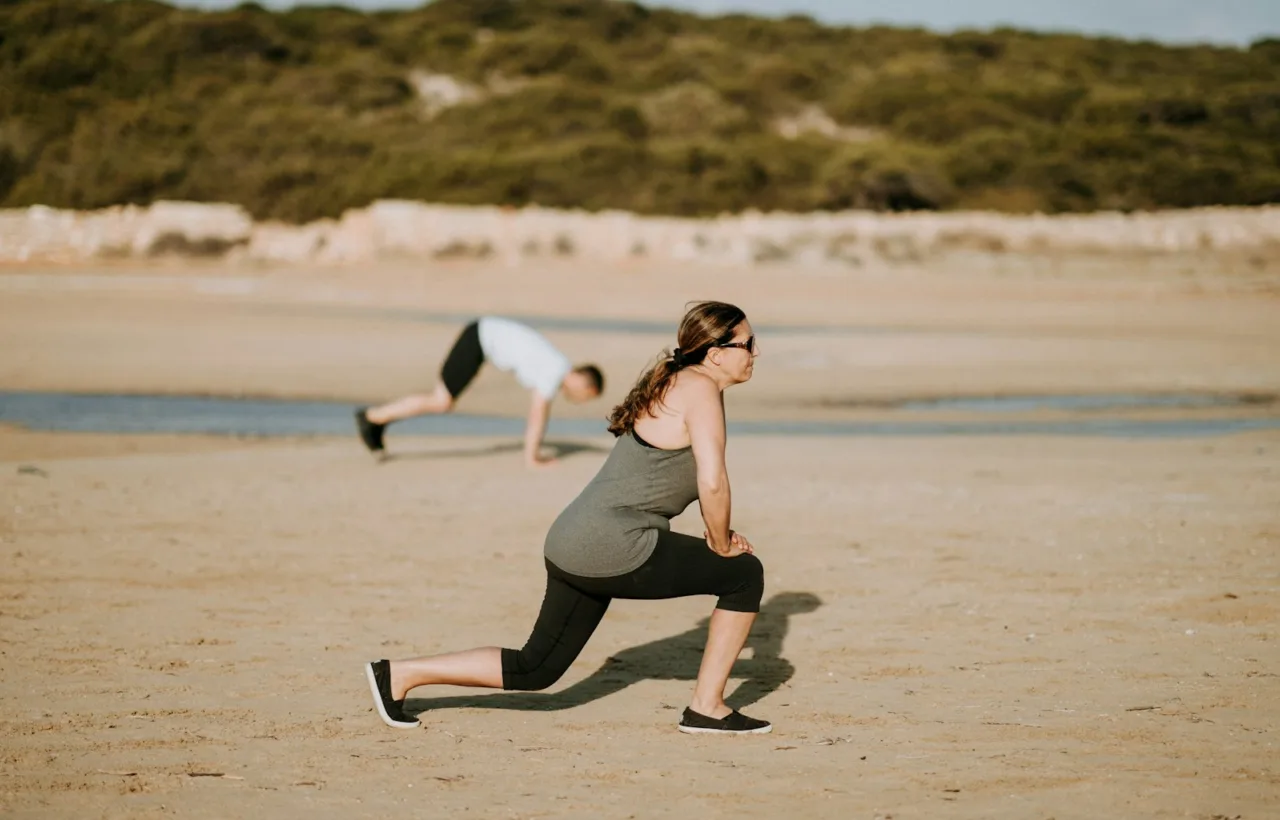

A thigh workout at home can build stronger, more defined thighs using bodyweight exercises like squats, lunges, and glute bridges. These movements target your quadriceps, hamstrings, and glutes effectively without needing a gym membership or equipment. The key is learning proper form, progressing the difficulty over time, and training consistently 2–3 times per week.
Home thigh training works because your legs already move your body weight all day. When you add controlled, full-range exercises and increase the challenge through tempo, volume, or single-leg variations, your muscles adapt by getting stronger. This guide covers the essential exercises, how to structure a routine, common mistakes that limit results, and how to keep progressing once bodyweight squats feel easy.
Why Training Your Thighs at Home Actually Works
Your thighs contain the largest muscle groups in your body: the quadriceps on the front, the hamstraces on the back, and the adductors on the inner thigh. These muscles respond to resistance, and your body weight provides enough load for most beginners and intermediates to build strength and muscle definition.
A 2015 study in the Journal of Strength and Conditioning Research found that push-ups and bench presses performed at comparable muscle activity produced similar strength gains over 5 weeks. The difference comes down to how you apply the resistance. At home, you control difficulty through exercise selection, tempo, and volume rather than adding weight plates.
The main challenge with home training is progressive overload for the posterior chain—your hamstrings and glutes. Squats and lunges hit your quads hard, but pulling movements that target the back of your thigh require either equipment or creative exercise variations. We'll cover both in the routine section below.
The Five Essential Bodyweight Thigh Exercises
These five movements cover all the major thigh muscles. Master these before adding variations or equipment.
Bodyweight Squat
Stand with feet shoulder-width apart, toes pointed slightly out. Push your hips back as if sitting into a chair, keeping your chest up and your weight on your whole foot. Lower until your thighs are at least parallel to the floor, then drive through your heels to stand. Your knees should track over your toes, not collapse inward.
Common mistake: lifting your heels off the floor at the bottom. If this happens, it usually means tight ankles or you're leaning too far forward. Try widening your stance slightly or placing small plates under your heels until your mobility improves.
Reverse Lunge
Step one foot back about two feet, then lower your back knee toward the floor until both knees form roughly 90-degree angles. Your front shin should stay vertical. Push through your front heel to return to standing, then repeat on the other side.
Reverse lunges are easier to balance than forward lunges and put less stress on your front knee, making them better for beginners or anyone with knee sensitivity.
Bulgarian Split Squat
Place the top of one foot on a chair or couch behind you, standing far enough forward that when you lower down, your front shin stays vertical. Lower until your back knee nearly touches the floor, then drive through your front heel to stand. This is a single-leg squat variation that dramatically increases the load on each leg.
If you feel this only in your front quad and not your glutes, move your front foot slightly farther from the chair.
Glute Bridge
Lie on your back with knees bent and feet flat on the floor, hip-width apart and close to your glutes. Press through your heels to lift your hips until your body forms a straight line from shoulders to knees. Squeeze your glutes at the top for one second, then lower. Keep your core tight so your lower back doesn't arch excessively.
For more hamstring activation, move your heels farther from your glutes so your shins are at about 45 degrees at the top position.
Single-Leg Romanian Deadlift
Stand on one leg with a slight bend in your knee. Hinge at your hips and reach your hands toward the floor while your back leg extends behind you for balance. Lower until you feel a stretch in your hamstring, keeping your back flat, then squeeze your glute to return to standing.
This exercise targets your hamstrings and glutes and improves balance. If you can't reach the floor without rounding your back, only go as far as your flexibility allows. Use a wall or chair for light support while learning the movement.
How to Structure a Home Thigh Routine
Train your thighs 2–3 times per week with at least one rest day between sessions. Your muscles need recovery time to get stronger.
A beginner routine (weeks 1–4):
- Bodyweight squat: 3 sets of 12–15 reps
- Reverse lunge: 3 sets of 10 reps per leg
- Glute bridge: 3 sets of 15 reps
- Single-leg Romanian deadlift (with support): 2 sets of 8 reps per leg
Rest 60–90 seconds between sets. The last two reps of each set should feel challenging but not impossible.
An intermediate routine (after week 4):
- Bulgarian split squat: 3 sets of 10 reps per leg
- Single-leg Romanian deadlift: 3 sets of 10 reps per leg
- Tempo squat (3 seconds down, 1 second pause, 1 second up): 3 sets of 10 reps
- Glute bridge: 3 sets of 20 reps
Once bodyweight feels easy, add difficulty by slowing down the lowering phase (eccentric), pausing at the bottom, or performing more reps. You can also use a loaded backpack, hold water jugs, or progress to pistol squat variations.
| Progression Method | When to Use It | Example |
|---|---|---|
| Add reps | You can do 15+ reps with good form | Move from 3×12 to 3×15 to 3×20 |
| Slow the tempo | Standard reps feel easy | 3-second lowering phase on squats |
| Add a pause | You want more time under tension | 2-second pause at the bottom of lunges |
| Single-leg variations | Bodyweight bilateral exercises feel light | Bulgarian split squat instead of regular squat |
| Weighted vest or backpack | You've maxed out bodyweight progressions | Add 10–20 lbs in a backpack |
Common Mistakes That Limit Your Results
Skipping the posterior chain. Most people do squats and lunges, which emphasize the quads, but neglect hamstrings and glutes. The result is muscle imbalance and underdeveloped thighs from the back view. Include at least one hip hinge movement (single-leg Romanian deadlift or glute bridge variation) in every workout.
Not progressing the difficulty. If you do the same 3 sets of 15 squats for months, your legs adapt and stop growing. Add reps, slow the tempo, or switch to harder variations every 4–6 weeks.
Letting your knees cave inward. This is called knee valgus, and it puts stress on your knee ligaments. It usually happens because of weak glutes or improper form. Film yourself from the front and watch whether your knees track over your toes or collapse inward. If they collapse, reduce the range of motion, slow down, and focus on pushing your knees outward throughout the movement.
Training too close to failure on single-leg exercises. Single-leg movements challenge your balance and stabilizers. Going to absolute failure increases injury risk because your form breaks down. Stop each set when you have 1–2 reps left in the tank until you're very experienced with the movement.
Not warming up. Jumping straight into weighted or single-leg exercises with cold muscles increases injury risk. Spend 5 minutes doing bodyweight squats, leg swings, and glute bridges at an easy pace before your working sets.
What the Research Says About Bodyweight Training
According to the American College of Sports Medicine’s 2009 position stand on resistance training, beginners should use loads they can lift for about 8–12 repetitions, a range many bodyweight leg exercises can be adjusted to fit. As you advance, the key is progressive overload—gradually increasing the training stimulus over time.
A 2017 study in the Journal of Exercise Science & Fitness found that push-ups produced muscle growth comparable to bench pressing at a similar load over 8 weeks. Single-leg variations and slower tempos are practical ways to make bodyweight exercises harder without adding load.
The limitation is that you'll eventually outgrow pure bodyweight training if your goal is maximal strength or significant hypertrophy. Most people reach this point after 6–12 months of consistent training, at which point adding resistance through a weighted vest, resistance bands, or dumbbells becomes necessary to keep progressing.
How to Know If You're Training Hard Enough
Use the rate of perceived exertion (RPE) scale to gauge intensity. On a scale of 1–10, where 10 is absolute failure (you cannot do another rep), aim for 7–8 on most sets. This means you could do 2–3 more reps if forced to, but the set feels challenging.
Physical signs you're working hard enough:
- Your muscles burn during the last few reps
- You feel fatigue between sets
- You experience mild muscle soreness 24–48 hours after training (especially in the first few weeks)
- You need the full rest period between sets
If you finish a workout feeling like you barely trained, you need to increase difficulty through one of the progression methods above. If you're so exhausted you can't complete your sets or your form breaks down completely, reduce the intensity or volume.
Balancing Quad and Hamstring Development
The quadriceps are easier to target at home because they're the prime movers in squats and lunges. Your hamstrings require hip hinge movements and knee flexion, which are harder to load without equipment.
To balance development:
- Include at least one hip hinge movement (single-leg RDL or glute bridge) for every quad-dominant movement (squat or lunge)
- Spend extra time on glute bridge variations, adding reps or tempo since they're less limited by balance
- Consider adding Nordic curls if you have a way to anchor your feet (under a couch or with a partner holding your ankles)—these are extremely effective for hamstrings but very challenging
- If muscle imbalance becomes noticeable, temporarily increase your hamstring-focused exercises to 2:1 ratio with quad exercises until balance improves
When Home Training Isn't Enough
Bodyweight thigh training works well for beginners and intermediates, but you'll eventually need additional resistance if your goals include:
- Building substantial muscle size (hypertrophy beyond moderate definition)
- Maximal strength for sports or performance
- Continuing to progress after 6–12 months of consistent bodyweight training
Signs you've outgrown bodyweight-only training:
- You can do 25+ Bulgarian split squats or 30+ regular squats per set
- You no longer feel challenged even with slow tempo and pauses
- You've stopped seeing visual or performance improvements for 6–8 weeks despite varying your routine
At this point, add external load through resistance bands, a weighted vest, dumbbells, or kettlebells. Alternatively, join a gym for access to barbells and machines that allow unlimited progressive overload.
Training Thighs at Home: Questions Answered
How long until I see results from home thigh workouts?
Most people notice improved muscle tone and strength within 4–6 weeks of consistent training. Visible muscle definition depends on your body fat percentage and takes 8–12 weeks. You'll feel stronger during daily activities (climbing stairs, standing from a chair) within 2–3 weeks.
Can I train thighs every day at home?
No. Your muscles grow during recovery, not during the workout. Training the same muscle groups every day doesn't allow enough recovery time and will stall your progress or lead to overuse injuries. Aim for 2–3 thigh workouts per week with at least one full rest day between sessions.
Do I need to feel sore after every workout?
Muscle soreness (delayed onset muscle soreness, or DOMS) is common when you first start training or try a new exercise, but it's not required for progress. As your body adapts, soreness decreases even though you're still building strength. Judge your workout quality by performance improvements and perceived effort, not soreness.
What if I have knee pain during squats or lunges?
Stop the exercise and check your form. Common causes include knees caving inward, heel lifting, or leaning too far forward. Reduce your range of motion (don't go as deep) and see if the pain disappears. If pain persists with proper form and reduced depth, try low-impact alternatives like glute bridges and single-leg Romanian deadlifts, and consult a healthcare provider if it continues.
How do home thigh workouts compare to gym training?
For beginners and intermediates, bodyweight training at home can build strength and muscle comparably to gym training when effort is high, according to research comparing push-ups with bench pressing. The main difference is progression: gyms offer barbells and machines that let you add weight indefinitely. At home, you're limited by bodyweight and creative variations, which eventually becomes a ceiling for advanced trainees.
Safety Note
The exercises in this guide are appropriate for most healthy adults. If you have existing knee, hip, or lower back problems, or any cardiovascular conditions, consult your doctor before starting a new exercise program. Start with easier variations and reduced range of motion if you're new to strength training, and stop any exercise that causes sharp pain.
How This Guide Was Put Together
This guide is based on the American College of Sports Medicine’s 2009 position stand on resistance training, along with peer-reviewed research comparing bodyweight and weight-based exercises. Exercise selection and programming follow standard progressive overload principles used by strength and conditioning professionals.


