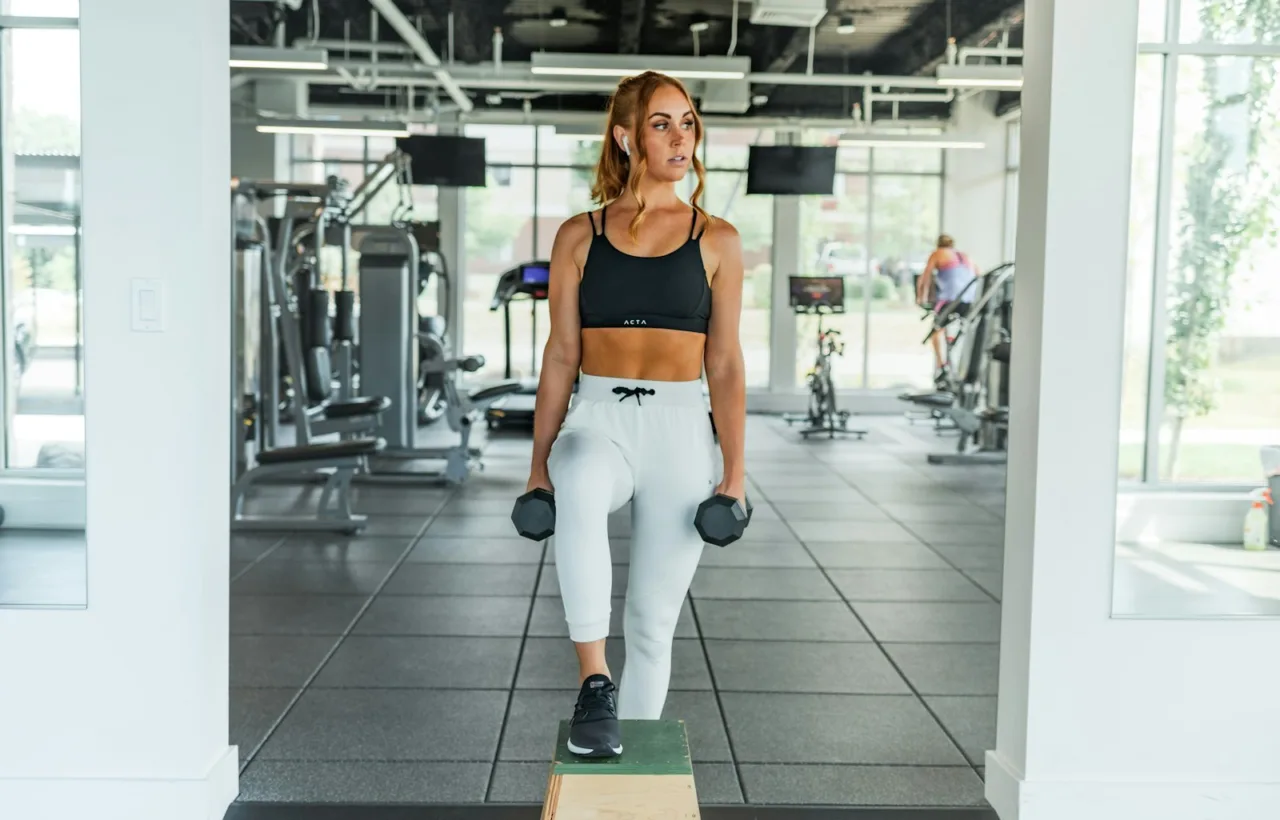

You can train your arms at home with a pair of dumbbells, a chair, and a wall—no gym required. A good arm workout for women at home pairs two pulling exercises with two pressing exercises, trains each muscle group twice a week, and takes about 25 minutes. After reading this, you'll know which moves to do, how heavy to go, and how to progress when the weights start to feel easy.
At-home arm training fails for one common reason: it becomes an all-biceps, all-the-time routine. The triceps make up roughly two-thirds of your upper-arm muscle mass, and the back muscles that shape your arms get skipped entirely when you only own light dumbbells. This plan fixes that imbalance with a simple weekly structure and clear progression rules.
Before starting: this is general fitness information, not medical advice. If you have shoulder, elbow, or wrist pain, a recent injury, or a health condition that affects exercise, check with a doctor or physiotherapist about which movements are safe for you. Stop any exercise that causes sharp pain.
What a Balanced Home Arm Workout Actually Includes
Arm training means four muscle groups, not two. The biceps bend your elbow, the triceps straighten it, the shoulders lift and press your arms, and the upper back pulls them back. Training only the front and inside of your arms creates strength gaps and does little for the shape most people are after.
Here's what each area does and which home exercises hit it:
| Muscle group | Job | Best home exercises | Gear needed |
|---|---|---|---|
| Biceps | Bends the elbow | Biceps curls, hammer curls, chin-ups (if you have a bar) | Dumbbells or resistance band |
| Triceps | Straightens the elbow | Overhead triceps extension, chair dips, close-grip push-ups, band pushdowns | One dumbbell, chair, or band |
| Shoulders | Presses and raises the arms | Shoulder press, lateral raises, front raises | Light dumbbells |
| Upper back | Pulls and stabilizes | Bent-over rows, band rows, reverse flys | Dumbbells or band |
If you own only one pair of dumbbells, the upper back and shoulders are where you'll feel limited first. A long resistance band—cheap and easy to store—solves most of that problem because you can anchor it to a door or wrap it around a sturdy post for rows and pull-aparts.
How Heavy Should You Go at Home?
Pick a weight that makes the last two reps of each set feel challenging but still clean. If you can breeze through 15 reps with perfect form, the weight is too light for building strength; if your form breaks down by rep six, it's too heavy.
Here's a rough starting guide. These are estimates for healthy adults new to strength training, not rules:
| Exercise | Typical starting weight (women) | Rep range |
|---|---|---|
| Biceps curl | 5–10 lb (2–5 kg) per hand | 8–12 |
| Shoulder press | 5–8 lb (2–4 kg) per hand | 8–12 |
| Lateral raise | 3–5 lb (1.5–2.5 kg) per hand | 10–15 |
| Overhead triceps extension | 8–15 lb (4–7 kg), one dumbbell | 10–12 |
| Bent-over row | 8–15 lb (4–7 kg) per hand | 8–12 |
Two rules keep progress honest. First, when you can complete the top of the rep range with good form on all sets, add the smallest increment you have—often 2–5 lb. Second, if you don't own heavier weights, slow the lowering phase to three seconds; that increases the challenge without new equipment.
The 25-Minute Home Arm Workout
Do this workout twice a week on non-consecutive days, such as Monday and Thursday. Warm up for five minutes first with arm circles, shoulder rolls, and 10 slow bodyweight squats to raise your body temperature.
- Bent-over rows — 3 sets of 8–12 reps. Hinge at the hips with a flat back, pull the weights toward your ribs, and squeeze your shoulder blades together.
- Shoulder press — 3 sets of 8–12 reps. Press overhead without arching your lower back; keep your ribs down.
- Biceps curls — 3 sets of 8–12 reps. Keep your elbows pinned to your sides and lower slowly.
- Overhead triceps extension — 3 sets of 10–12 reps. Hold one dumbbell with both hands behind your head and straighten your elbows.
- Lateral raises — 2 sets of 10–15 reps. Raise to shoulder height with a slight bend in the elbows; don't swing.
- Chair dips or close-grip push-ups — 2 sets to near-fatigue. Choose dips if your shoulders feel fine, push-ups if dips bother them.
Rest 60–90 seconds between sets. The whole session takes about 25 minutes once you know the moves.
Watch the Form for Each Exercise
A Bodyweight-Only Version
No weights at all? Swap the first four exercises for: towel rows (loop a towel around a sturdy door handle and lean back), wall push-ups or incline push-ups on a counter, doorway biceps isometrics (press your palm up against the door frame and hold for 20 seconds), and bench dips on a chair. Bodyweight-only training works, but progress comes from changing leverage—lowering the angle of push-ups, for example—rather than adding weight.
A Sample Two-Week Schedule
| Day | Session | Time |
|---|---|---|
| Monday | Full arm workout (above) | 25 min |
| Tuesday | Walk or light cardio | 20–30 min |
| Wednesday | Rest or gentle mobility | — |
| Thursday | Full arm workout (repeat) | 25 min |
| Friday | Walk or light cardio | 20–30 min |
| Saturday | Optional: one extra set of rows and push-ups | 10 min |
| Sunday | Rest | — |
Repeat this pattern for two weeks, then check your rep counts. If every set of an exercise now lands at the top of its range with clean form, increase the weight on that exercise the following week.
Mistakes That Stall Arm Progress at Home
Training arms every day. Muscles need roughly 48 hours to recover between hard sessions; daily arm work interferes with that repair. Twice a week is enough for most people, per general strength-training guidance.
Letting momentum do the work. Swinging your torso to curl a weight shifts the work to your hips and lower back. Slow the lowering phase and keep your torso still.
Skipping the back. Rows build the rear of the shoulder and upper back, which is what gives arms a defined look from behind. If you only have time for three exercises, make one of them a row.
Never changing the load. If the weights feel identical after eight weeks, something isn't progressing. Add reps, add weight, or slow the tempo.
Ignoring elbow and shoulder niggles. Soreness in the muscle is normal; sharp pain at a joint is not. Reduce the range of motion, lighten the load, or swap the exercise, and see a professional if it persists.
What the Guidelines Say About Frequency and Volume
The World Health Organization's 2020 guidelines on physical activity recommend adults do muscle-strengthening activities involving all major muscle groups on at least two days a week. The American College of Sports Medicine's position on resistance training similarly supports two to three sessions per week for general strength gains, with progressive overload—gradually increasing demand—as the key driver of improvement.
For arm-specific volume, general strength-training guidance suggests roughly 8–15 hard sets per muscle group per week for most people, which is why the plan above totals about 8–10 sets per arm muscle across two sessions. Doing substantially more isn't automatically better, and beginners often make steady progress on the lower end.
One honest limitation: at-home dumbbell training can build solid strength and muscle, but the ceiling arrives when your heaviest dumbbell feels light. At that point, options include a heavier adjustable set, a pull-up bar, or a gym membership for the arm work.
Questions About Training Arms at Home
How long until I see a difference in my arms?
Most people notice better muscle tone and strength within four to eight weeks of consistent twice-weekly training, though visible change depends on starting point, nutrition, and genetics. Strength gains often come first—expect your rep counts to climb before the mirror shows much.
Can I tone my arms without making them bulky?
Yes. Building noticeable muscle size takes months of consistent training with progressively heavier loads and a calorie surplus for many people. Training twice a week with moderate weights builds definition and strength without rapid size gains.
Are 5-pound dumbbells enough to start?
For many women with no strength-training background, yes—for curls, lateral raises, and shoulder presses. They will likely be too light for rows and triceps work within a few weeks, so plan to add a heavier pair or a resistance band.
Should I do cardio or arm workouts first?
Do strength training before long cardio in the same session, or separate them by several hours or a day. Hard cardio first can leave you too fatigued to lift with good form, which matters more for the exercises in this plan.
Is it okay to work arms the day after leg day?
Yes. Splitting leg and arm work on back-to-back days is fine because the muscle groups are different. Just avoid training the same arm muscles on consecutive days.
How This Guide Was Put Together
The frequency and structure here follow the World Health Organization’s 2020 physical activity guidelines and the American College of Sports Medicine’s resistance-training guidance, both referenced above. The exercise selection and programming choices reflect standard strength-training principles applied to home equipment; they are general fitness information, not a personalized program or medical advice.


