
You can train your chest at home with nothing more than a floor, a sturdy surface, and a plan. Push-ups and their many variations are the core of an effective chest workout at home, and adding a pair of dumbbells or a resistance band lets you keep progressing for months. This guide shows you exactly which movements to do, how to arrange them into a workout, and how to make each one harder or easier so you keep getting stronger rather than stalling after two weeks.
Your chest does one main job: pushing things away from your body. Every effective home chest exercise is a variation on that pushing motion, which is why you do not need a bench press to train it well. What you do need is a way to add resistance over time, and enough knowledge to keep your shoulders and wrists safe while you do it.
Push-Up Form: The Five Points That Matter
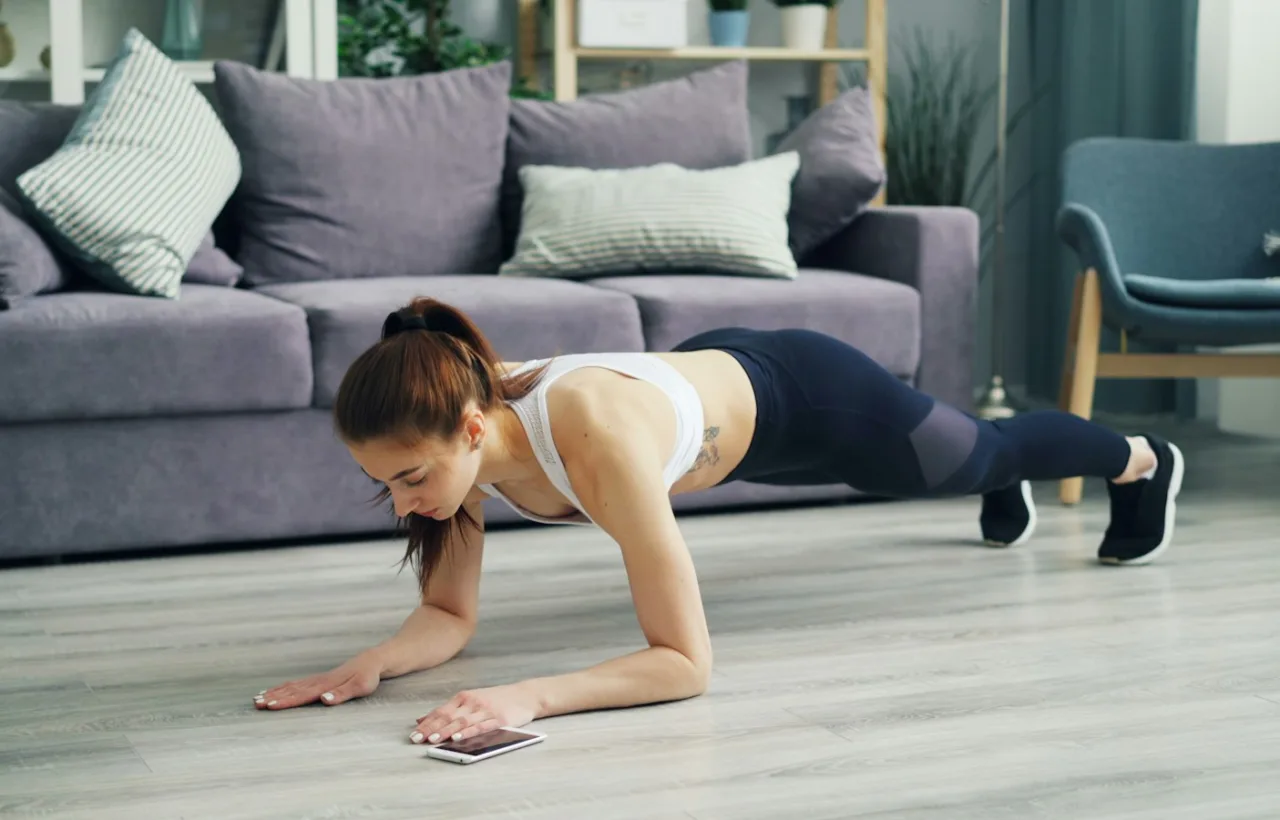
A push-up is a moving plank, and the quality of your plank decides whether your chest does the work or your lower back pays for it. Get these five points right before you add reps:
- Hands: slightly wider than shoulder-width, fingers spread, middle finger pointing roughly forward. Placing them too far forward strains the shoulders.
- Elbows: track back at roughly 45 degrees from your torso, not flared out to 90 degrees.
- Body line: squeeze your glutes and brace your abs so your body forms one straight line from head to heels.
- Depth: lower until your chest is about a fist's height from the floor, or as far as you can go with control.
- Head: keep your neck in line with your spine rather than craning toward the floor.
If your hips sag, you are not ready for full push-ups yet. Drop to an easier variation (covered below) and build the position first. A clean set of eight beats a sloppy set of twenty every time.
Watch the Push-Up Form
The Home Chest Exercises Worth Doing
These movements cover the chest from several angles and let you adjust difficulty without new equipment. Pick the ones that match your level.
| Exercise | Difficulty | What you need | Main benefit |
|---|---|---|---|
| Incline push-up (hands on a table or counter) | Beginner | A raised surface | Teaches the pattern with less load |
| Knee push-up | Beginner | Floor only | Builds strength with a shorter lever |
| Standard push-up | Intermediate | Floor only | The foundation movement |
| Decline push-up (feet raised) | Intermediate | A chair or step | Shifts load toward the upper chest |
| Wide push-up | Intermediate | Floor only | Emphasizes the outer chest |
| Diamond push-up | Advanced | Floor only | Adds triceps and inner-chest demand |
| Deficit push-up (hands on books or blocks) | Advanced | Two sturdy raised objects | Increases range of motion |
| Dumbbell floor press | Beginner to advanced | A pair of dumbbells | Lets you load the chest directly |
| Dumbbell fly on the floor | Intermediate | A pair of dumbbells | Trains the chest through a stretch |
| Band chest press | Beginner to intermediate | A resistance band | Easy to scale resistance |
The chest has three regions — the upper (clavicular) portion, the middle, and the lower portion. Decline push-ups bias the upper chest because your torso angles downward; standard and wide push-ups hit the middle; and dips or feet-on-floor pressing cover the lower part. You do not need to isolate each region, but rotating through angles once or twice a week keeps your training balanced.
Watch the Form for Each Variation
How to Structure a Chest Workout at Home
A simple, effective session has three parts: a warm-up, three to five chest movements, and a short finisher or cooldown. Keep the whole thing under 40 minutes.
- Warm up for 5 minutes. Do arm circles, shoulder rolls, and 10 slow incline push-ups against a wall or counter. This raises blood flow and rehearses the movement before you load it.
- Do your hardest push variation first. Strength work suffers when you are fatigued, so front-load the movement you want to improve.
- Add two or three supporting movements. Pair push-ups with a dumbbell floor press and a fly, or with a band press and a diamond push-up.
- Rest 60–90 seconds between sets. Shorter rest is fine for endurance; longer rest is better if your goal is strength.
- Finish with 2 minutes of easy movement — a few slow push-ups and some chest stretches.
A Sample Beginner Workout
Do 3 sets of each movement with 60 seconds of rest between sets:
- Incline push-up: 8–12 reps
- Knee push-up: 6–10 reps
- Dumbbell floor press (light weight): 10–12 reps
- Band chest press: 12–15 reps
If you have no dumbbells, swap the floor press for a second set of incline push-ups.
A Sample Intermediate Workout
Do 4 sets of the first two movements and 3 of the rest:
- Standard push-up: as many clean reps as you can, stopping 1–2 short of failure
- Decline push-up: 8–12 reps
- Dumbbell floor press: 8–12 reps
- Dumbbell fly: 10–12 reps
- Diamond push-up: 6–10 reps
How to Make It Harder Without a Bench
Progressive overload means gradually asking more of your muscles over time. At home, you have five reliable levers:
- Add reps. Move from 3 sets of 10 to 3 sets of 15 before changing the exercise.
- Slow the tempo. Lowering over three seconds instead of one makes the same rep much harder.
- Change the lever. Elevate your feet to shift more body weight onto your arms.
- Increase range of motion. Deficit push-ups, with your hands on low blocks, force a deeper stretch.
- Add external load. A weighted vest, dumbbells, or a resistance band across your back lets you load push-ups beyond body weight.
Add difficulty only when your current version feels controlled for all prescribed reps. A good rule of thumb: when you can complete your top set with two reps still in reserve, it is time to progress.
Common Mistakes and How to Fix Them
- Flared elbows. If your elbows point straight out, your shoulders take the load. Fix it by turning your hands slightly outward and thinking about tucking your elbows toward your ribs.
- Half reps. Cutting depth short limits how much the chest actually works. Use a raised surface for your hands if full depth is not yet possible.
- Holding your breath. Breathe in as you lower and out as you push. Holding your breath raises blood pressure and makes the set harder than it needs to be.
- Training chest every day. Your muscles need recovery to grow. Two or three chest sessions per week, with at least one rest day between them, is plenty for most people.
- Ignoring the back. A chest-only program pulls your shoulders forward over time. Balance each push with a pull — rows, band pull-aparts, or inverted rows.
What the Guidelines Say About Strength Training
The World Health Organization's 2020 physical activity guidelines recommend that adults do muscle-strengthening activities at all major muscle groups on at least two days a week. The chest is one of those major groups, which is why a regular push session earns a place in your weekly routine. According to the WHO guidelines, these sessions should be in addition to at least 150 minutes of moderate aerobic activity per week.
For most healthy adults, bodyweight and light dumbbell work at home can meet that strength goal. If you have a shoulder, wrist, or lower-back injury, or you have not exercised in a long time, check with a doctor or physiotherapist before starting a new program.
The advice in this guide is general fitness information, not medical advice. Push-ups load the wrists and shoulders heavily, so stop any movement that causes sharp pain and scale back to an easier variation if you feel joint discomfort rather than muscle effort.
Push-Up and Chest Training Questions
How many push-ups should I be able to do?
There is no universal number, and a "good" count depends on your age, body weight, and training history. Focus on adding one or two clean reps per week rather than chasing a target. Progression matters far more than the absolute number.
Can I build chest muscle with only bodyweight exercises?
Yes, for most beginners and intermediates. Muscle grows when you progressively overload it, and push-up variations provide enough resistance for months of progress. Once you can do 15–20 controlled decline or deficit push-ups, adding a weighted vest or dumbbells helps you keep advancing.
How long does it take to see results?
Strength gains often show up within a few weeks, while visible muscle changes typically take longer and depend on your training consistency, nutrition, and starting point. Nobody can promise a specific timeline, so track your reps and how your clothes fit rather than a deadline.
Should I do cardio and chest training on the same day?
You can, but do the strength work first if chest training is your priority. Hard cardio before lifting leaves you fatigued and reduces how much quality work you can do. If you prefer to separate them, put them on different days or at least a few hours apart.
Is a dumbbell floor press as good as a bench press?
The floor press limits how far your elbows can travel, so it works a slightly shorter range of motion than a bench press. That makes it easier on the shoulders and a solid substitute at home, though you may need to add push-up variations to make up for the reduced stretch.
How This Guide Was Put Together
This guide is based on the WHO 2020 physical activity guidelines for muscle-strengthening exercise and on standard strength-training principles for progressive overload and push-up technique. It does not include personal testing or expert review, and it is not a substitute for individual medical advice.
Sources
- World Health Organization, WHO Guidelines on Physical Activity and Sedentary Behaviour, 2020 — who.int


