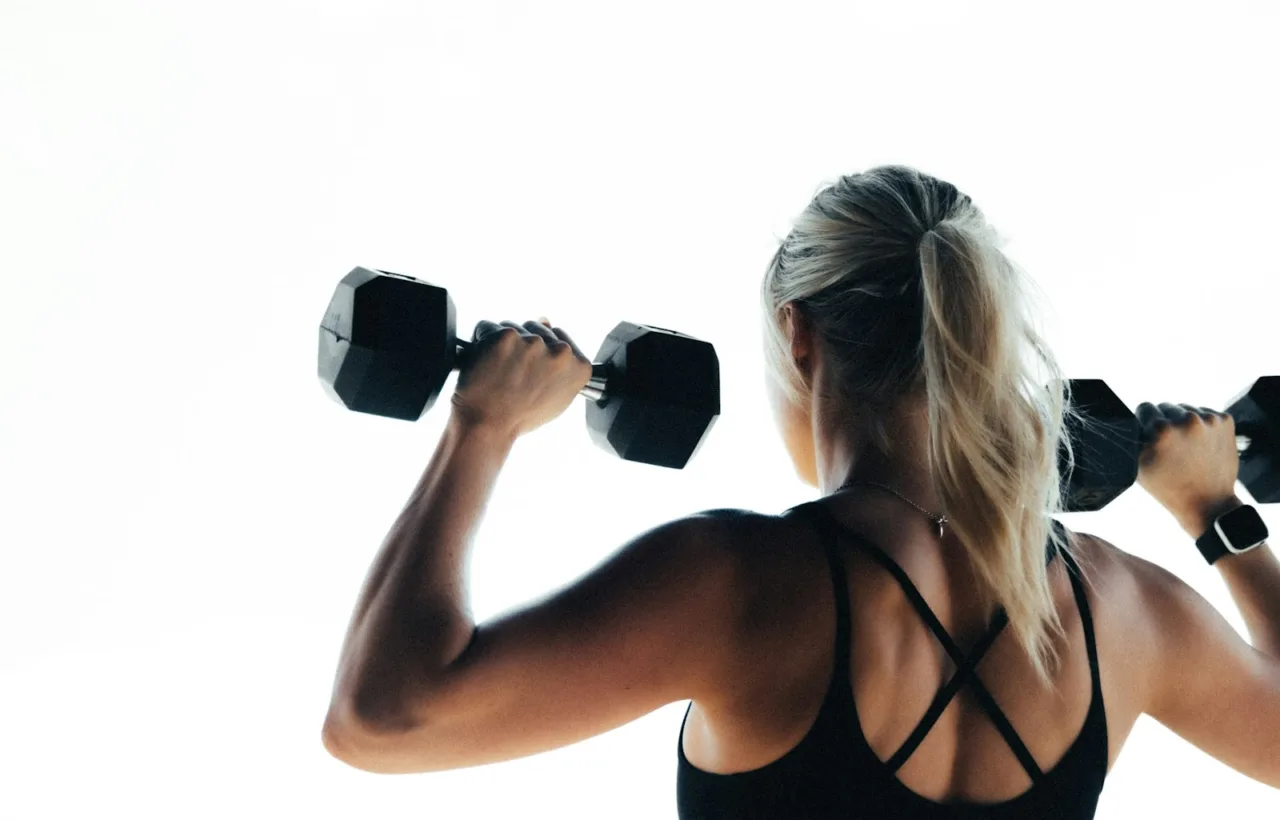

An hourglass body workout at home strengthens your shoulders, back, and glutes while keeping your waist defined. You need only bodyweight exercises, resistance bands, or light dumbbells, done 3–4 times per week. The shape comes from building muscle in the upper and lower body, not from spot-reducing fat at the waist.
This guide walks you through a complete routine, shows you how to progress without a gym, and explains what actually works. You'll know which exercises target the right muscle groups, how to structure a weekly plan, and how to troubleshoot the most common problems people hit when training at home.
What Creates the Hourglass Shape Through Exercise
The hourglass shape depends on the ratio between your shoulders, waist, and hips. Exercise influences this by building muscle in your shoulders (deltoids), upper back (lats), and glutes, which makes your waist appear narrower by comparison. You cannot change your bone structure or spot-reduce waist fat, but you can strengthen the frame around it.
Muscle-building requires progressive overload: you must gradually increase the resistance, reps, or sets over time. Bodyweight exercises work at first, but most people need to add resistance bands or dumbbells within a few weeks to keep progressing. Following the American College of Sports Medicine’s guidance for beginners, resistance training for muscle growth can involve 2–3 sessions per week, with 8–12 reps per set at a challenging weight.
Cardio and diet control overall body fat, which reveals the muscle you build. If your waist is currently larger than you want, combine this workout with a moderate calorie deficit. But cardio alone won't create the hourglass shape—you need the resistance work to build the shoulders and glutes.
The Core Exercise Selection for Hourglass Training at Home
Focus your workout on four muscle groups: side and rear deltoids (shoulders), lats (upper back), glutes (hips), and obliques (sides of the waist, trained carefully to avoid thickening).
Shoulder Exercises (Width at the Top)
Lateral raises target the side deltoids. Stand with a light dumbbell or resistance band in each hand, arms at your sides. Raise your arms out to shoulder height, leading with your elbows, then lower slowly. Your elbows should stay slightly bent. Start with 3 sets of 12–15 reps.
Pike push-ups build the front and side deltoids without equipment. Start in a downward dog position, hands and feet on the floor, hips high. Bend your elbows to lower your head toward the floor, then push back up. If this is too hard, elevate your hands on a chair or table. Work up to 3 sets of 8–12 reps.
Reverse flyes with bands work the rear deltoids. Loop a resistance band around a sturdy post at chest height. Hold one end in each hand, step back until there's tension, and pull both hands out to the sides, squeezing your shoulder blades together. Do 3 sets of 12–15 reps.
Back Exercises (Width and Taper)
Resistance band rows build the lats and mid-back. Anchor a band at waist height, hold both ends, and step back. Pull the band toward your waist, keeping your elbows close to your body, then release slowly. Do 3 sets of 12–15 reps.
Inverted rows use a sturdy table or low bar. Lie underneath, grab the edge, and pull your chest up to the table while keeping your body straight. Lower with control. If you can't complete 8 reps, bend your knees to make it easier. Build to 3 sets of 10–15 reps.
Glute Exercises (Width at the Bottom)
Hip thrusts are the most effective glute builder. Sit on the floor with your upper back against a couch or bench, knees bent, feet flat. Drive through your heels to lift your hips until your body forms a straight line from shoulders to knees. Squeeze at the top, then lower. Add weight by holding a dumbbell or heavy object on your hips. Do 3 sets of 12–15 reps.
Bulgarian split squats work each glute individually. Place one foot behind you on a chair, step the other foot forward, and lower into a lunge until your front thigh is parallel to the floor. Push back up. Do 3 sets of 10–12 reps per leg, adding dumbbells as you get stronger.
Side-lying hip abductions target the gluteus medius, which shapes the upper hip. Lie on your side, legs straight, and lift your top leg about 45 degrees, then lower. Keep your hips stacked and your toes pointing forward, not up. Do 3 sets of 15–20 reps per side.
Waist Definition (Minimal Direct Work)
Most of your waist definition comes from reducing overall body fat, not from targeted ab exercises. Overdeveloping your obliques (the sides of your waist) can make your waist appear wider, which works against the hourglass shape.
Planks strengthen your core without adding bulk. Hold a push-up position with your forearms on the floor, body straight, for 30–60 seconds. Do 3 sets. Planks stabilize your torso during other exercises and improve posture, which makes your waist look narrower.
Avoid weighted side bends, heavy Russian twists, and high-volume oblique work if your goal is a narrow waist.
Your Weekly Hourglass Workout Plan
This plan trains each muscle group twice per week with at least one rest day in between. Rest days let your muscles recover and grow.
| Day | Focus | Exercises |
|---|---|---|
| Monday | Shoulders & Back | Lateral raises, pike push-ups, reverse flyes, resistance band rows |
| Tuesday | Glutes & Core | Hip thrusts, Bulgarian split squats, side-lying abductions, planks |
| Wednesday | Rest or light cardio | Walk, yoga, or complete rest |
| Thursday | Shoulders & Back | Lateral raises, inverted rows, reverse flyes, resistance band rows |
| Friday | Glutes & Core | Hip thrusts, Bulgarian split squats, side-lying abductions, planks |
| Weekend | Rest or light cardio | One or both days off, optional 20–30 min cardio |
Do each exercise for 3 sets, resting 60–90 seconds between sets. Each session should take 35–45 minutes. If you can do more than 15 reps of an exercise with good form, add resistance by using a heavier band, holding dumbbells, or making the movement harder (for example, elevating your feet during hip thrusts).
How to Progress Without Gym Equipment
Bodyweight exercises stop building muscle once your body adapts. To keep progressing, you need to make the exercises harder every 2–3 weeks.
Resistance bands (medium to heavy resistance) are the most versatile home tool. They cost $15–$30 and let you add variable resistance to almost every exercise. Loop them around your thighs for hip thrusts, hold them for rows and lateral raises, or anchor them to a door for pull variations.
Adjustable dumbbells or water jugs add fixed resistance. Start with 5–15 lb dumbbells depending on the exercise. If you don't have dumbbells, fill gallon jugs with water (8.3 lb each) or sand (12–13 lb each).
Tempo training makes bodyweight moves harder without adding weight. Slow down the lowering phase to 3–4 seconds. For example, during a pike push-up, take 4 seconds to lower your head toward the floor, then push up normally. This increases time under tension, which stimulates muscle growth.
Unilateral work (one side at a time) doubles the challenge. Do single-leg hip thrusts or single-arm rows instead of the two-sided version.
Track your workouts in a notebook or app. Write down the resistance, reps, and sets for each exercise. When you can complete all 3 sets at the high end of the rep range (for example, 15 reps), increase the resistance or difficulty the next session.
Common Mistakes and How to Fix Them
Doing cardio instead of resistance work. Cardio burns calories but doesn't build the muscle that creates the hourglass shape. Running, cycling, or jump rope should supplement your resistance routine, not replace it. If time is limited, prioritize the strength work.
Training abs too much. Daily ab circuits and weighted oblique exercises can make your waist thicker. The obliques are muscles—they grow when you overload them, just like any other muscle. Stick to planks and let compound exercises like rows and hip thrusts provide indirect core work.
Not eating enough protein. The International Society of Sports Nutrition recommends about 1.4–2.0 grams of protein per kilogram of body weight per day (roughly 0.6–0.9 g per pound) for most people who exercise. (source: Jäger R et al., 2017, J Int Soc Sports Nutr) If you weigh 140 lb (about 64 kg), that works out to roughly 90–125 g of protein daily from sources like chicken, fish, eggs, Greek yogurt, lentils, and protein powder.
Expecting changes in two weeks. Visible muscle growth takes 6–12 weeks of consistent training, and most people see waist changes (from fat loss) before they see shoulder or glute growth. Take progress photos every 4 weeks in the same lighting and position—this shows changes better than daily mirror checks.
Skipping the shoulder work to focus only on glutes. The hourglass shape requires both the top and bottom to be developed. If you only train glutes, your proportions won't change as much. Balance your volume: if you do 9 sets of glute work per week, do at least 9 sets for shoulders and back.
Why Pulling Exercises Are Hard at Home (and What to Do About It)
Most people can do push-ups and squats at home without trouble, but pulling movements—rows, pull-ups, and reverse flyes—are harder to replicate. These exercises build the lats and upper back, which are critical for the hourglass taper.
Resistance bands solve most pulling gaps. A single heavy-resistance loop band ($15–$25) lets you do rows, reverse flyes, and lat pullovers by anchoring it to a door or sturdy post. For rows, anchor the band at waist height and pull it toward your torso. For lat pullovers, anchor it overhead and pull the band down to your thighs.
Inverted rows under a table work if you have a sturdy dining table or desk. Lie underneath, grab the edge with both hands, and pull your chest up. The lower the table, the harder the movement. If your table is too high, elevate your feet on a chair.
Avoid relying on light lat pulldowns with light bands. A common mistake is doing dozens of reps with a thin, easy-stretch band. Your lats are a large, strong muscle group—they need meaningful resistance. Use a band that makes 12 reps genuinely hard, or switch to a harder variation.
If you have access to a sturdy tree branch, door-mounted pull-up bar, or playground equipment, add pull-ups or Australian pull-ups (inverted rows on a low bar) once a week.
What the Research Says About Resistance Training and Body Composition
Resistance training increases lean muscle mass and improves body composition more effectively than cardio alone. A 2017 meta-analysis in the Journal of Strength and Conditioning Research found that lighter and heavier loads produced similar muscle growth when sets were taken to failure, which matters if you train at home without heavy equipment.
The American College of Sports Medicine recommends 8–12 repetitions per set for beginners, using a weight that makes the set genuinely challenging by the final reps. For home workouts with lighter resistance, higher reps (12–20) can also build muscle as long as you train close to failure.
Spot reduction—losing fat from a specific area—has been consistently disproven. A study in the Journal of Strength and Conditioning Research (2011) found that six weeks of abdominal exercises alone did not reduce abdominal fat compared with a group that did no exercise. (source: Vispute SS et al., 2011, J Strength Cond Res) Fat loss happens across the whole body based on your calorie deficit and genetics.
Muscle growth is local, but fat loss is not. That's why this routine builds specific muscles (shoulders, glutes) while relying on overall calorie balance to reduce waist size.
How Long Until You See Results
Most people notice strength improvements in 2–3 weeks—exercises feel easier, and you can add reps or resistance. Visible muscle growth appears around week 6–8, starting with better posture and a slight widening of the shoulders or lift in the glutes. The hourglass shape becomes clear after 12–16 weeks of consistent training and fat loss if needed.
Progress depends on your starting point. If you're new to resistance training, you'll build muscle faster in the first 6 months (beginner gains). If you're already active, changes will be slower but still measurable.
Fat loss, which makes your waist appear smaller, depends on your calorie deficit. A safe rate is 0.5–1% of body weight per week, or roughly 1–2 lb per week for most people. Faster weight loss risks losing muscle along with fat.
Take front, side, and back photos in the same spot and lighting every 4 weeks. Measure your shoulders (widest point), waist (narrowest point, usually at the belly button), and hips (widest part of your glutes). The ratio is more meaningful than any single measurement.
Questions About Hourglass Workouts at Home
Can you build an hourglass shape without weights?
You can make early progress with bodyweight exercises, but most people need to add resistance within 4–8 weeks to keep building muscle. Resistance bands are the most practical option—they're portable, inexpensive, and let you load the muscles that create the hourglass shape (shoulders, back, glutes).
How many days per week should you train?
3–4 days per week of resistance training, with at least one rest day between sessions for the same muscle group. More isn't always better—muscles grow during rest, not during the workout. If you do 6–7 days, split your sessions so you're not training shoulders, back, or glutes on consecutive days.
Will this routine make your waist smaller?
This routine builds muscle in your shoulders and glutes, which makes your waist look smaller by comparison. If your waist is also carrying excess fat, you'll need a calorie deficit to reduce its size. The exercises alone won't shrink your waist, but they will improve your proportions even if your waist measurement stays the same.
Do you need to do cardio?
Cardio supports fat loss and cardiovascular health, but it's optional for the hourglass shape itself. If you want to reduce waist size or improve overall fitness, add 20–30 minutes of moderate cardio (walking, cycling, swimming) on rest days or after your resistance workout. Don't replace resistance sessions with cardio.
What if you have wide hips but narrow shoulders?
This is a common starting point, and it's ideal for hourglass training because you already have the lower width. Focus extra volume on shoulder and back exercises—add a fourth set of lateral raises and reverse flyes, or do a third shoulder session per week. Your upper body will respond with consistent training.
Can resistance bands really replace dumbbells?
For most home exercises, yes. Bands provide enough resistance to build muscle in the 8–20 rep range, which is the effective range for hypertrophy. They work especially well for rows, lateral raises, and reverse flyes. The main limitation is hip thrusts and split squats, where dumbbells or weighted objects give you more stable, measurable load. If you can only choose one, buy a set of medium and heavy resistance loop bands.
Safety note: This article is general fitness information, not medical advice. If you have an injury, a heart or blood-pressure condition, are pregnant or postpartum, or have not exercised in a long time, check with a doctor or physiotherapist before starting. Stop and get advice if you feel chest pain, dizziness, unusual breathlessness, or sharp joint pain. Your body shape also depends on genetics and overall body fat, which no exercise plan fully controls.
How This Guide Was Put Together
This routine is based on resistance training principles from the American College of Sports Medicine's guidelines on muscle hypertrophy and the exercise selection used in structured body recomposition programs. The advice on fat loss and spot reduction reflects findings from peer-reviewed studies in exercise physiology, cited in this article.


