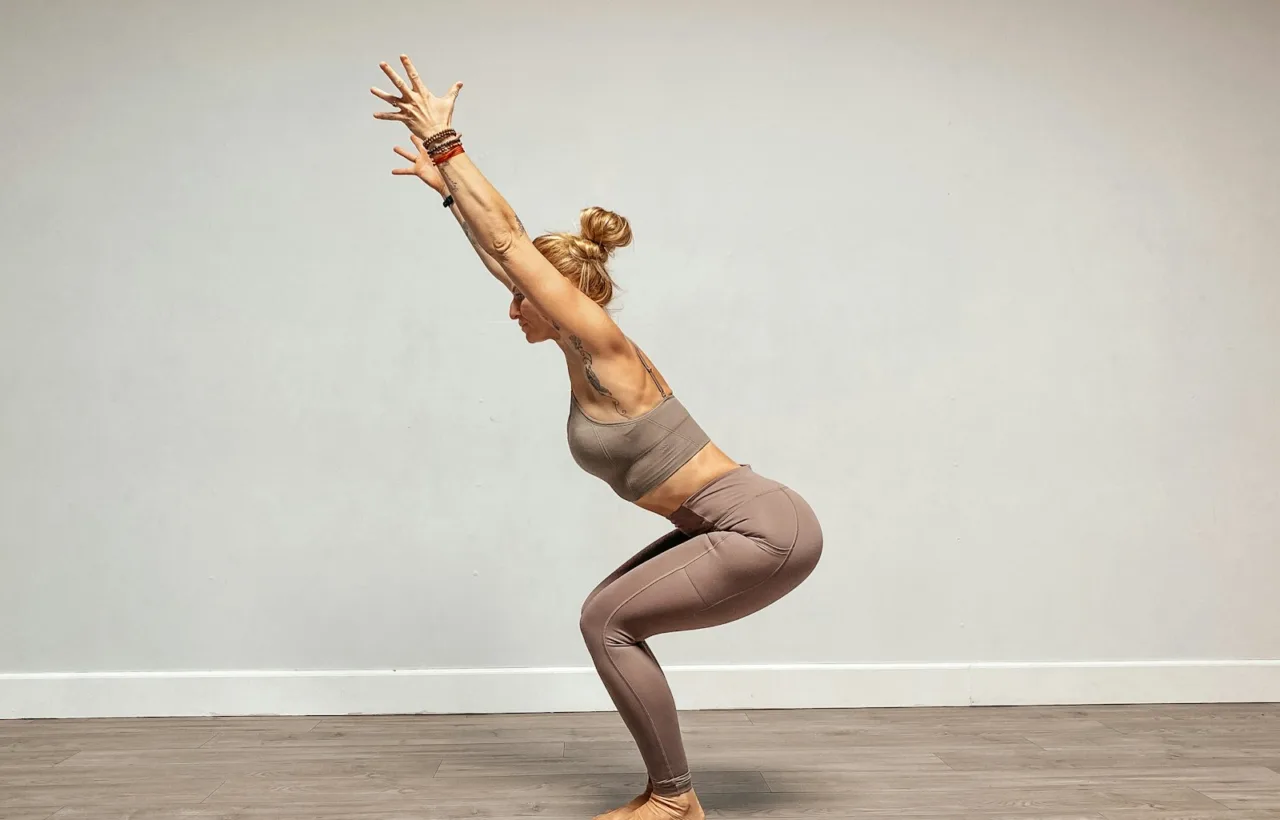

A leg workout at home succeeds or fails on one decision: whether you train more than squats. Squats cover your quads and a good share of your glutes, but your hamstrings and calves need hinge and raise patterns that most living-room routines skip entirely. The result is legs that look trained from one angle and feel weak from another. Below: what each muscle group needs, exercise ladders for every level, a complete 30-minute session, and straight answers about knees and squat depth.
The Squat-Only Trap
Your lower body has four jobs to cover: quads (squatting and stepping), hamstrings and glutes (hinging and bridging), and calves (raising). A balanced home plan hits all four, and leans on single-leg work — one-leg exercises load each leg like a heavier two-leg version would, without any equipment.
Single-leg training also exposes and fixes side-to-side differences, which matter more than most people realize: the leg that never works alone stays the leg that stays behind.
Quads: The Squat Family
Move down the ladder from easiest to hardest, progressing when the bottom of the list feels easy:
- Chair sit-to-stand: stand up from a chair without using your hands. Easier with a higher seat, harder with a lower one.
- Bodyweight squat: feet slightly wider than hip-width, sit back and down, chest upright. Add a two-second pause at the bottom for difficulty.
- Split squat: step one foot forward and lower the back knee toward the floor. Elevate the front foot on a book to make it harder.
- Reverse lunge: step back, touch down lightly, drive through the front foot to return. Step-ups onto a sturdy stair or box are the cousin of this move.
- Single-leg sit-to-stand: the same chair stand, on one leg. If it wobbles, that’s the training effect talking — assist with a hand on a wall, then let go.
Hamstrings: The Hinge Family
Hamstrings bend the knee and extend the hip, so they get real work from bridging and hinging — two things no gym is required for:
- Glute bridge: lie on your back, knees bent, drive your hips up by squeezing glutes and hamstrings. Keep your lower back from over-arching.
- Single-leg bridge: the same, one foot down, the other knee held toward your chest.
- Sliding leg curl: lie down with a towel under each heel on a smooth floor, lift your hips, then slide your heels out and drag them back in. The home version of a leg curl, and it is honest work.
- Hip hinge with a flat back: standing, push your hips back and lower your torso with a long spine, feel the hamstrings load, stand tall. Add a loaded backpack for resistance once the pattern is smooth.
Glutes and Calves: The Supporting Cast
Bridges, hinges, and lunges already hit your glutes hard, so no separate glute day is needed for a general leg routine. Calves, though, almost never get trained by accident:
- Calf raises: rise onto the balls of your feet slowly, hold the top briefly, lower with control. 15 to 20 reps that way beats 50 bounced ones.
- Deficit calf raises: do the raises with the balls of your feet on a stair edge so the heel drops below level. This adds range, not just reps.
- Single-leg calf raises: the same movement on one leg, free hand on a wall for balance.
| Muscle group | Start here | Next step | Hardest home option |
|---|---|---|---|
| Quads | Chair sit-to-stand | Bodyweight squat, then split squat and reverse lunge | Single-leg sit-to-stand |
| Hamstrings | Glute bridge | Single-leg bridge | Sliding leg curl, backpack hip hinge |
| Calves | Slow calf raises | Deficit calf raises on a stair edge | Single-leg calf raises |
| Glutes | Covered by bridges and squats | Reverse lunge, split squat | Single-leg bridge |
Move up a step when you can do about 20 clean reps, or the top of the rep range, with good form.
A Complete 30-Minute Leg Session
Three rounds. Rest 60 to 90 seconds between rounds; keep moving from exercise to exercise inside each round:
- Squat variation of your level — 12 to 15 reps
- Split squat or reverse lunge — 8 to 10 reps per leg
- Glute bridge or sliding leg curl — 12 to 15 reps
- Single-leg bridge — 10 reps per side
- Slow calf raises — 15 to 20 reps
- Wall sit — 30 to 45 seconds
New to this? Two rounds. When the last round stops feeling hard, use one of the progression levers below. Give legs a full day off between sessions — two or three leg days a week is the productive zone.
Knees, Depth, and Squat Myths Worth Clearing Up
- How deep should you squat? As deep as you can go while keeping control, heels down, and your back neutral. For many beginners that is stopping at a chair; depth improves with practice.
- Should knees pass the toes? They can. Knees traveling forward while staying aligned over the foot is normal and not dangerous. What you avoid is collapsing inward — push the knee gently toward the little toe if it caves.
- Sore versus sharp: a dull burn in the muscle is fine. Sharp, pinching, or single-spot knee pain means change the variation — shallower depth, slower tempo — not push through.
- Do squats ruin knees? Trained appropriately, they’re one of the best things for knees: controlled squats, sit-to-stands, and wall sits build the support around the joint.
What Research Says About Squat Depth and Leg Training
Backed by research
Squat depth, loads and frequency
- A 2013 review of knee and spine loading concluded that deep squats, learned with good technique and progressed gradually, do not increase injury risk to passive tissues and are an effective way to strengthen the lower body.Source: Hartmann H et al. (2013). Analysis of the load on the knee joint and vertebral column with changes in squatting depth and weight load. Sports Med
- A 2017 meta-analysis found that muscle growth was similar with light and heavy loads, while maximal strength benefited most from heavy loads. Single-leg and tempo variations taken close to your limit keep your legs growing without weights.Source: Schoenfeld BJ et al. (2017). Strength and hypertrophy adaptations between low- vs. high-load resistance training. J Strength Cond Res
- A 2016 meta-analysis found that training a muscle group twice a week led to more growth than once a week, matching the two to three leg days recommended here.Source: Schoenfeld BJ et al. (2016). Effects of resistance training frequency on measures of muscle hypertrophy. Sports Med
- The NHS recommends strengthening activities that work all major muscle groups, including the legs and hips, on at least 2 days a week.Source: NHS: Physical activity guidelines for adults aged 19 to 64
How to Keep a Home Leg Day Hard
Legs adapt fast because bodyweight squats become easy quickly. Rotate through these levers whenever the current variation feels manageable:
- Reps to the top of the range: build toward 20 clean reps before escalating the variation.
- Tempo: three seconds down, no bounce.
- Pauses: two seconds in the bottom position of squats and split squats.
- Unilateral: split squats, single-leg bridges, and one-leg calf raises double the load per leg.
- Range: elevate the front foot, use a stair edge, or deepen the squat.
- Load: a backpack with books turns hinges and split squats into weighted movements.
Leg Day Questions, Answered Straight
How many days a week should you train legs at home?
Two sessions a week is the effective minimum; three suits most people if each session is separated by a day. Legs respond to hard sessions followed by genuine recovery — daily leg days typically trade progress for soreness.
Can you build leg muscle without weights?
Yes — up to a point that is further away than most people expect. Single-leg variations and tempo work provide months of real stimulus. The eventual ceiling is honest: when pistols and single-leg bridges get easy, a loaded backpack extends progress, and beyond that, external weight is the next honest step.
Why do my legs shake during squats and wall sits?
Shaking near the end of a hard set is normal — it’s fatigue in the muscles doing the bracing, not a sign of damage. The useful line is form: a little trembling is fine; losing alignment or depth is when the set is over.
Are lunges or squats better for home workouts?
They train slightly different things: squats emphasize both legs together and are easier to load with tempo; lunges and split squats add single-leg strength and balance. The best answer is usually both, alternating as the session above does.
How this guide was put together: This guide was written to cover every part of the legs, not just the quads. Exercise selection, weekly volume and progression rules follow published guidance, mainly the WHO 2020 physical activity guidelines and the American College of Sports Medicine position stand on resistance training, plus the studies linked in this article. Last reviewed October 2026.
Safety note: This article is general fitness information, not medical advice. If you have an injury, a heart or blood-pressure condition, are pregnant or postpartum, or have not exercised in a long time, check with a doctor or physiotherapist before starting. Stop and get advice if you feel chest pain, dizziness, unusual breathlessness, or sharp joint pain. Sharp or pinpoint knee pain means changing the variation, as explained in the knee section above.


